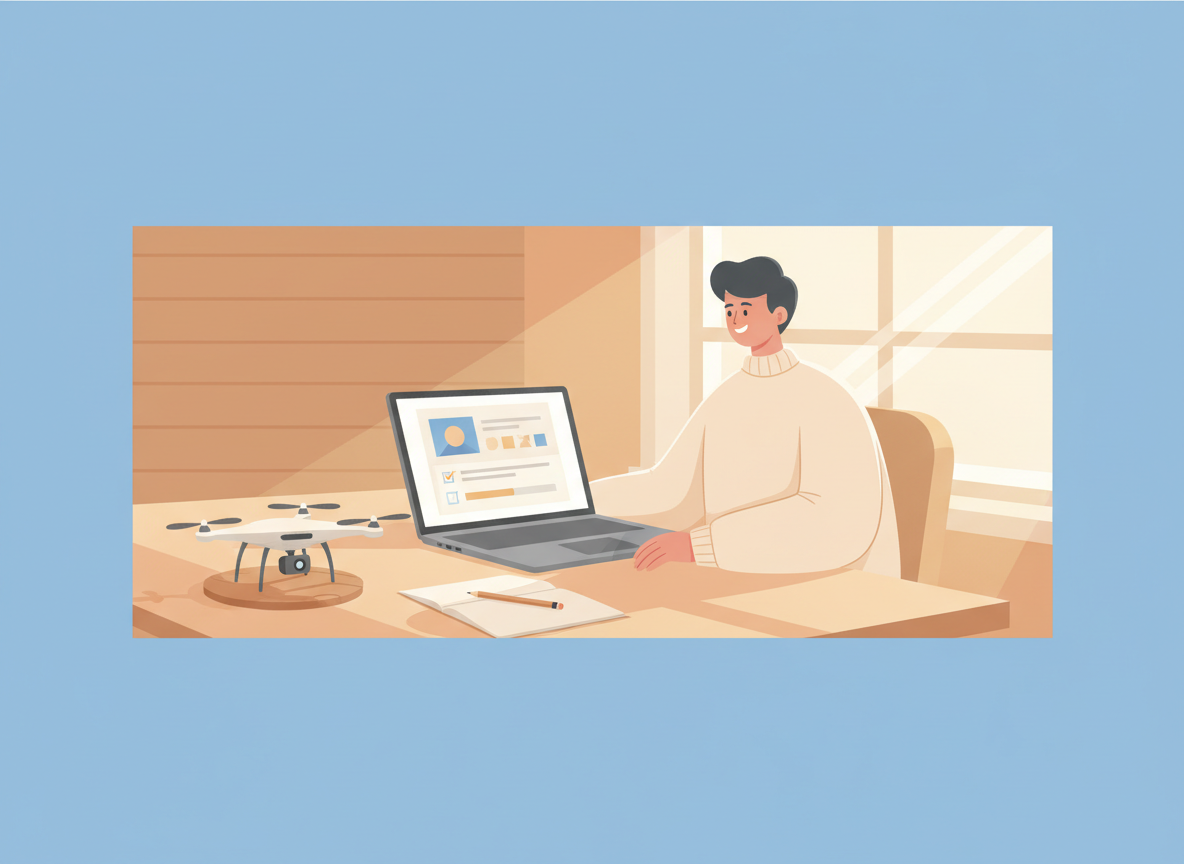
If you fly a drone for fun in the United States, federal law requires you to pass the FAA’s Recreational UAS Safety Test — TRUST — before your first flight, and to carry proof of completion whenever you fly it. The test is free, entirely online, and effectively impossible to fail: you correct any wrong answers until you reach 100 percent before your certificate is issued. This guide covers what TRUST actually tests, who has to take it (including a common point of confusion for Part 107 holders), how to take it in about half an hour, and the rest of the checklist — registration, Remote ID, and airspace limits — that goes with it.
What TRUST Actually Is (and Isn’t)
TRUST — The Recreational UAS Safety Test — exists because of 49 U.S.C. § 44809, the law that lets people fly drones recreationally without holding a full FAA remote pilot certificate, as long as they meet a short list of conditions. Passing TRUST is one of those conditions. Per the FAA’s Aeronautical Information Manual, “any person who flies a UAS for recreational use under 49 USC 44809 must take and pass TRUST.”
It is not the same thing as the Part 107 Aeronautical Knowledge Test. A Part 107 remote pilot certificate requires a proctored exam and recurrent training every 24 months. TRUST is, in the FAA’s words, “taken on a once-and-done basis; no recurrent testing is required.” It also isn’t graded the way most tests are — approved administrators must let you correct any wrong answers until you reach a perfect score before issuing your completion certificate. The goal isn’t to filter anyone out; it’s to make sure every recreational flyer has actually read the core safety rules once.
Do You Need to Take It?
If you’re flying purely for personal enjoyment — not for anyone’s business, and not as part of a job or as a public-safety operation — you need TRUST, regardless of your age or how long you’ve flown model aircraft.
- New recreational flyers: Yes, before your first flight. It’s a one-time requirement.
- Existing Part 107 certificate holders: Not required, as long as you fly under Part 107 rules the entire time. The FAA’s AIM is explicit on the flip side, though: “if a part 107 sUAS certificate holder wishes to fly under 49 USC 44809, they must take and pass TRUST” as well.
- Kids and other minors: The FAA doesn’t publish a separate minimum age for TRUST itself. Drone registration (below) requires the registrant to be at least 13, or a parent or guardian may register on a younger pilot’s behalf — and should walk through the TRUST material with them either way.
How to Actually Take the Test
TRUST is free and delivered online through 16 FAA-approved test administrators, including organizations like the Academy of Model Aeronautics and Embry-Riddle Aeronautical University. The safety content is standardized by the FAA, so it doesn’t matter which approved administrator’s version you use — pick whichever site’s interface you prefer.
- Go to the FAA’s TRUST page and choose any approved test administrator.
- Work through the safety material and questions at your own pace — most people finish in well under an hour.
- Correct any missed questions. The test is designed so everyone reaches 100 percent before finishing.
- Download, save, or print your completion certificate yourself. The FAA notes that test administrators “don’t maintain records” of who passed, so your copy is the only proof you’ll have.
- Keep that certificate somewhere you can produce it quickly — a photo on your phone works — since you’re required to present it if a law enforcement officer asks.
The Rest of the Recreational Pre-Flight Checklist
TRUST is necessary, but it isn’t the only box to check before your drone leaves the ground for the first time.
- Register the aircraft, if it needs it. Any drone weighing between 0.55 lbs (250 g) and 55 lbs must be registered with the FAA at FAADroneZone before it flies. Registration costs $5, is valid for three years, and requires the registrant to be at least 13 years old. Once registered, label the outside of the aircraft with your registration number.
- Check your Remote ID setup. Since September 16, 2023, any drone that requires registration must broadcast Remote ID information — essentially a digital license plate for the aircraft — unless you’re flying strictly within an FAA-Recognized Identification Area (FRIA). We cover the standard, module, and FRIA options in our FAA Remote ID guide.
- Follow your Community-Based Organization’s safety guidelines. Recreational flyers must fly under the safety guidelines of an FAA-recognized Community-Based Organization, such as the Academy of Model Aeronautics. The FAA publishes the current list of recognized organizations.
- Respect altitude and airspace limits. Stay at or below 400 feet in Class G (uncontrolled) airspace, and get prior authorization before flying in controlled airspace near an airport. Recreational flyers typically check and request that authorization through the FAA’s B4UFLY app or FAADroneZone, built on the same LAANC system our airspace authorization guide walks through in more depth.
- Keep the aircraft within visual line of sight, on your own or with a co-located visual observer, for the whole flight.
If you’re still working out the basics of controlling the aircraft itself once the paperwork is handled, our first 30 days roadmap and first-flight skills guide pick up right where this checklist leaves off.
What Happens If You Skip It
The FAA doesn’t publish a specific fine schedule for flying without a TRUST certificate, but its recreational flyer guidance is direct: individuals violating any of these requirements, or operating in a dangerous manner, may be subject to FAA enforcement action. In practice, the moment this usually surfaces is mundane rather than dramatic — a park ranger, local police officer, or airport official asks a flyer for proof of registration and TRUST completion, and someone without either has to explain why. Since both take under an hour combined and cost at most $5, there’s little upside to skipping them and finding out.
The Bottom Line
Before a new drone’s first flight for fun, work through this in roughly this order: take the free TRUST test and save your certificate, register the aircraft at FAADroneZone if it weighs 0.55 lbs or more and label it with your number, confirm your Remote ID setup, learn your Community-Based Organization’s guidelines, and check your airspace with B4UFLY. None of it takes long, none of it costs more than $5, and all of it is required before you’re legally in the air.
Reviewed September 25, 2026. This article provides general educational information, not legal advice. FAA requirements, test administrators, and procedures can change; verify current requirements at faa.gov before you fly.
Sources
- FAA: Recreational Flyers & Community-Based Organizations
- FAA: The Recreational UAS Safety Test (TRUST)
- FAA Aeronautical Information Manual, Chapter 11, Section 5: UAS Pilot Testing, Certification and Responsibilities
- FAA: How to Register Your Drone
- FAA: FAA-Recognized Community Based Organizations
- FAA: B4UFLY