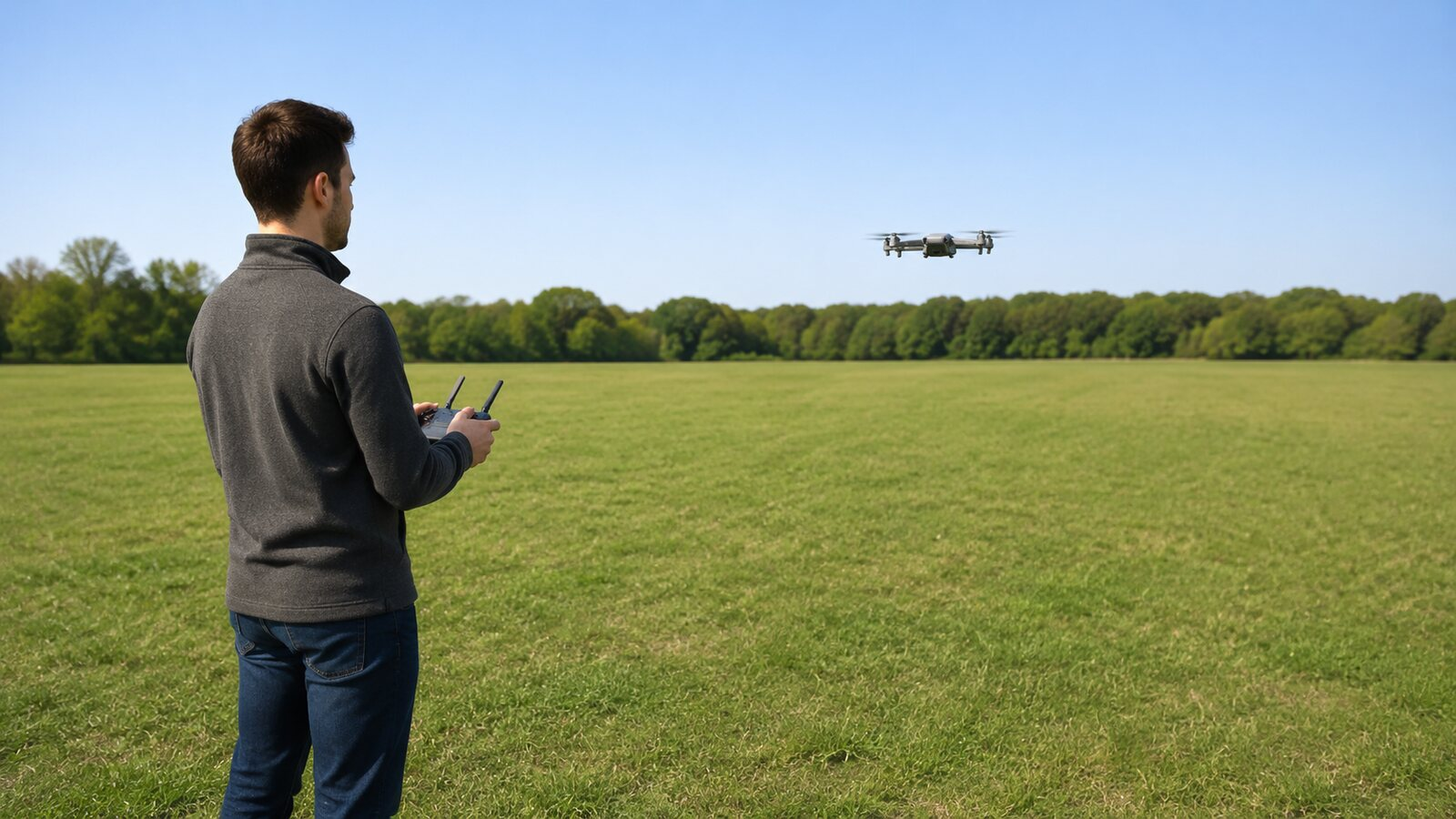
A new pilot’s first flights should build five specific skills: a consistent hover, controlled directional movement, smooth yaw turns, a deliberate landing, and the judgment to stop when conditions or a maneuver exceed their comfort level. This guide puts those skills in a safe practice order so early flights stay controlled and repeatable.
This guide assumes the legal groundwork is already in place. If registration, the TRUST test, Remote ID compliance, or airspace authorization still need attention, start with our first 30 days roadmap before working through the skills below.
Before Takeoff: Make the Practice Flight Legal and Predictable
Choose a spacious area where drone use is permitted, with clear sightlines and generous distance from people, moving vehicles, trees, structures, and other obstacles. Check the airspace and any temporary restrictions before launch. Recreational flyers need prior FAA authorization in controlled airspace, must stay at or below 400 feet in Class G airspace, and must keep the drone within visual line of sight.
Run the same preflight check every time, in the same order, until it becomes routine:
- Propellers are installed correctly and free of cracks, chips, or deformation
- The flight battery is charged, undamaged, cool enough to use, and fully latched
- The controller, app, and aircraft show no unresolved warnings
- If the aircraft uses satellite positioning or a home point, both are ready and correct before takeoff
- Return-to-home altitude and lost-link behavior are appropriate for the site
- Wind, temperature, and precipitation are within the manufacturer’s limits
- The airspace, launch area, and planned flight path are clear and permitted
Do not calibrate sensors simply because a checklist says to. Follow the aircraft manual and respond to actual warnings; unnecessary calibration near metal, vehicles, or reinforced concrete can create its own problems.
Skill 1: Hold a Stable Hover
Take off, climb to a low but safe training height, and hold position. Resist the urge to immediately fly away. A controlled hover uses small stick inputs. If each correction overshoots, release pressure, let the aircraft stabilize, and make a smaller input.
Practice in short sessions across several flights rather than deliberately draining a battery. End each session with enough reserve for a controlled approach, landing, and an unexpected go-around.
Skill 2: Add Directional Movement
Once the hover is consistent, add slow movement in one direction at a time: forward, backward, left, and right. Keep the drone close enough to see its position, altitude, attitude, and direction of flight without depending on the camera feed.
Fly a slow, wide square and pause to hover at each corner. This builds clean transitions between movement and stillness without adding unnecessary distance.
Skill 3: Practice Yaw and Orientation
Yaw rotates the aircraft around its vertical axis. When the nose points toward the pilot, the drone’s left and right appear reversed from the pilot’s viewpoint. That change can trigger an instinctive wrong-direction correction.
Practice slow 90-degree turns while hovering. Pause at each orientation, identify where the nose is pointing, and make one deliberate movement before returning to a hover. If orientation becomes uncertain, stop lateral input, hold position if the aircraft can do so safely, and re-establish its heading.
Skill 4: Make Controlled Landings
Descend gradually, keep the aircraft centered over a clear landing spot, and follow the manufacturer’s landing procedure. Practice on a visible pad or marked target placed in a clear area. Precision matters because it reduces rushed corrections near the ground—not because it makes landing close to people acceptable.
Land with a planned battery reserve. Learn the aircraft’s warning levels and automated low-battery behavior from the manual, then choose a personal return point that leaves time to respond to wind, a blocked landing area, or another aircraft.
Skill 5: Learn the Aircraft’s Emergency Behavior
Before adding distance, learn on the ground what the aircraft does after a control-link loss, how return-to-home selects altitude and route, and how to cancel an automated maneuver if continuing would create a hazard. Procedures vary by model and software version, so check the current manual even if you have flown another drone.
When to Add More Complexity
There is no universal flight count that proves readiness. Look for repeatable behavior instead:
- Hover corrections are small and controlled
- The pilot can identify orientation after a yaw turn without guessing
- Square patterns remain deliberate and within the planned practice area
- Landings consistently finish inside the chosen clear target
- The preflight and airspace checks happen every time
- The aircraft returns and lands with the planned battery reserve
Once those habits are consistent, add only one new variable at a time—more distance, more altitude, a more complex route, or camera work. Pilots preparing to fly for work should then move into formal Part 107 study and operating requirements.