A new drone pilot should spend the first month building three habits: know which FAA rules apply, check the aircraft and airspace before every launch, and practice basic maneuvers in a low-risk location. This new drone pilot guide turns those priorities into a practical four-week plan so your early flights are legal, controlled, and repeatable.
This roadmap is for people flying strictly for recreation in the United States. If a flight supports a business, client, employer, or another non-recreational purpose, review the FAA’s Part 107 requirements instead. You can also browse the site’s UAV Guides for more training and operating resources.
Week 1: Complete the legal steps in this new drone pilot guide
Before flying recreationally, take the Recreational UAS Safety Test (TRUST) through an FAA-approved test administrator. The test is free, online, untimed, and designed to teach the basic safety rules. Congress set no minimum age for TRUST, and FAA guidance says the certificate does not expire. Save a digital copy and carry proof of passage whenever you fly.
Next, determine whether the aircraft must be registered. A drone weighing less than 250 grams, including everything attached at takeoff, generally does not require FAA registration when it is flown only under the recreational exception. A recreational drone weighing 250 grams or more must be registered through FAA DroneZone, marked on the outside with its registration number, and accompanied by proof of registration.
Registration also connects to Remote ID. If a recreational drone is required to be registered, it generally must broadcast Remote ID through built-in equipment or a registered broadcast module. The alternative is operating without Remote ID equipment only inside an FAA-Recognized Identification Area (FRIA), while staying within visual line of sight.
- Pass TRUST and save the completion certificate.
- Confirm the aircraft’s takeoff weight with accessories installed.
- Register and mark the aircraft when required.
- Confirm how the drone satisfies Remote ID before launch.
- Make sure the flight is genuinely recreational; the purpose of the flight determines which rules apply.
Week 2: Learn the aircraft before adding distance
Read the manufacturer’s current manual before the first flight. Learn how to install the propellers and battery correctly, remove any gimbal guard, interpret status lights, set the return-to-home behavior, and confirm that the home point has been recorded. Do not perform a compass or sensor calibration simply out of habit; follow the manufacturer’s instructions and respond to prompts from the aircraft or app.
Choose a location where drone launches are permitted and where you have room to recover from mistakes. A broad open field away from people, roads, trees, wires, and structures is a better classroom than a backyard crowded with obstacles. Check wind and weather against the limits in the aircraft manual, and postpone the flight if conditions exceed your comfort or the aircraft’s specifications.
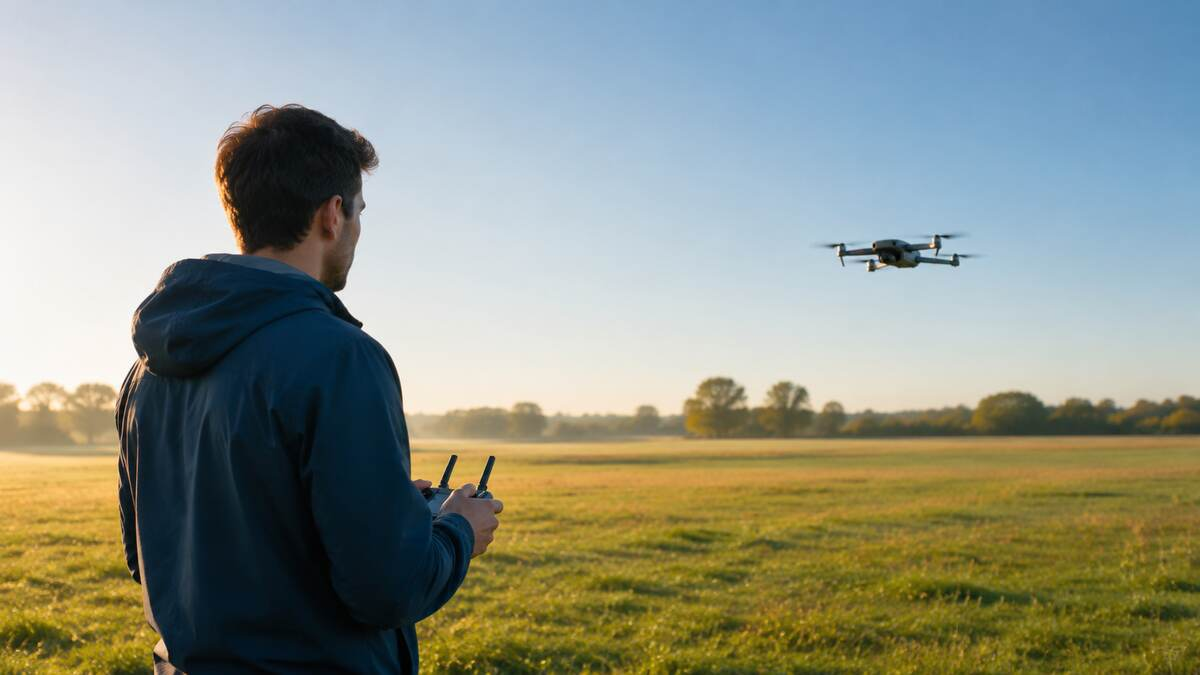
Keep the first sessions simple. Hover at a low, controlled altitude; make slow forward, backward, and sideways movements; practice gentle yaw turns; and finish with deliberate landings. Keep the drone close enough that you can see its position, direction, altitude, and movement without relying only on the camera feed.
Week 3: Make airspace checks part of every flight
Recreational flyers operating under the federal exception must follow the FAA’s recreational rules and the safety guidelines of an FAA-recognized community-based organization. In uncontrolled Class G airspace, recreational flights are generally limited to 400 feet above ground level. In controlled airspace near airports, obtain FAA authorization before flight through LAANC or FAA DroneZone.
The FAA’s B4UFLY service is available through approved desktop and mobile providers, including Airspace Link, Aloft, AutoPylot, Avision, and UASidekick. Use one of those services for situational awareness, but remember that the pilot remains responsible for checking restrictions and obtaining any required authorization.
Temporary Flight Restrictions can appear around wildfires, security events, major gatherings, and VIP travel. Check for them before every launch, not just when planning the trip. Our Chicago Air and Water Show restriction guide illustrates why event airspace can change the flight plan even when a location normally looks flyable.
Week 4: Build battery and emergency habits
Most consumer drones use lithium-based batteries that can overheat or burn when damaged, short-circuited, or charged incorrectly. Use the supplied or manufacturer-approved charging equipment, charge where you can monitor the battery, protect terminals during transport, and follow the manufacturer’s storage-charge guidance. Do not charge or fly a battery that is swollen, punctured, unusually hot, leaking, or otherwise damaged.
Use the fourth week to rehearse predictable responses. Practice a manual landing before the battery becomes low. Learn what the aircraft does after a lost control link, how return-to-home chooses its altitude and route, and how to cancel an automated maneuver when continuing it would create a hazard. Before each takeoff, check propellers, battery seating, satellite or positioning status, the home point, nearby people, obstacles, wind, and the available landing area.
What success looks like after 30 days
A successful first month is not measured by maximum distance or cinematic footage. It means you can explain which operating rules apply, identify whether registration and Remote ID are required, confirm the airspace, inspect the aircraft, fly basic patterns smoothly, and land with battery reserve. Build those habits first, then add photography techniques, more complex flight paths, or formal Part 107 study without rushing the foundation.