The takeaway: Taiwan broke ground on September 28 on the Minxiong Aerospace and UAV Industrial Park in Chiayi County, moving a long-planned drone cluster from proposal toward construction. The project is meant to connect research, testing, component suppliers and aircraft manufacturing in one region. For UAV readers, the important development is the physical start of the hub—not the much larger production and employment projections that still depend on construction, tenant commitments and actual orders.
Taiwan starts construction on the Minxiong drone industrial park
President Lai Ching-te attended the groundbreaking in Minxiong Township on September 28, according to Reuters reporting from Chiayi. Lai framed the project as part of Taiwan’s effort to strengthen its unmanned-aircraft supply chain and cooperate with democratic partners.
The ceremony matters because it provides a concrete milestone for a project that had previously been described mainly through plans and targets. The site is intended to support drone development and manufacturing while working alongside the existing Asia UAV AI Innovation Application R&D Center in nearby Puzi City.
That combination could shorten the distance between prototype work and scaled production. A useful industrial cluster needs more than airframe assemblers: it also needs propulsion, navigation, communications, sensors, precision machining, composite materials, software, testing infrastructure and qualified labor. Bringing those functions into one regional ecosystem can make supplier coordination and design changes easier, although a groundbreaking alone does not demonstrate that the network is operating.
What is verified—and what remains a target
Earlier reporting from Taiwan News, citing the National Chung-Shan Institute of Science and Technology and Chiayi County Government, put the facility’s construction budget at about NT$6.85 billion. The plans cover research and development, manufacturing, system testing, flight trials and virtual simulation for military and commercial drones.
The same October 2025 account described a neighboring supplier cluster with environmental review and construction work extending toward 2028. It reported projections of roughly 72 companies in that zone, more than 100 drone-related companies across the broader facility, over 1,200 jobs and about NT$8 billion in annual output.
Those figures should not be read as current tenant counts, employment or production. They are planning estimates published before Monday’s groundbreaking. No newly verified public list of committed tenants, signed production orders, annual aircraft capacity or completion date accompanied the event.
Why this matters beyond a new industrial park
Taiwan already has strengths in semiconductors, electronics and precision manufacturing. The Minxiong project is an attempt to organize more of those capabilities around complete unmanned systems and their supply chains. That is especially relevant as governments and operators increasingly ask where flight controllers, communications modules, cameras, motors, batteries and other critical parts are designed and made.
The industrial logic resembles other national efforts to create regional drone-manufacturing capacity. All About UAVs recently examined Hungary’s expansion of civilian drone manufacturing, where projected capacity likewise needed to be separated from current output. Taiwan’s differentiator is the potential link between its established electronics base, a dedicated R&D center and a purpose-built production campus.
Still, a concentrated supply chain does not automatically solve every constraint. Drone programs must convert research into airworthy products, secure dependable component sources, train workers, pass customer testing and sustain production quality. Export controls and end-use requirements can also affect which overseas customers and technology partners are available, particularly when platforms or components have defense applications.
Defense demand is part of the backdrop
Reuters reported that Taiwan’s cabinet proposed an additional NT$145.7 billion in defense spending this month for systems including drones and anti-ballistic missiles. The plan includes more than 600 coastal surveillance and reconnaissance drones, more than 40,000 coastal attack drones and an initial group of over 100 small uncrewed boats.
Those procurement figures provide context for the government’s emphasis on domestic capacity, but they are not production commitments for the Minxiong park. The public information available Monday did not identify which aircraft would be built there, which suppliers had received orders or how much of the proposed defense spending would flow through the new facility.
The park also should not be described as exclusively military. Planning documents have included commercial UAV research and manufacturing, and the supplier capabilities being discussed—sensing, navigation, power systems and precision fabrication—can support civil as well as defense aircraft. Actual tenant mix will show whether that dual-use ambition survives the construction phase.
What to watch next
The next meaningful checkpoints are construction progress, a confirmed opening timetable and named tenants with disclosed roles. Flight-test facilities and simulation capabilities will matter only when their availability, operating rules and certification support are clear.
Production disclosures will be even more important. Useful evidence would include signed orders, monthly output, delivery acceptance, the origin of critical components and test results. Until then, the Minxiong groundbreaking is best understood as an infrastructure commitment: Taiwan has started building a dedicated home for a larger drone industry, but the scale and competitiveness of that industry remain to be demonstrated.
Sources
- Reuters: “Taiwan must deepen drone cooperation with democratic partners, president says” (Sept. 28, 2026)
- Taiwan News: “Taiwan to open drone industrial park in Chiayi by 2026” (Oct. 31, 2025)
- Taiwan News: “Cabinet proposes NT$145.7 billion in additional Taiwan defense spending” (Sept. 4, 2026)
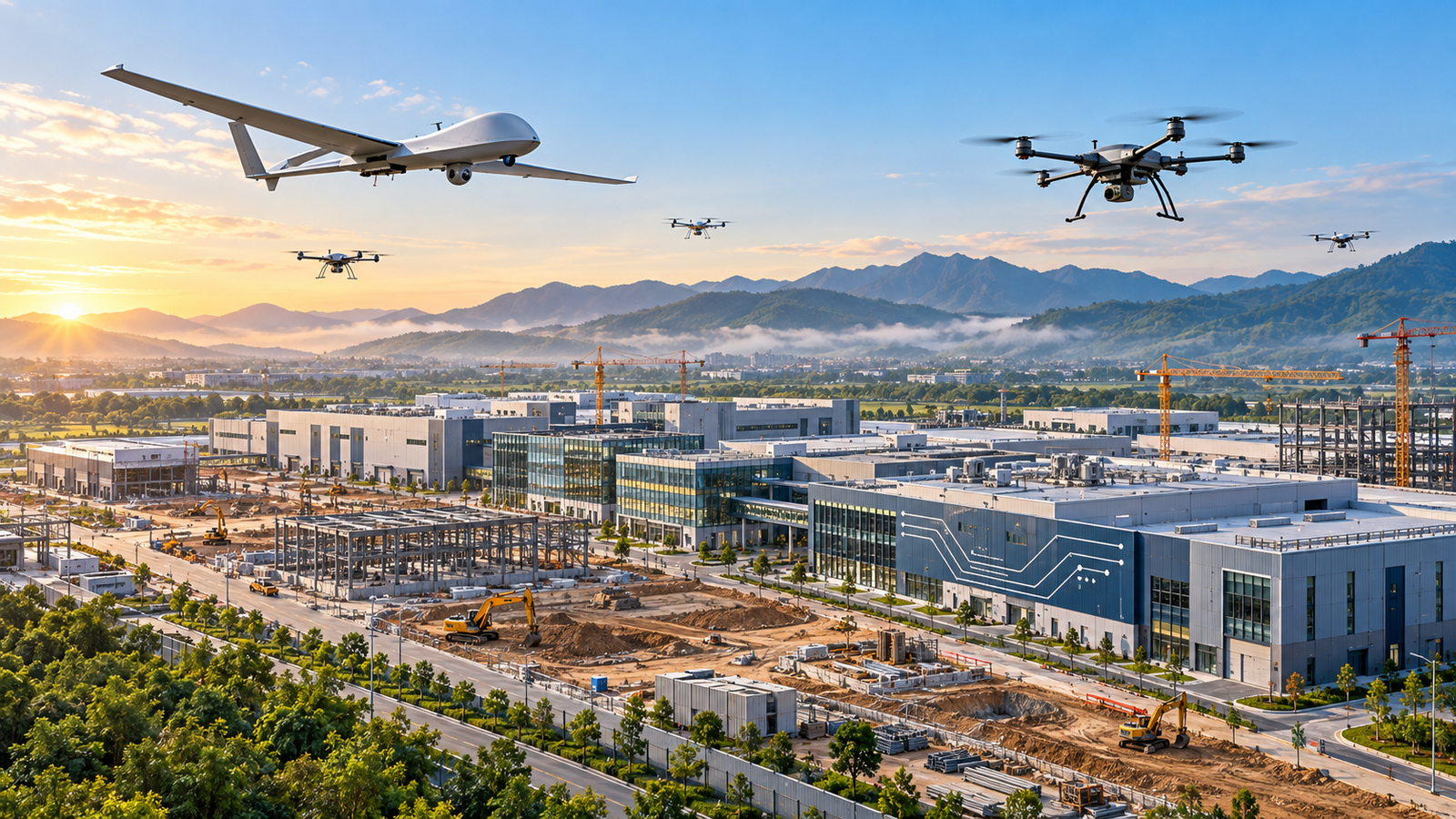
Featured image: Original AI-generated editorial illustration by All About UAVs; it is not a documentary photograph. No affiliate links or paid placement are included in this article.
Leave a Reply