Hungarian manufacturer ABZ Innovation has opened a €7 million expansion at its civilian-drone factory in Szentendre. The company says the expanded site can produce 2,000 industrial drones a year on one shift and 3,500 on two shifts. Those figures describe stated manufacturing capacity—not current output, orders or sales—but the investment is a concrete addition to Europe’s heavy-lift civilian UAV supply base.
What ABZ Innovation opened in Hungary
Reuters reported from the September 17 opening that ABZ Innovation completed a €7 million factory extension in Szentendre, Hungary. Chief Executive and co-founder Karoly Ludvigh said the company expects the additional capacity to help it quintuple output by the end of 2027 while serving customers primarily in the United States and Europe.
Ludvigh put nominal annual capacity at 2,000 aircraft on a single shift and 3,500 on a double shift. ABZ described the site as one of Europe’s largest civilian-drone production facilities. That size comparison is a company characterization; Reuters did not publish an independently audited ranking of European factories.
The investment was backed by U.S.-based Assembly Ventures, Germany’s Vsquared Ventures and Hungary’s Day One Capital. Reuters also reported that ABZ recorded a 1 billion-forint loss—about $3.2 million—during 2025 as it absorbed production-ramp costs. Management said it hopes to reach break-even within several years, but no firm profitability date was disclosed.
The factory targets civilian heavy-lift work
This is not a consumer-camera-drone line. ABZ’s current product portfolio centers on heavy-duty aircraft for crop spraying and spreading, industrial cleaning, logistics, research and specialized payload integration. The manufacturer says its products are sold in more than 40 countries.
That product mix matters because heavy-lift commercial drones are harder to scale than small photography platforms. They require larger propulsion systems, high-current power electronics, pumps or payload interfaces, stronger structures, serviceable components and application-specific software. Agricultural and cleaning systems also need field support, spare parts and operator training; factory throughput alone does not create a durable commercial ecosystem.
ABZ publishes performance figures for individual models, but those numbers are manufacturer specifications rather than independent test results. This article therefore does not use claimed acres per hour, chemical savings, payload endurance or cleaning productivity to estimate customer returns.
Capacity is not the same as production
The most important qualification is the difference between capacity and realized output. A plant configured to build 3,500 drones annually will only reach that rate if demand, staffing, components, quality control and working capital support two-shift operation. ABZ did not disclose its current annual production, order backlog, signed contracts, utilization rate or the model mix planned for the expanded line.
Nor does a European final-assembly location prove that every component is European. Motors, batteries, flight controllers, radios, cameras, sensors and semiconductor content can come from multiple countries. Reuters reported that the expansion could reduce reliance on Chinese manufacturing, according to Ludvigh, but neither the company nor the report supplied a bill-of-materials breakdown or domestic-content percentage.
That distinction is familiar to U.S. operators evaluating alternatives amid tariffs and supply-chain restrictions. Our earlier analysis of agricultural spray-drone costs and trade policy explains why replacing a finished aircraft source does not automatically localize batteries, propulsion, sensors or repair inventory.
Why European civilian drone manufacturing matters
The expansion still represents meaningful industrial progress. Europe has strong aerospace, robotics and agricultural-equipment sectors, but civilian drone manufacturing remains fragmented compared with established Asian supply chains. A plant capable of serial production can improve lead times, standardize quality processes and make spare-parts support more predictable—provided demand materializes and suppliers can keep pace.
The immediate opportunity appears strongest in specialized jobs where operators buy an entire supported workflow rather than the cheapest airframe: precision application, elevated-surface cleaning, custom payload integration and cargo movement. In those markets, training, repairability, documentation and local regulatory support can matter as much as purchase price.
One constraint remains outside the factory. Reuters cited drone-technology adviser Gergely Kis, who said Europe’s slow progress in unmanned traffic-management systems is holding back civilian applications. More manufacturing capacity cannot by itself create operating authority, scalable low-altitude traffic services or routine beyond-visual-line-of-sight access.
What UAV readers should watch next
The next useful evidence will be actual annual deliveries, utilization of the second shift, model-level production numbers, customer contracts and service performance. Supply-chain disclosures would also show whether the factory is reducing foreign dependence at the component level or primarily expanding European assembly.
For operators, the practical test is straightforward: can ABZ translate added factory capacity into available aircraft, parts, training and support at competitive total cost? The new site improves the company’s ability to attempt that. It does not yet prove that the full 3,500-unit rate will be reached or absorbed by the market.
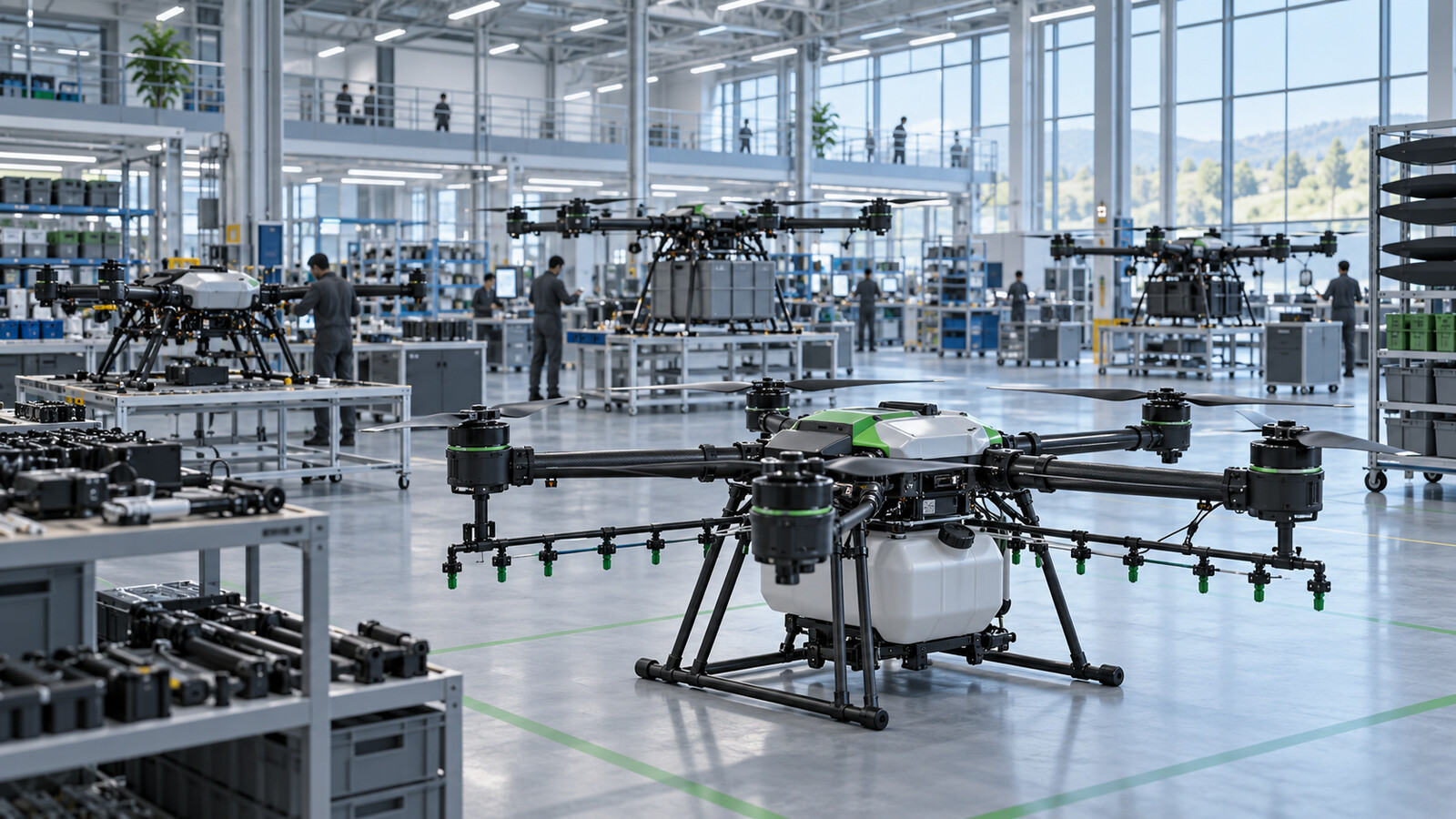
Disclosure: This article contains no affiliate links or paid placement. The featured image is an original AI-generated conceptual illustration and does not depict ABZ Innovation’s actual factory, employees or aircraft.