
The takeaway: The U.S. Army announced 10 new counter-drone indefinite-delivery/indefinite-quantity contracts on September 29 with combined ceilings of $4.15 billion. That is procurement capacity, not $4.15 billion already spent: only about $50 million was obligated at award, according to Defense One. The package matters because it gives military buyers a faster way to assemble layered defenses from radars, cameras, software, electronic systems and kinetic effectors instead of committing to one universal counter-UAS solution.
What JIATF-401 awarded
U.S. Army Public Affairs said Joint Interagency Task Force 401 established the new contracts to support Domestic Shield, its counter-UAS marketplace and other counter-drone requirements. Domestic Shield is intended to improve protection for risk-prioritized U.S. military facilities and assets.
The official award list names Allen Control Systems, Digital Force Technologies, DroneShield, Napatree Technology, RADA Technologies, SRC and L3Harris WESCAM with $500 million ceiling contracts. Echodyne and PVP Advanced EO Systems received $250 million ceilings, while SmartShooter received a $150 million ceiling. Together, the 10 announced ceilings total $4.15 billion.
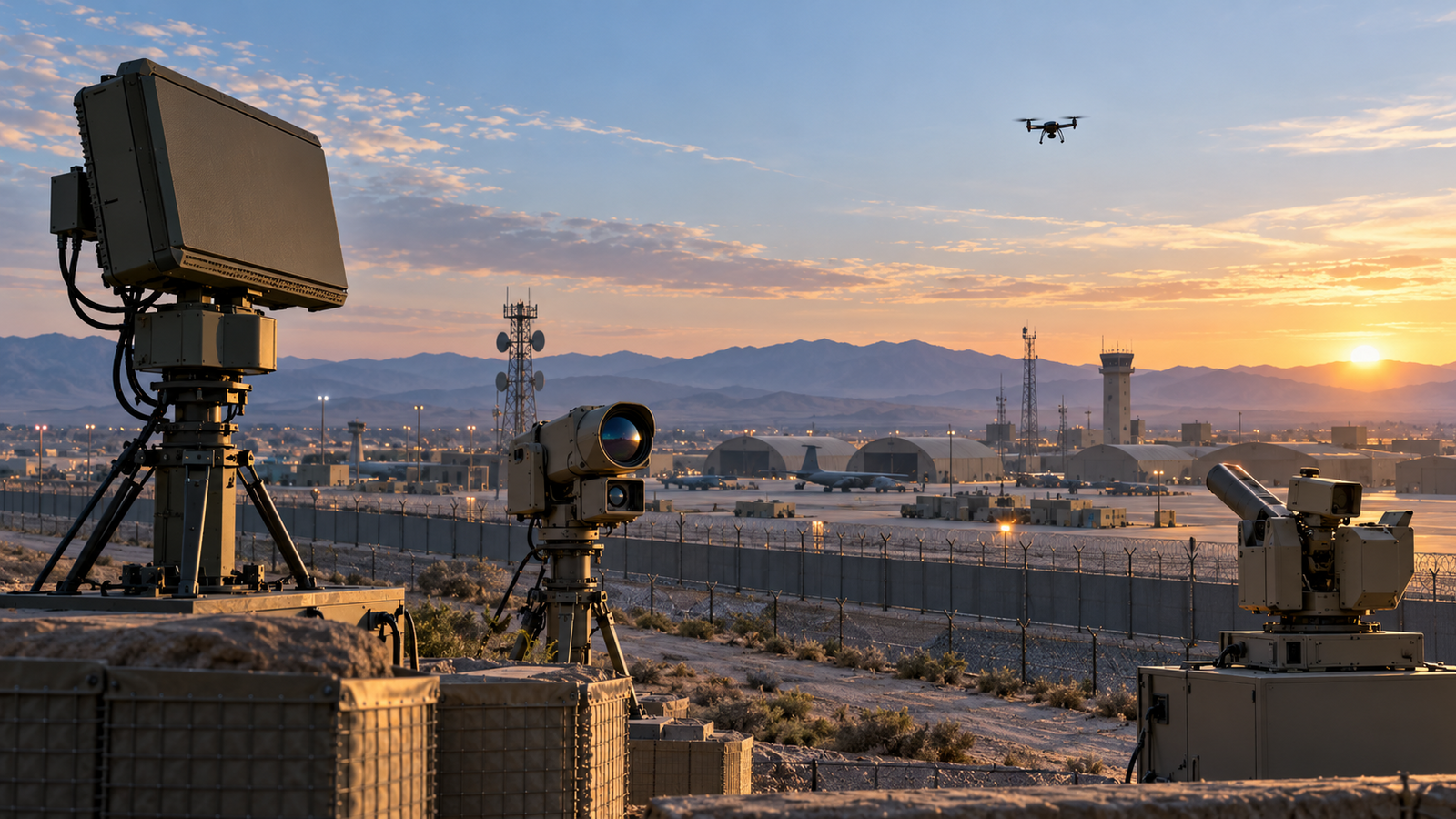
The technologies span several parts of a defensive chain. The Army described smart optical sights designed to help soldiers engage drones with standard rifles, automated weapon stations, compact radars and long-range tracking cameras. That variety reflects a central counter-UAS reality: detecting a small aircraft, classifying it, identifying its operator, tracking it and lawfully defeating it are separate tasks that may require different equipment.
$4.15 billion is not immediate spending
The most important qualification is the contract structure. An IDIQ establishes a ceiling and terms under which the government may place future orders. It does not guarantee that the maximum value will be ordered, funded or paid to the contractor.
Defense One reported that only about $50 million was obligated when the awards were made. Officials also said JIATF-401 had awarded more than $5 billion when earlier contracts were included and that a broader $7 billion ceiling was available for current and expected awards. Those figures describe different scopes: $4.15 billion across the 10 contracts announced Tuesday, more than $5 billion including earlier awards, and up to $7 billion in overall contracting capacity.
That distinction prevents a common procurement error. A large ceiling can help vendors plan production and make it easier for approved customers to order equipment, but actual revenue depends on task orders, appropriations, delivery, acceptance and contract performance. Public reporting did not provide a company-by-company breakdown of the approximately $50 million initially obligated.
Why the marketplace approach matters
JIATF-401 is using multiple vendors because no single counter-drone system fits every site. A remote installation may prioritize long-range detection and wide-area radar coverage. An urban base faces buildings, radio-frequency congestion, civilian aircraft and tighter collateral-risk limits. A mobile Army unit needs equipment that can move and operate with limited power and staffing.
The Army says the marketplace requires open-architecture standards intended to reduce proprietary lock-in and allow new capabilities to integrate with existing networks. That is an important goal, but the announcement does not prove that every sensor, command-and-control layer and effector is interoperable today. Interfaces, data rights, cybersecurity accreditation, latency, training and sustainment will determine whether a mixed-vendor architecture works outside demonstrations.
Defense One reported that the related unmanned-systems marketplace has processed about $800 million in transactions since opening and that Australia recently became the first allied customer to use it through the foreign military sales process. The official C-UAS Marketplace describes itself as a government portal for discovering, evaluating and procuring counter-drone technology. Marketplace listing, however, should not be treated as proof that a product will satisfy every mission or legal requirement.
A contract vehicle is not an operational endorsement
The award package creates access to vendors and ordering pathways; it does not disclose independent performance results for every product. Buyers still need threat-specific testing, safety analysis, spectrum coordination and rules for escalation. Kinetic systems add range-safety and collateral-risk questions. Electronic attack can affect authorized communications and may be restricted by law and operating authority.
The layered approach also needs reliable classification. A detector that reports every small object can overwhelm operators, while an automated effector that acts on incomplete identification creates obvious safety risks. Useful evaluations should publish detection probability, false-alarm performance, track continuity, environmental limits and results against representative aircraft—not only maximum detection distance.
This award is a material acquisition step beyond the test planning covered in All About UAVs’ recent analysis of NORTHCOM’s planned urban counter-drone exercise. The two developments are related but not interchangeable: Falcon Peak is meant to test performance in a difficult urban environment, while these IDIQs provide contractual pathways for later purchases.
What to watch next
The clearest evidence of execution will be task orders and obligated funding rather than headline ceilings. Watch for which agencies buy from which vendors, the quantities ordered, delivery schedules, test results and whether installations receive complete detection-to-response systems or isolated components.
Lifecycle performance will matter as much as initial acquisition. Counter-UAS equipment requires software updates, threat-library maintenance, operator training, spare parts and recurring testing as commercial drones and hostile tactics change. Open architecture could make upgrades easier, but only if the government enforces interfaces and retains enough technical data to compete future integrations.
For the UAV industry, the practical signal is that federal counter-drone procurement is moving from isolated demonstrations toward larger enterprise vehicles. The financial scale is significant, but it should be measured through funded orders and operational results—not the sum of contract ceilings alone.
Sources and disclosure
- U.S. Army: JIATF-401 advances Domestic Shield with counter-UAS contract awards (September 29, 2026)
- Defense One: Army awards counter-drone contracts worth more than $4 billion (September 29, 2026)
- GovConWire: Army awards 10 counter-drone IDIQs worth $4.2B (September 29, 2026)
- JIATF-401 C-UAS Marketplace
All About UAVs has no affiliate or material relationship with the agencies or vendors discussed. The featured image is an original AI-generated conceptual illustration and does not depict a specific vendor system, installation or operational engagement.
Leave a Reply