The takeaway: U.S. Northern Command announced on Sept. 25, 2026 that it plans to move the next Falcon Peak counter-drone demonstration into an urban environment for the first time. The shift matters because detecting and stopping a small drone over a city is fundamentally harder than doing so at an open desert range: buildings block sensors, radio congestion complicates tracking, civilians and infrastructure raise collateral-risk concerns, and domestic law limits who can mitigate an aircraft. NORTHCOM has not disclosed the city or date, so this is a planned test—not a completed urban deployment.
What NORTHCOM announced about urban counter-drone testing
DefenseScoop reported on September 25 that the fifth major Falcon Peak counter-small-UAS demonstration will focus on integrating and testing counter-drone capabilities in a dense city environment. Brig. Gen. Jason “Ox” Rueschhoff, NORTHCOM’s director of operations, described the urban setting as the next major problem set after the command’s recently completed border-focused trial.
The announcement is intentionally preliminary. NORTHCOM did not identify a host city, test date, participating vendors, planned threat aircraft or evaluation criteria. It also did not announce the purchase or operational deployment of a specific system. The verified development is a change in the intended environment for the next experiment.
Falcon Peak began in 2024 as a recurring joint military effort to evaluate technologies that detect, track, identify and mitigate small drones. Earlier iterations emphasized ready-to-use systems and faster purchasing decisions. The fourth event, Falcon Peak 26.2, ran at Yuma Proving Ground in Arizona and emphasized threats around the U.S.-Mexico border.
Why a city changes the counter-UAS problem
Open desert terrain is useful for controlled testing, but it removes several problems that dominate real urban operations. Tall buildings create radar shadows and reflections. Glass, moving vehicles, HVAC equipment, cellular networks and other emitters can complicate detection or classification. A legitimate news, public-safety, construction or recreational drone may also operate near the same airspace as an unauthorized aircraft.
That makes classification as important as detection. A sensor track alone does not establish intent, operator identity or legal authority to intervene. Operators need a reliable engagement sequence that combines multiple sensors, identifies friendly or authorized aircraft and gives the responsible authority enough confidence to act without endangering people below.
Rueschhoff told DefenseScoop that collateral-damage questions will be a central concern. That is the crucial difference between a test range and a populated area. Kinetic defeat, electronic attack and interceptor drones can create different risks to bystanders, buildings, communications and lawful aviation. A system that works against a target in isolated airspace may be unacceptable near traffic, hospitals, airports or crowded venues.
What Falcon Peak 26.2 tested at Yuma
A separate DefenseScoop report from the closing phase of Falcon Peak 26.2 described three testing lanes: drone-on-drone interceptors, shotgun-based kinetic mitigation and sensing or detection systems. The exercise involved at least 20 vendors and provided between 15 and 30 interception opportunities, according to the Yuma Proving Ground sensor branch team lead quoted in the report.
For the first time in the Falcon Peak series, participants were required to feed sensor, radar-track and targeting information into Anduril’s Lattice command-and-control software. NORTHCOM was using the software as a common digital backbone against which commercial sensor-to-shooter systems could be integrated and assessed.
Those details should not be read as a public performance ranking. The reporting did not provide vendor-by-vendor detection probability, false-alarm rates, successful intercept counts, engagement distances or cost per defeat. The number of vendors and opportunities indicates testing breadth, not proof that every system met an operational threshold.
Detection, tracking and mitigation are separate capabilities
Counter-UAS coverage often compresses several tasks into one label. In practice, sensing a possible aircraft, maintaining a track, classifying it, identifying whether it is authorized, locating its operator and legally mitigating it are distinct steps. Each can fail independently.
That distinction also appeared in All About UAVs’ earlier coverage of the UK Army’s Project Halo Shield deployment. Passive detection can improve awareness without automatically identifying a pilot or providing authority to interfere with the aircraft. An urban Falcon Peak test will be useful only if it measures the entire decision chain rather than emphasizing a dramatic intercept.
Domestic mitigation authority is another constraint. Counter-drone equipment may be technically capable of jamming, taking control of or destroying an aircraft, but most organizations cannot lawfully use those functions. NORTHCOM’s experiment can inform military and federal response procedures; it does not grant local police, venue owners or private critical-infrastructure operators new powers.
What useful results would look like
The next test will be most valuable if NORTHCOM publishes evidence that reflects urban complexity. Useful measures would include detection and tracking performance between buildings, false alerts caused by lawful drones or city infrastructure, handoff quality between sensors, time from detection to classification, operator workload and the ability to stop an engagement when confidence falls.
Safety measures also matter: debris containment, lost-link behavior for interceptor drones, geofencing, electromagnetic-interference testing and procedures for nearby crewed aviation. Scenario design should include ambiguous targets and legitimate aircraft, not only clearly hostile drones approaching from a predictable direction.
What UAV readers should watch next
The first milestones will be the city, date, participating agencies and legal operating framework. Afterward, readers should look for a public after-action report, specific performance data and any acquisition decision tied to the results.
For commercial and public-safety operators, the broader lesson is practical: dense cities require shared situational awareness and disciplined authorization, not simply more powerful sensors or effectors. The urban trial may expose where today’s counter-drone systems struggle with clutter, interoperability and lawful decision-making—the problems that must be solved before metropolitan protection can be both effective and safe.
Sources
- DefenseScoop: “Northcom’s next counter-drone demo will be its first in an urban area” (Sept. 25, 2026)
- DefenseScoop: “What’s unique about Northcom’s Falcon Peak 26.2 counter-drone exercise” (Sept. 23, 2026)
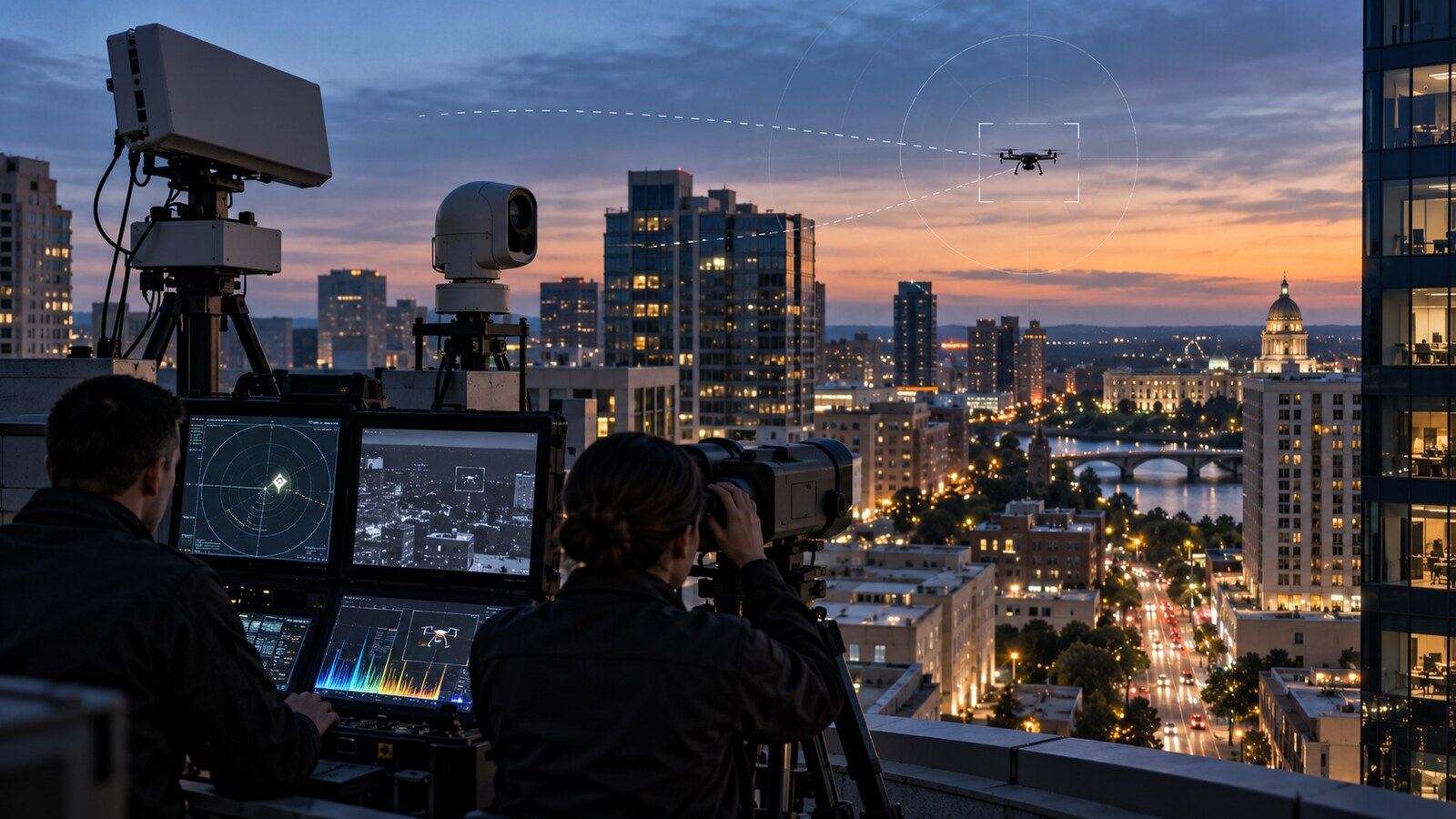
Disclosure: This article contains no affiliate links or paid placement. The featured image is an original AI-generated conceptual illustration and does not depict an actual Falcon Peak exercise, location, system or participant.