
The takeaway: DoorDash announced DoorDash Air on September 30, unveiling a purpose-built delivery aircraft and an end-to-end system for restaurant drone delivery, with early pilot deliveries planned in Northern California. The announcement matters because DoorDash is moving beyond partnerships and putting its own aircraft inside the same software network that assigns orders to human couriers and ground robots. But this is still an early-stage rollout: DoorDash did not disclose the aircraft’s payload, range, launch date, service area, certification path or expected daily flight volume.
DoorDash Air combines the aircraft with the handoff system
DoorDash announced DoorDash Air on September 30, describing it as an integrated delivery system rather than a standalone aircraft. The company says its work began with the parts of the operation that are easy to overlook: loading equipment, kitchen handoffs, packaging, order data and the final transfer to the customer.
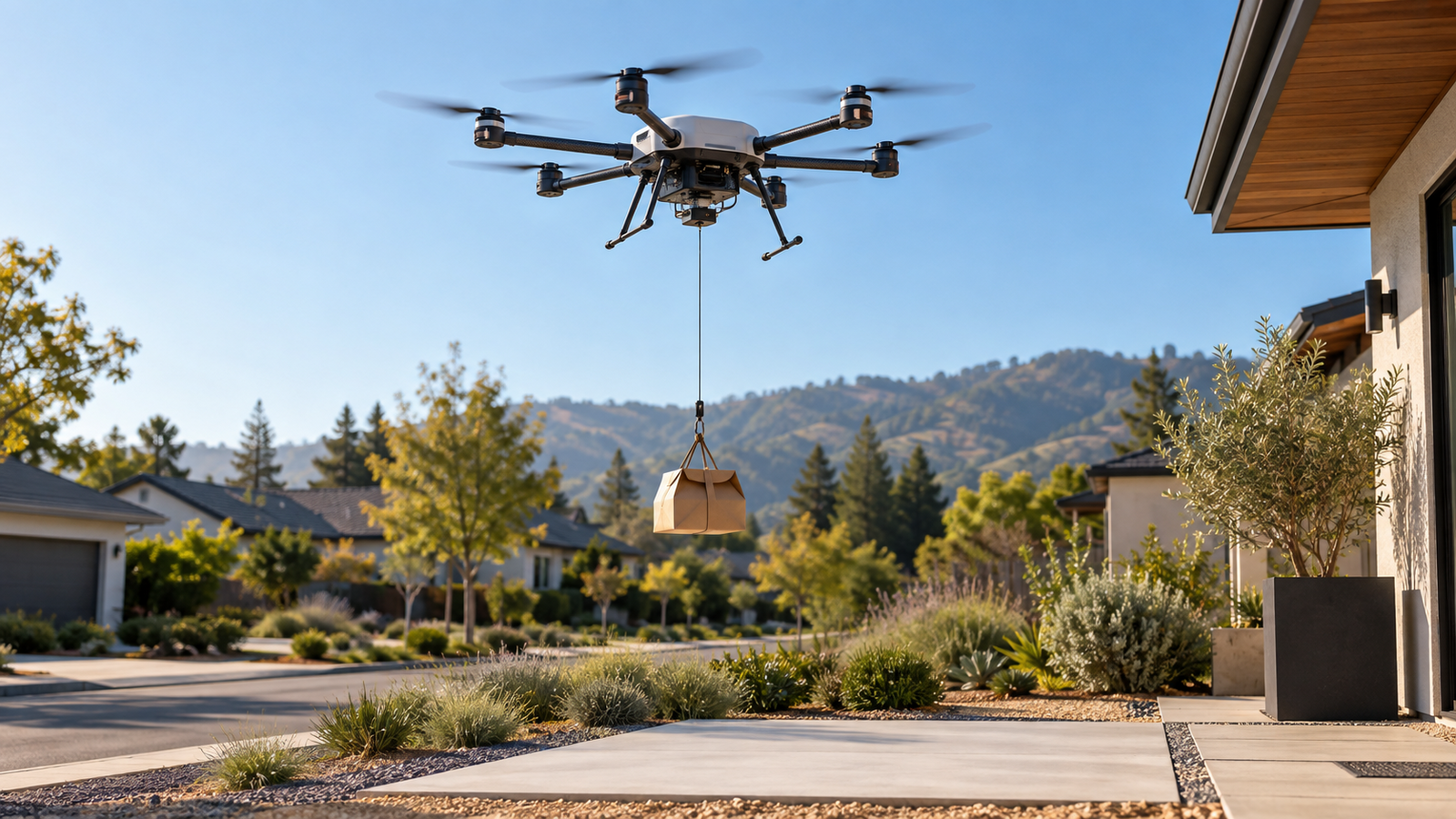
The aircraft has six slow-turning propellers and uses a winch for pickup and delivery. DoorDash says the winch is intended to make handoffs smoother and that the aircraft includes systems designed to lower it safely after certain failures. The company has not published enough technical information to independently assess those safety claims, however, and it did not provide a detailed specification sheet.
DoorDash says early pilot deliveries will involve Chipotle, Popeyes and Momo N Curry in Northern California. Its announcement does not identify the communities, participating restaurant locations, operating radius or a firm start date. “Will begin” should therefore be read as a plan, not evidence that routine customer service is already underway.
The routing software may be the more important development
The new aircraft will connect to DoorDash’s Autonomous Delivery Platform, which the company says evaluates distance, order weight, weather, ground traffic, kitchen timing and other factors before selecting a delivery mode. The same platform coordinates human Dashers, DoorDash’s Dot ground robot and third-party autonomous-delivery partners.
That approach reframes the drone as one tool in a mixed fleet. A short, lightweight order with a clear landing area may be suitable for air delivery, while a larger order, unfavorable weather or a difficult destination could remain with a courier or ground robot. DoorDash says about 80% of typical U.S. restaurant orders are small and light enough for the aircraft. That figure is based on a limited sample of the company’s own order data; distance, weather, airspace, landing-site and operating-approval constraints will reduce the share actually eligible for flight.
Axios reported that DoorDash’s existing drone relationships with Wing and Flytrex will continue alongside the in-house program. The company therefore appears to be adding another delivery option rather than replacing its current partners.
Performance figures remain company claims
DoorDash says its initial tests produced average restaurant-to-door delivery times of less than five minutes. It also compares the aircraft’s cruising noise at delivery height with that of a passing car. Neither measure came with an independently reviewed test protocol, route profile, sample size, sound level, measurement distance or weather conditions.
Those omissions do not make the figures meaningless, but they limit comparisons. A sub-five-minute airborne leg is not the same as a five-minute total order time, because meal preparation, loading, preflight checks and customer retrieval also matter. Likewise, a general noise analogy cannot show how the aircraft will sound during hover, winch deployment or repeated neighborhood operations.
DoorDash also did not disclose several specifications UAV readers would normally use to evaluate the platform:
- maximum payload and package dimensions;
- aircraft weight, range and cruise speed;
- battery type, endurance and turnaround process;
- detect-and-avoid, communications and command-and-control architecture;
- wind, precipitation and temperature operating limits; or
- approval structure for beyond-visual-line-of-sight flights.
A product reveal is not operating authority
Launching customer deliveries in the United States requires more than a capable aircraft. The operator still needs the appropriate FAA authority, compliant procedures and site-specific operational approvals. DoorDash’s September 30 materials do not say whether DoorDash Air will operate under its own certificate, through an existing partner or under another arrangement.
That distinction is particularly important while the FAA’s broader drone-delivery framework remains contested. In our earlier analysis of the states’ challenge to the FAA’s drone-delivery environmental review, we noted that commercial delivery operations currently depend on existing certification and waiver pathways while the agency develops a more scalable framework. The new DoorDash aircraft does not itself create permission for BVLOS operations, flights over people or service in a particular community.
Local implementation will also determine whether the system works outside a demonstration. Restaurants need a handoff process that does not slow kitchen staff, customers need a suitable delivery point, and operators need reliable contingency plans for weather, blocked landing areas, communications loss and abnormal aircraft behavior.
What to watch next
The most useful next disclosures will be concrete rather than promotional: the first service location, operating partner, approval basis, aircraft specifications, eligible delivery radius and measured operating results. Noise data and the actual percentage of orders assigned to drones will matter more than the share that fits within a theoretical size-and-weight envelope.
DoorDash’s strategic move is still significant. It gives a large delivery marketplace direct control over aircraft design, merchant handoffs and mode-selection software while preserving outside drone partnerships. Whether that integration produces a repeatable commercial service will depend on regulatory approvals, neighborhood acceptance and day-to-day reliability—questions the unveiling does not yet answer.
Sources and disclosure
- DoorDash: DoorDash Air unveils in-house drone delivery system (Sept. 30, 2026)
- Axios: DoorDash’s drone delivery options expand with in-house program
- All About UAVs: States sue FAA over drone-delivery environmental review
Featured image: AI-generated editorial illustration by OpenAI for All About UAVs. It depicts a generic delivery drone and is not a photograph of DoorDash’s aircraft. No affiliate links or paid placement are included in this article.
Leave a Reply