The takeaway: Fifteen states and Harris County, Texas, filed a petition on September 28 asking the U.S. Court of Appeals for the Second Circuit to review the FAA’s nationwide environmental analysis for commercial drone package delivery. The filing does not halt delivery operations or revoke any operator’s authority. It does, however, put the agency’s assumptions about noise, safety, community effects and future flight volume under legal scrutiny just as the sector prepares for broader beyond-visual-line-of-sight operations.
What the states filed
The coalition filed its petition in the U.S. Court of Appeals for the Second Circuit, according to Reuters and a release from the California attorney general. California, New York, Arizona, Colorado, Delaware, Illinois, Maine, Maryland, Massachusetts, Michigan, New Mexico, Oregon, Rhode Island, Washington and Wisconsin joined the case, along with Harris County.
The petition challenges the FAA’s final Programmatic Environmental Assessment, or PEA, and the associated Finding of No Significant Impact and Record of Decision. The Department of Transportation’s official notice confirms that the FAA made those documents available in late July. The plaintiffs allege that the review did not satisfy the National Environmental Policy Act because it understated or inadequately examined cumulative noise, safety, public-health and community effects.
Those are allegations, not findings by a court. The FAA had not issued an immediate public response when Reuters reported the filing. No judge has yet ruled that the agency’s analysis was unlawful.
What the lawsuit does—and does not—change
The case targets the environmental review supporting a national framework; it is not a judgment against drone delivery itself. Filing a petition does not automatically vacate the PEA, stop existing services, cancel Part 135 certificates or eliminate site-specific approvals. Any practical interruption would require later court action, an agency decision or a separate change to an operator’s authority.
That distinction matters because drone delivery depends on several layers of permission. The FAA says it regulates aviation safety, certifies air carriers under Part 135 and performs required environmental review. Operators and local governments still handle matters such as facility siting, land use, emergency planning and community engagement. The FAA says it has completed more than 20 individual environmental assessments for package-delivery proposals in addition to the programmatic review.
All About UAVs recently examined that split in its report on Amazon’s proposed Massachusetts drone-delivery hub: a local board’s site approval can move a project forward, but it does not replace federal operating authority. The new litigation focuses on the federal environmental layer, not one municipality’s zoning decision.
Why the environmental assumptions matter
A programmatic assessment lets an agency study a broad class of similar actions before reviewing individual deployments. That can make repeat projects more efficient, but the usefulness of the document depends on the realism of its operating assumptions and the quality of later site-specific analysis.
Reuters reported that the FAA modeled a unit capacity threshold of 1,150 average annual-day deliveries per hub, a figure confirmed in the agency’s own final PEA document. The plaintiffs argue that this may not capture the cumulative effects of dense networks, repeated overflights or multiple hubs serving the same communities. For operators, the important question is not simply whether one aircraft meets a noise threshold. It is how route concentration, time of day, fleet size, maintenance activity and hub traffic combine over months or years.
Other issues can be location-specific: wildlife disturbance, historic resources, battery handling and fire response, traffic around launch sites, and unequal exposure across neighborhoods. A national analysis cannot predict every local outcome. Conversely, the existence of those concerns does not prove that every delivery network creates a significant environmental impact. The dispute is about whether the FAA’s national review and mitigation framework adequately account for them.
Practical implications for drone operators
For delivery companies, the immediate operational message is continuity with added uncertainty. Existing authorizations remain in place unless an agency or court says otherwise. Applicants should still expect Part 135 certification, aircraft and operational approvals, airspace coordination, environmental review and local site processes. The FAA’s public guidance describes delivery routes below 400 feet and emphasizes that advanced operations may rely on unmanned traffic management and beyond-visual-line-of-sight capabilities, but those concepts do not create blanket permission to fly.
Project teams can reduce risk by building a defensible record early: document expected daily flights rather than only peak aircraft count, measure representative sound levels, map sensitive receptors, explain route-selection criteria, and publish a credible complaint-response process. Emergency procedures for battery incidents and lost links should be coordinated with local responders. Community outreach is most useful before a hub layout or route network becomes difficult to change.
Manufacturers and service providers should also avoid treating the national PEA as a universal environmental clearance. Site-specific conditions, local permits and operator-specific approvals still matter. If the court sends the review back to the FAA, projects with incomplete environmental records could face more delay than those that have already documented local impacts and mitigations.
What happens next
The next meaningful developments will be the FAA’s formal response, the case briefing schedule and any request to pause reliance on the challenged documents while litigation proceeds. The court could ultimately uphold the review, require more analysis or send part of the decision back to the agency. None of those outcomes should be assumed from the filing alone.
The litigation is also separate from broader FAA work on routine BVLOS operations. A future rule may change how scalable drone networks are authorized, but it will not by itself resolve land-use, noise or environmental-review questions. For the UAV industry, the case is a reminder that scaling delivery is not solely an aircraft-performance problem. Durable operations require aviation approval, locally workable infrastructure and an environmental record capable of surviving public and judicial scrutiny.
Sources and disclosure
- Reuters: states challenge FAA drone-delivery environmental review
- California Department of Justice: coalition announcement
- U.S. DOT: notice of final PEA and FONSI/ROD
- FAA: package-delivery drone guidance
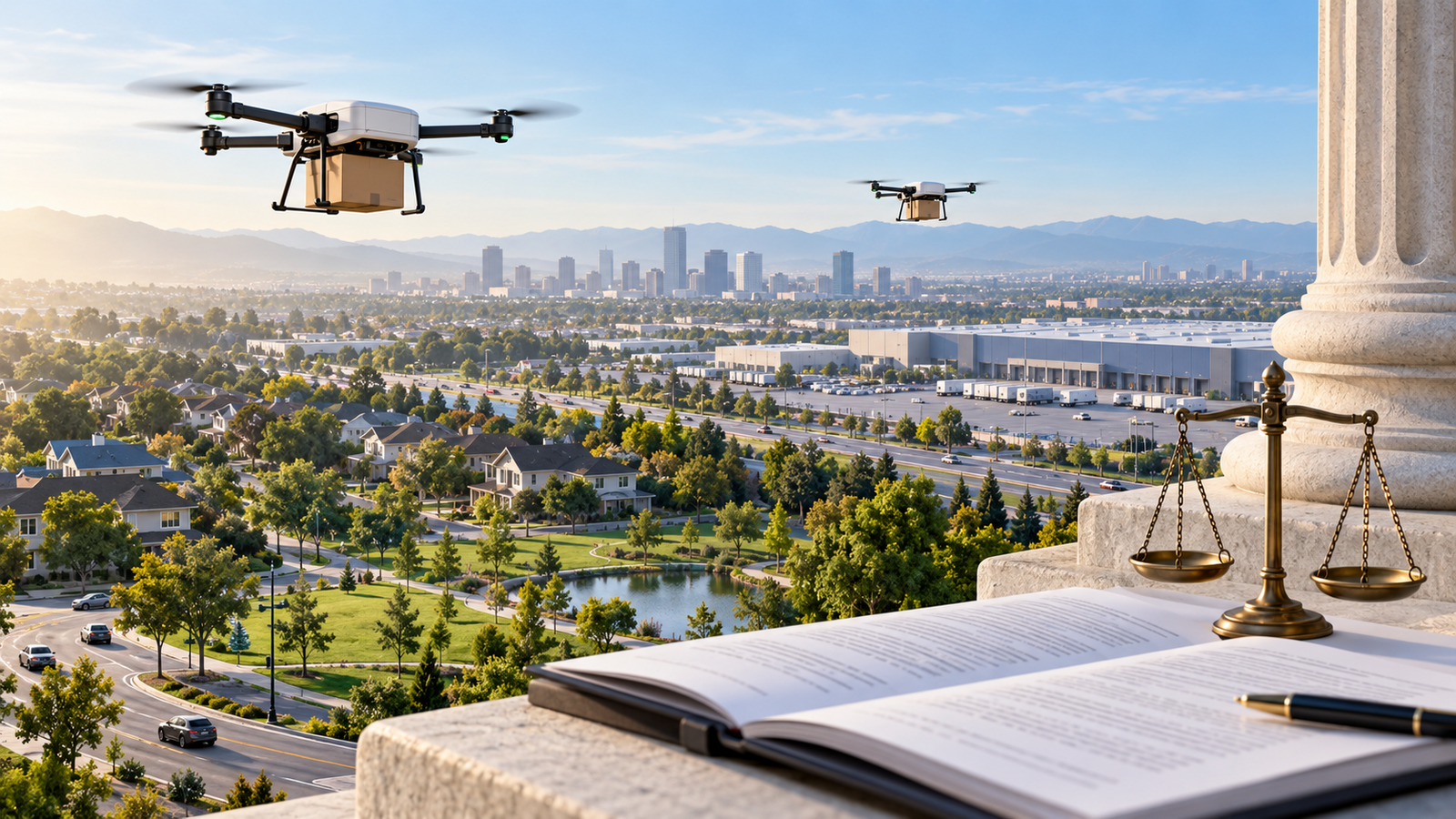
All About UAVs has no affiliate or material relationship with the parties discussed. The featured image is an AI-generated conceptual illustration and does not depict a specific litigant, court, facility or flight.
Leave a Reply