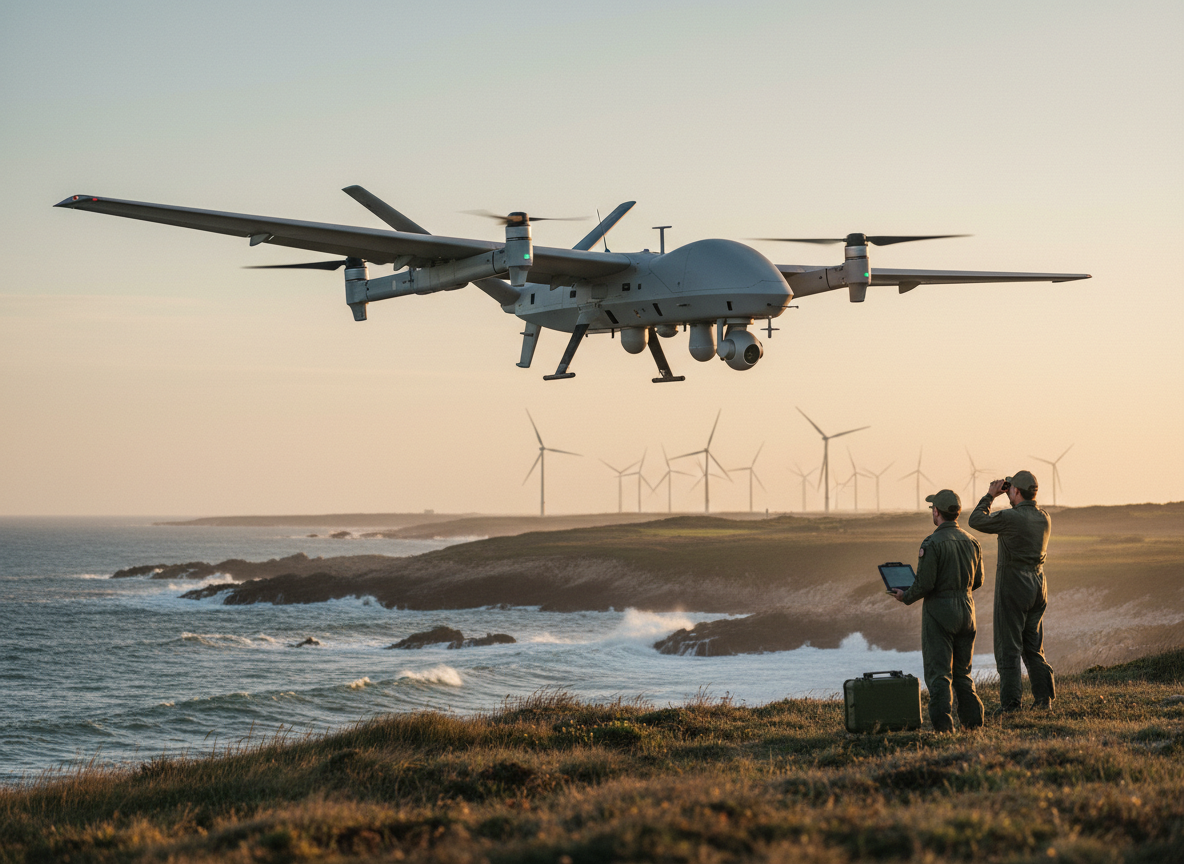
The Dragonfish-25 is Autel Robotics’ next-generation tilt-rotor eVTOL, announced in late October 2025 and sitting above the existing Dragonfish Standard and Pro in the company’s lineup. It keeps Autel’s signature tilt-rotor layout — combining multirotor VTOL with fixed-wing cruise efficiency — but scales up nearly every spec that matters: payload, endurance, and range.
Dragonfish-25 specifications
| Spec | Value |
|---|---|
| Weight (w/ battery, no gimbal) | 29.0 kg |
| Max takeoff weight | 39.0 kg |
| Max extra payload | 10 kg |
| Max flight time (no payload, ideal conditions) | 240 min claimed |
| Longest flight time with payload | 210 min claimed |
| Max flight distance | 220 km claimed |
| Max horizontal speed | 35 m/s (126 km/h) |
| Service ceiling | 5,000 m; max takeoff altitude 4,000 m |
| Wind resistance | 10 m/s (multirotor mode), 15 m/s (fixed-wing mode); Autel also summarizes the fixed-wing maximum as 12 m/s elsewhere on the same product page |
| Ingress protection | IP45 |
| Signal range | ≥30 km omnidirectional, ≥60 km directional antenna (FCC) |
| Positioning | RTK: 1 cm + 1 ppm horizontal / 1.5 cm + 1 ppm vertical (multirotor); 3 cm + 1 ppm (fixed-wing); GPS+Galileo+BeiDou+GLONASS |
| Air sensing | ADS-B receiver (1090ES) |
| Assembly time | Under 10 minutes, tool-free, single operator |
| Payload options | DG-T5 (35x optical zoom, 640×512 tele thermal with 45 mm lens, 10–2,000 m laser rangefinder, Class 1 laser) or DG-T5L (35x optical zoom, 640×512 thermal with 25 mm lens, Class 3B laser fill light reaching about 800 m) |
| U.S. price (As of October 2026) | No published Autel price. One U.S. dealer lists the Dragonfish-25 with DG-T5 at $99,999 (out of stock); Advexure says Dragonfish packages start at $99K |
What’s actually new versus the Standard and Pro
The jump from Dragonfish Standard (7.5 kg airframe, 1.5 kg payload, 126-minute flight time) to the Dragonfish-25 is not incremental — it’s a different weight class entirely, with roughly 4x the airframe weight and nearly 7x the payload capacity. That scale gets you significantly heavier EO/IR gimbals, longer detection ranges, and the endurance to actually use them on long linear or perimeter missions. It also means a bigger transport footprint and a heavier case, which matters for agencies used to backpack-deployable platforms. For the smaller aircraft, see our Autel Dragonfish Standard and Pro review.
The U.S. operating and procurement hurdles
The first hurdle is aircraft weight. At 29 kg (about 64 lb) before a gimbal and up to 39 kg (about 86 lb) at maximum takeoff weight, the Dragonfish-25 is not a small UAS under ordinary Part 107 rules. The FAA says Part 107 applies only below 55 lb at takeoff. A U.S. civil operator would generally need a Section 44807 exemption or another applicable certification and operating pathway, plus paper-based aircraft registration. Public-aircraft operators follow a separate authorization route. This makes the aircraft a program-level acquisition, not a conventional Part 107 purchase.
The second hurdle is radio equipment authorization. On December 22, 2025, the FCC added foreign-made UAS and critical components to its Covered List on a going-forward basis, preventing newly covered devices from receiving FCC equipment authorization. A buyer should not infer U.S. legality from Autel’s publication of FCC-region frequencies or range figures. Ask the seller for the exact aircraft, controller and radio-module FCC IDs, then verify each grant in the FCC database before contracting or importing.
We could not independently confirm a current FCC grant tied specifically to the Dragonfish-25 configuration described here. That is not proof that no authorized configuration exists, but it is a material procurement gap. The safe buying sequence is to obtain the complete model and FCC ID list from the dealer, verify the grants, and have the intended FAA operating pathway in hand before placing a deposit.
A separate FCC proceeding, PS Docket 26-189, also considers previously authorized foreign-produced UAS in higher-risk categories, including aircraft at or above 55 lb and systems designed for certain advanced payloads. It is a proposal, not a final rule. Independently, Autel states that flight-time and range figures come from controlled, low-interference testing. Treat the 210-minute loaded endurance and 220 km distance as manufacturer ceilings, not expected field results.
How it compares
Within Autel’s own eVTOL lineup, the Dragonfish-25 is a clear step up for missions where the Standard or Pro’s payload ceiling is the limiting factor — heavier thermal/zoom combos, longer-range laser rangefinding, and multi-hour patrol windows. Against Western competitors in the same class (long-endurance tilt-rotor and fixed-wing VTOL platforms from Quantum Systems or Threod, for instance), the Dragonfish-25’s raw endurance and payload numbers are competitive on paper, but for U.S. buyers the FCC question above usually decides the comparison before specs come into it.
Bottom line
On paper, the Dragonfish-25 offers unusually high endurance and payload capacity for a deployable tilt-rotor. For U.S. buyers, however, specifications are secondary to two gate checks: a viable FAA operating pathway for an aircraft over 55 lb and valid FCC authorizations for the exact configuration. If a dealer cannot document both, this is not a prudent U.S. purchase. Operators elsewhere should still demand configuration-specific pricing, support terms and realistic mission endurance before committing.
Sources
- Autel Robotics: Dragonfish-25 official product page and specifications
- FAA: Section 44807 authority for UAS at or above 55 lb
- FCC: Covered List and UAS notices
- Autelpilot: Dragonfish-25 announcement and payload details
- Advexure: Dragonfish series pricing and dealer information
- Kings Hobby: Dragonfish-25 with DG-T5 U.S. dealer listing
- Holland & Knight: FCC adds all foreign-made drones and critical components to the Covered List
- Wiley: FCC drone ban update, including Autel authorization revocations
- Iowa State CALT: Foreign-made UAS stay on the Covered List as DJI and Autel challenges proceed
- DroneDeploy: What’s in scope in the FCC’s military-grade drone proposal
Disclosure: This review is based on published documentation and independent research; All About UAVs did not conduct hands-on flight testing. The featured image is an original AI-generated editorial illustration and does not depict an exact production configuration.
Leave a Reply