Bottom line: Autel’s Dragonfish combines vertical takeoff with fixed-wing endurance for public-safety, infrastructure, security, and long-corridor missions. Its architecture is compelling, but U.S. buyers should demand a configuration-specific demonstration and written quotation because Autel’s current materials contain conflicting endurance figures and do not publish a standard U.S. price.
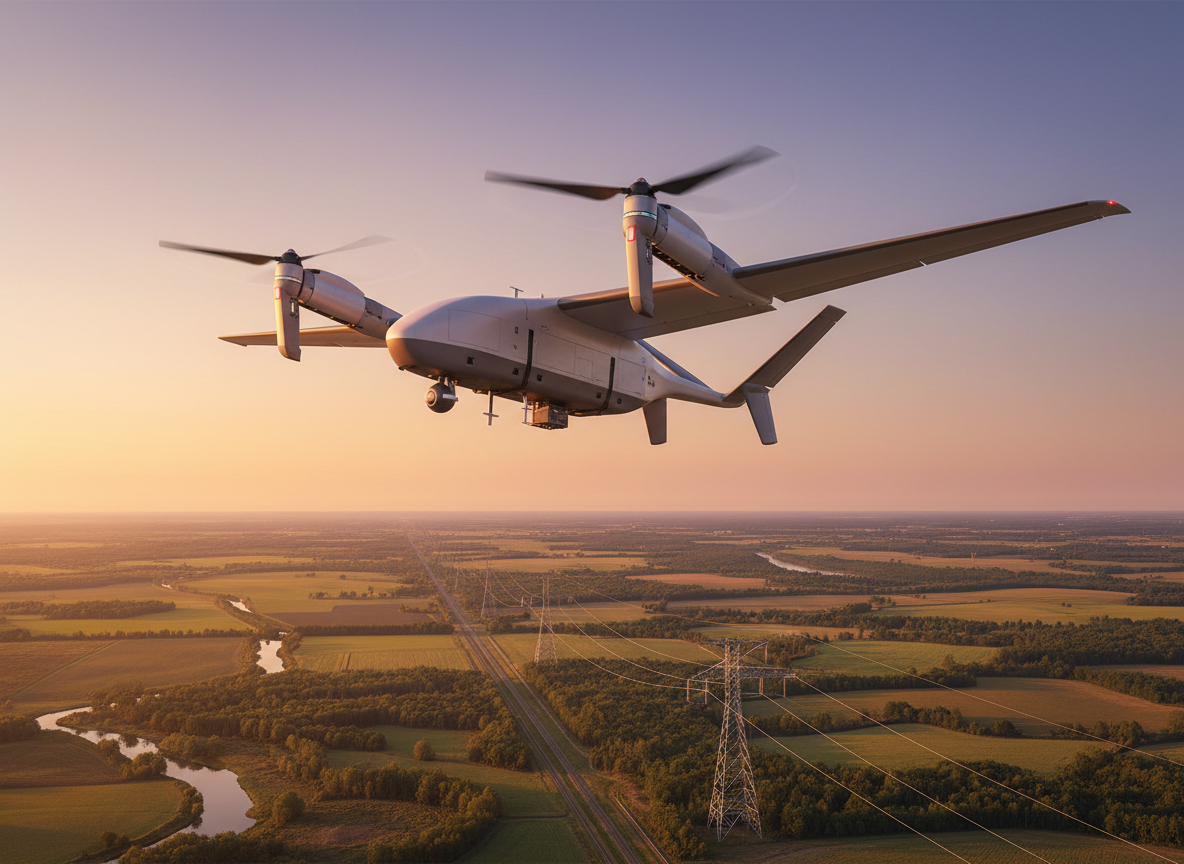
Disclosure: All About UAVs has not flown or tested the Dragonfish. This assessment is based on current manufacturer documentation, FAA guidance, and publicly available dealer information. No manufacturer supplied this article or controlled its conclusions. The featured image is an original editorial illustration, not a photograph of a tested aircraft. No affiliate links are included.
Who the Autel Dragonfish is for
The Dragonfish is a large enterprise tiltrotor aircraft intended for missions that need more endurance and area coverage than a conventional multirotor can usually provide, without requiring a runway or catapult. Autel identifies security, coastal patrol, firefighting support, traffic monitoring, power-line inspection, and energy inspection as applications.
That makes it most relevant to public agencies, utilities, industrial inspection teams, emergency-management organizations, and specialized contractors with formal operating procedures. It is not a sensible first commercial drone, and its price, logistics, regulatory burden, and training requirements put it well beyond ordinary photography or small-site inspection work.
Configuration and specifications
Autel’s current Dragonfish page lists Standard and Pro aircraft. The detailed table gives the Standard a 7.5-kilogram weight with batteries and no gimbal, a 9-kilogram maximum takeoff weight, a 1.5-kilogram maximum payload, and a 2.49-meter wingspan. The Pro is listed at 14.5 kilograms with batteries and no gimbal, 17 kilograms maximum takeoff weight, a 2.5-kilogram payload limit, and roughly a 2.98-meter wingspan excluding propellers.
Both are rated IP43 and list a maximum speed of 30 m/s. That speed is a ceiling, not a promise of normal cruise performance. IP43 means limited protection against solids and sprayed water; it should not be read as approval for unrestricted operation in heavy rain, icing, or other severe weather.
The endurance numbers require care
Autel’s current page is internally inconsistent. Its main presentation advertises up to 179 minutes, while a detailed aircraft table lists 126 minutes for Dragonfish Standard and 158 minutes for Dragonfish Pro. Another comparison table lists 107 and 179 minutes. Autel says its flight-time testing used no wind, sea-level flight at 8 m/s, photo capture only, braking-mode obstacle behavior, and continued until the battery reached zero.
Those are controlled manufacturer maximums, not responsible mission-planning values. Real endurance will depend on the aircraft revision, payload, reserve, wind, temperature, climb profile, loiter time, and battery condition. A buyer should require Autel or the dealer to identify which figure applies to the exact quoted U.S. aircraft and demonstrate a representative mission with a safe landing reserve.
Payloads and communications
Autel’s current page emphasizes the DG-L20T, combining wide-angle and zoom cameras, a 640×512 thermal imager, and a laser rangefinder. The same page also lists DG-L50T support for one Pro configuration, while other current and legacy Autel materials reference additional payload names. Buyers should treat payload compatibility as configuration-specific and obtain exact model numbers, firmware requirements, radiometric capabilities, calibration terms, and aircraft compatibility in writing.
The communication claims also depend on hardware. An older Autel specification page lists a 10-kilometer FCC maximum for the handheld ground station and 30 kilometers between a mobile base station and aircraft under unobstructed, interference-free conditions. Autel’s newer product page advertises up to 45 kilometers using the optional Autel Smart Antenna Transmission system. None of these figures establishes reliable range at a buyer’s site or legal authority to fly that far.
Capabilities and limitations
The practical advantage of Dragonfish is mission geometry. Vertical takeoff removes the runway and belly-landing problem associated with many fixed-wing systems, while wing-borne cruise can cover long linear assets more efficiently than hovering aircraft. Autel also advertises automated route execution, tracking, terrain avoidance, return protections, RTK positioning, quick payload changes, and optional infrastructure including a repeater and Dragonfish Nest.
Those capabilities do not eliminate operational work. A large aircraft still requires site surveys, crew training, battery management, maintenance records, communications planning, emergency procedures, weather limits, and a recovery plan. Automated tracking is not the same as verified target identification, and RTK positioning accuracy does not guarantee survey-product accuracy without appropriate payload calibration, checkpoints, processing, and quality control.
Price and availability
Autel does not publish a universal U.S. package price. Dealer listings reviewed during research placed configured Dragonfish Standard systems above $110,000, but package contents differed. Older references near $25,000 should not be used as a current complete-system estimate.
A usable quotation should separately identify the aircraft, payload, batteries, charger, controller, smart-antenna or base-station equipment, RTK hardware, cases, software, training, warranty, spares, repair turnaround, and ongoing support. Procurement teams should also verify the precise aircraft and component configuration against their organization’s cybersecurity, country-of-origin, grant, and approved-vendor requirements.
U.S. regulatory considerations
Dragonfish’s long-range hardware does not itself permit beyond-visual-line-of-sight operations. The FAA’s Part 107 waiver guidance identifies visual-line-of-sight requirements as waivable, while the agency’s public-safety guidance says routine BVLOS requires a Part 107 waiver or an applicable provision in a public-aircraft COA.
The aircraft’s weight also matters. Depending on configuration and operating authority, buyers may face requirements beyond the familiar small-UAS assumptions used for sub-55-pound Part 107 aircraft. Agencies and contractors should define their intended operating authority before purchasing, not after delivery.
Alternatives to compare
For mapping-first work, compare Dragonfish with purpose-built eVTOL survey platforms such as the Quantum Systems Trinity Pro and Wingtra systems. For shorter-range inspection, public safety, and thermal work, a compatible enterprise multirotor may offer easier logistics and a broader payload ecosystem. The right comparison should be based on the mission deliverable, not endurance alone.
Questions to resolve before purchase
- Which aircraft revision, payload, firmware, and communications hardware are included?
- What endurance has been demonstrated with the quoted payload and a required landing reserve?
- Are the smart antenna, RTK equipment, repeater, and Nest included or optional?
- What U.S. training, parts inventory, repair location, loaner policy, and response time are guaranteed?
- Can the seller support the buyer’s intended FAA authority and document procurement compliance?
- Will the seller provide a representative dataset and conduct an acceptance flight using the buyer’s mission profile?
Recommendation
Shortlist the Dragonfish when runway-independent long endurance genuinely changes the economics or safety of a defined mission. Do not purchase it from headline range and flight-time figures alone. The sensible path is a payload-specific demonstration, a complete written quotation, an acceptance test, documented support terms, and a regulatory plan. Until Autel reconciles its published endurance and configuration information, buyers should make the exact quoted configuration—not the family name—the basis of every comparison.
Leave a Reply