The takeaway: Wing says it will invest up to $125 million in U.S. drone manufacturing over the next two years, centered on a 15,000-square-foot facility in Fort Worth, Texas. The Alphabet-owned delivery company says the plant can eventually build tens of thousands of aircraft annually and create up to 100 jobs. The commitment is a meaningful step toward scaling its Walmart network, but the announced capacity, employment and market-reach figures are targets—not current production results.
What Wing announced in Fort Worth
Wing published its manufacturing plan on November 6. In the company announcement, it describes up to $125 million in “direct manufacturing” investment over two years, a 15,000-square-foot Fort Worth facility and as many as 100 new manufacturing jobs.
Wing says the plant will build its next-generation delivery aircraft and have capacity for tens of thousands of units per year. That is a capacity statement, not a disclosed annual production schedule. The announcement does not identify the facility’s address, current workforce, present output, production ramp by quarter, equipment list or the portion of the $125 million assigned specifically to the building.
Aviation Week independently reported the U.S. manufacturing expansion and Fort Worth production plan on November 6. The Wall Street Journal also reported the investment, facility size and employment target. Public reporting reviewed for this article does not provide audited capacity data or a binding promise that the maximum investment, job count or aircraft output will be reached.
This is a material update to Wing’s delivery expansion
All About UAVs covered Wing and Walmart’s October launch in the Charlotte market. That report explained that the partners’ plan to reach more than 270 Walmart stores and 40 million Americans was a future network target, not the number of active locations.
The Fort Worth announcement materially advances that story because it adds a defined manufacturing investment, a production location and a capacity goal intended to support the national rollout. The earlier update concerned where customers could order; this one concerns how Wing expects to supply aircraft for a much larger network.
It does not prove that the wider network is complete. Wing says it currently operates from more than 70 sites and has completed more than one million U.S. home deliveries during 2026. Those are company-reported operating metrics. The announcement does not publish site-level delivery counts, cancellation rates, aircraft utilization, maintenance hours, weather availability or cost per completed delivery.
Why manufacturing scale matters for drone delivery
Delivery networks need more than enough aircraft for headline launch days. Operators require spares, replacement airframes, batteries, propulsion components, ground equipment and a repair pipeline that can support daily service across many cities. A factory capable of producing aircraft in large batches could reduce bottlenecks as new sites open and older equipment cycles through maintenance.
Volume also raises the importance of repeatable quality. Production teams must control component traceability, software configuration, workmanship, flight testing and acceptance records across every aircraft. “Tens of thousands” of annual capacity is useful only if the line can maintain airworthiness and reliability while output rises.
Fort Worth is a logical location for that work because Wing already operates in North Texas and the region has a substantial aerospace workforce and supplier base. Even so, geographic proximity does not establish how much of the aircraft or its critical components will be produced domestically. Wing’s release does not provide a bill of materials, domestic-content percentage or named supplier list.
The regulatory pathway is not finished
Wing connects its expansion plan to an “upcoming” federal beyond-visual-line-of-sight rule. As of November 8, the official OIRA review record for RIN 2120-AL82 still lists the FAA’s Normalizing UAS BVLOS Operations rule as a pending Final Rule-stage review, received July 10, 2026, with no concluded action yet. It has not become an effective final rule merely because companies are preparing for it.
Wing already operates through existing FAA authorities, including its Part 135 air-carrier certificate and operation-specific approvals. A future Part 108 framework may create a more standardized route for scalable BVLOS operations, but its final requirements, compliance dates and transition provisions must come from the published rule.
Manufacturing investment therefore does not grant new flight authority. Each service area still depends on applicable operating approvals, airspace access, safe hub siting, local land-use requirements and the operator’s ability to meet weather, maintenance and oversight obligations.
What the announcement does not establish
- Maximum spending is not money already invested: Wing’s wording is “up to” $125 million over two years.
- Capacity is not output: The company gives no current production rate or dated ramp schedule.
- Jobs are a ceiling: “Up to 100” does not identify present hiring or payroll.
- Market goals are not active coverage: Reaching nearly 20 markets and 40 million people by 2027 remains a forward-looking plan.
- Domestic assembly is not complete domestic content: Component origins and supplier shares are not disclosed.
What UAV readers should watch next
The most useful next disclosures would be the plant’s current production status, a dated capacity ramp, completed hiring, annual deliveries from the line and quality or reliability measures as output increases. Aircraft allocations to specific operating markets would connect factory activity to the customer network.
Regulatory progress matters just as much. Publication of the final BVLOS rule, effective dates and Wing’s resulting operating model will determine whether a larger aircraft supply can translate into faster geographic expansion.
Wing has moved beyond a general promise to expand by naming a U.S. manufacturing investment and production site. That makes the announcement consequential. The proof will be sustained aircraft output, safe operations and active customer coverage—not the maximum figures in the investment plan alone.
Sources and disclosures
- Wing manufacturing announcement — November 6, 2026
- Aviation Week manufacturing report — November 6, 2026
- The Wall Street Journal investment report — November 7, 2026
- OIRA pending-review record for the FAA BVLOS final rule (RIN 2120-AL82)
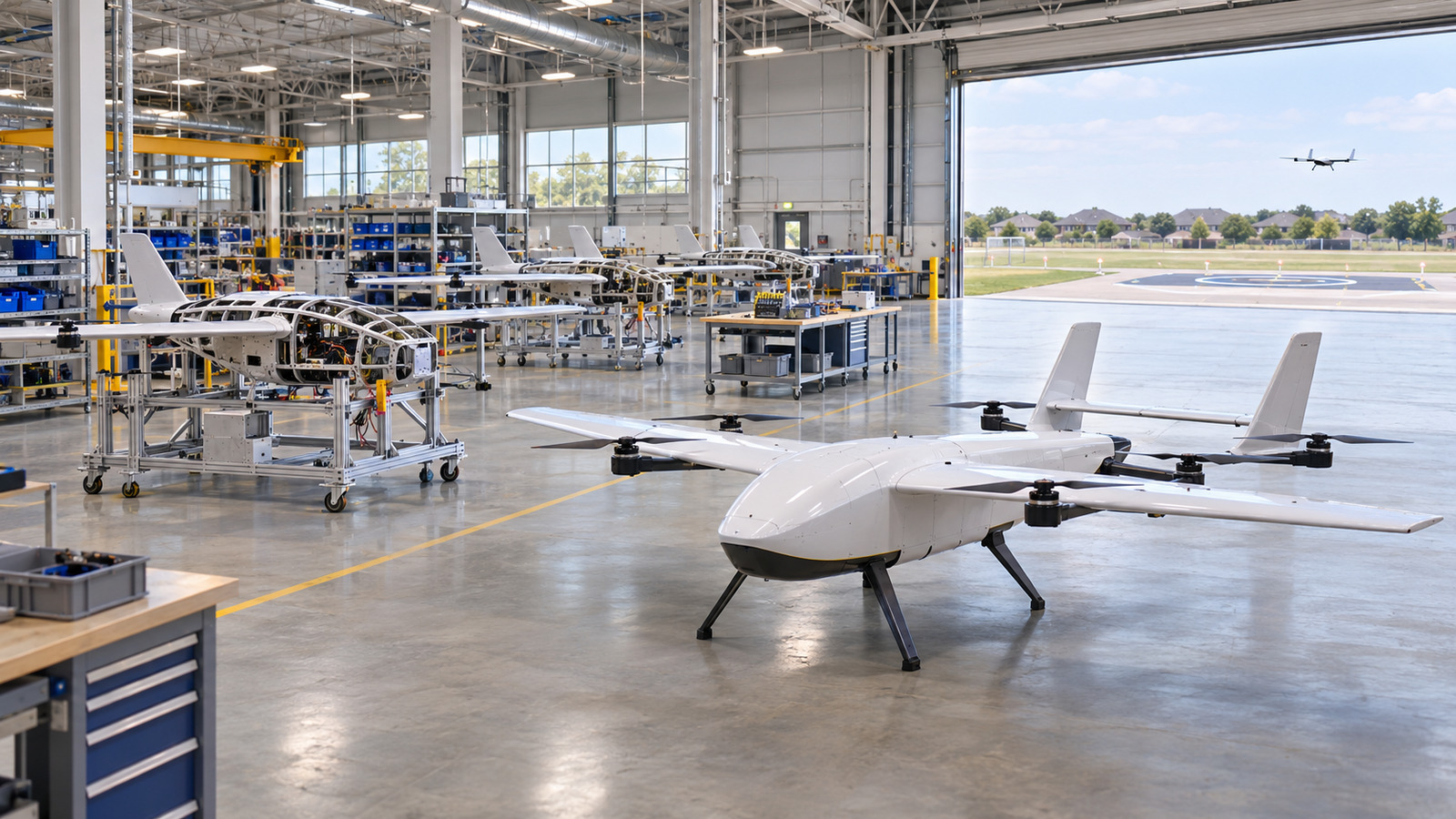
Independent fallback research was used because today’s Drive brief was unavailable. All About UAVs has no disclosed material relationship with Wing, Alphabet, Walmart or the organizations named. No affiliate links, sponsorship or paid placement. The featured image is an AI-generated conceptual illustration, not a photograph of Wing’s Fort Worth factory, aircraft or production line. General information, not procurement, legal or investment advice. Corrections: help@allaboutuavs.com.
Leave a Reply