The takeaway: Wing and Walmart’s drone-delivery service began taking Charlotte-area orders on October 21, adding a large retailer to an already active local delivery market. Wing’s current Charlotte page names ten North Carolina communities, but customers still must check a specific address. Claims that the rollout already extends into South Carolina are not supported by the company’s published coverage list.
What launched in Charlotte
Retail Technology Innovation Hub reported that Walmart customers in Charlotte could begin ordering Wing-powered drone delivery on October 21. Wing’s own Charlotte service page now offers an address-eligibility tool and lists Charlotte, Concord, Gastonia, Huntersville, Indian Trail, Kannapolis, Kings Mountain, Lincolnton, Matthews and Shelby.
That list matters because “Charlotte” describes a metropolitan market, not a blanket service boundary. A customer in a named community may still be outside an operating radius, while an address near a store or delivery hub may qualify. Wing tells shoppers to enter an address before assuming service is available.
Eligible customers can see drone delivery while shopping in the Walmart app or on Walmart.com, and Wing says orders can also be placed through its own app. The aircraft carries the order to a customer-selected delivery spot and lowers the package rather than landing. Wing markets delivery “in as little as 30 minutes”; that is a best-case service claim, not a guaranteed time for every order, address or weather condition.
What the coverage map does—and does not—show
All ten communities on Wing’s published Charlotte list are in North Carolina. The metro area sits close to South Carolina, but proximity is not evidence that the current service reaches Fort Mill, York, Lancaster or other South Carolina addresses. All About UAVs found no official coverage statement confirming those communities, so this report does not include them.
The same caution applies to scale. Wing and Walmart have said they are working toward service from more than 270 Walmart stores, reaching more than 40 million people. Their October 5 expansion announcement describes those numbers as goals for the broader coast-to-coast buildout, not the number of active Charlotte locations today.
This is an expansion, not Charlotte’s first delivery drone
The Walmart partnership is a meaningful retail expansion, but it should not be described as Charlotte’s first commercial drone-delivery operation. The Federal Aviation Administration’s package-delivery page says Zipline began operations in Charlotte after receiving its Part 135 air-carrier authority. DoorDash and Wing also previously offered restaurant delivery in part of the market.
What changed this week is the availability of Walmart inventory through Wing’s network. That potentially shifts drone delivery from occasional restaurant orders toward everyday retail items, including groceries, over-the-counter medicine and small household goods. Payload varies by aircraft: Wing’s standard delivery drone is commonly cited at roughly 2.5 pounds of cargo cruising at up to 60 mph, while a newer, larger Wing aircraft is rated for up to five pounds; which model handles a given Charlotte order isn’t publicly confirmed. Either way, the practical selection depends on item dimensions, stock, address eligibility and operating conditions.
Why it matters to UAV operators and communities
Routine retail delivery is one of the clearest tests of whether beyond-visual-line-of-sight operations can scale without losing public acceptance. The FAA says compensated small-package delivery beyond visual line of sight must use the Part 135 certification path, along with the relevant exemptions, waivers, operating specifications and airspace approvals. The agency also says operators select hub locations and may need local land-use or zoning approvals.
For operators, the notable development is not a new aircraft specification. It is the integration of certified flight operations with a national retailer’s checkout, inventory and fulfillment systems. Reliability at that interface—whether an eligible item can actually reach an eligible address when promised—will be as important as flight performance.
For communities, expansion brings familiar questions about noise, routes, privacy expectations and hub siting. Those issues are already drawing scrutiny elsewhere, as covered in our earlier drone-delivery and noise roundup and our report on the lawsuit challenging the FAA’s national delivery-drone environmental review. Neither dispute proves that Charlotte operations are unsafe; they show why transparent service boundaries, complaint channels and operating data matter as networks grow.
What to watch next
The immediate questions are practical: which Charlotte-area Walmart locations are live, how many addresses qualify, what hours and weather limits apply, and whether deliveries consistently meet the advertised speed. Wing’s address checker is the best current test for customers; a city name alone is not enough.
The next geographic milestone would be an official addition of South Carolina communities. Until Wing, Walmart or an aviation authority confirms that change, maps showing the broader Charlotte metro should not be read as a cross-state operating footprint.
Sources and disclosures
- Wing: Charlotte service page and address checker
- Wing: October 5, 2026 network expansion announcement
- FAA: Package Delivery by Drone (Part 135)
- Retail Technology Innovation Hub: Charlotte launch report
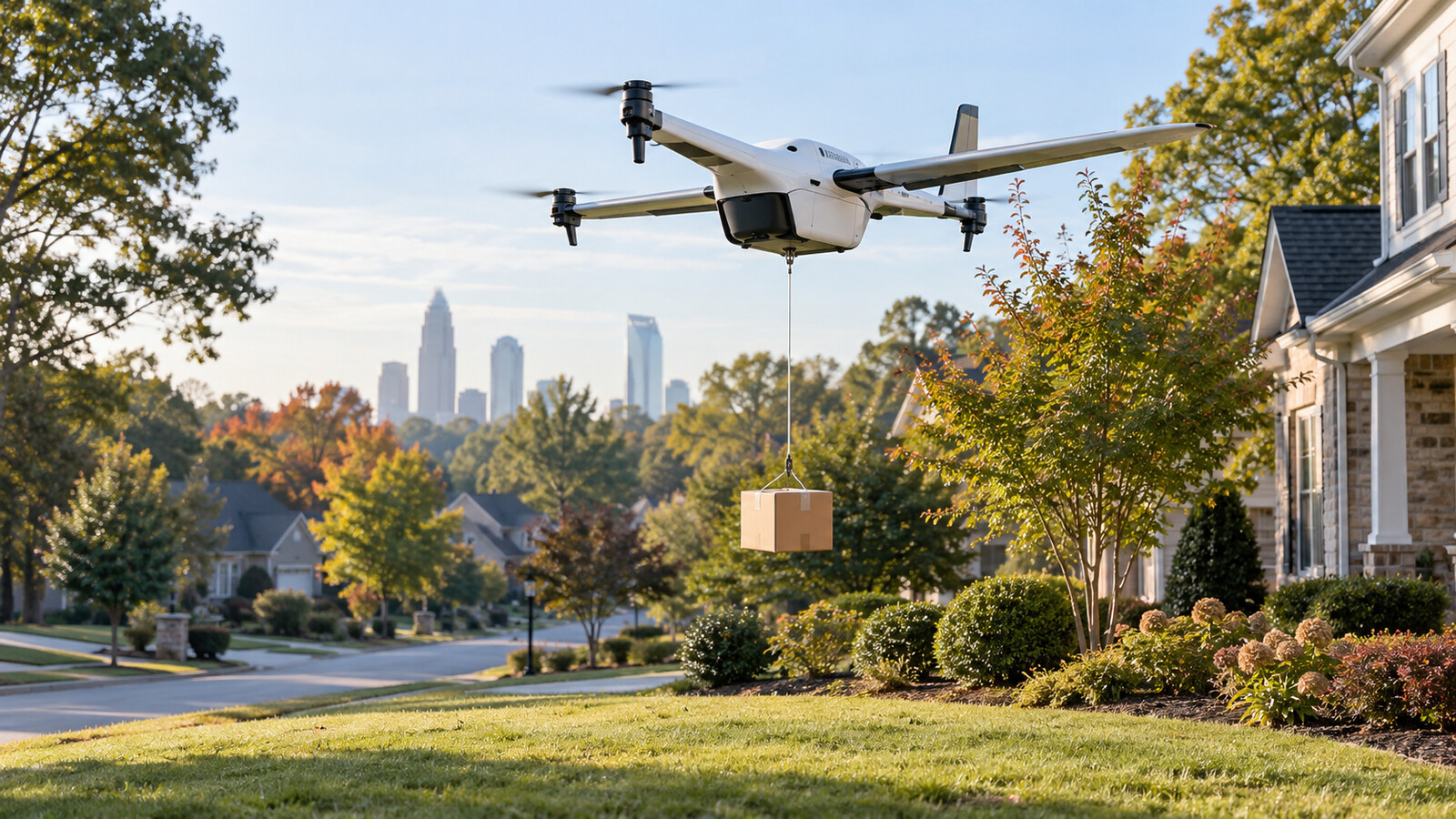
All About UAVs has no disclosed material relationship with Wing, Walmart or the other organizations named. The featured image is an AI-generated conceptual illustration, not a photograph of the service, aircraft or an actual delivery.
Leave a Reply