
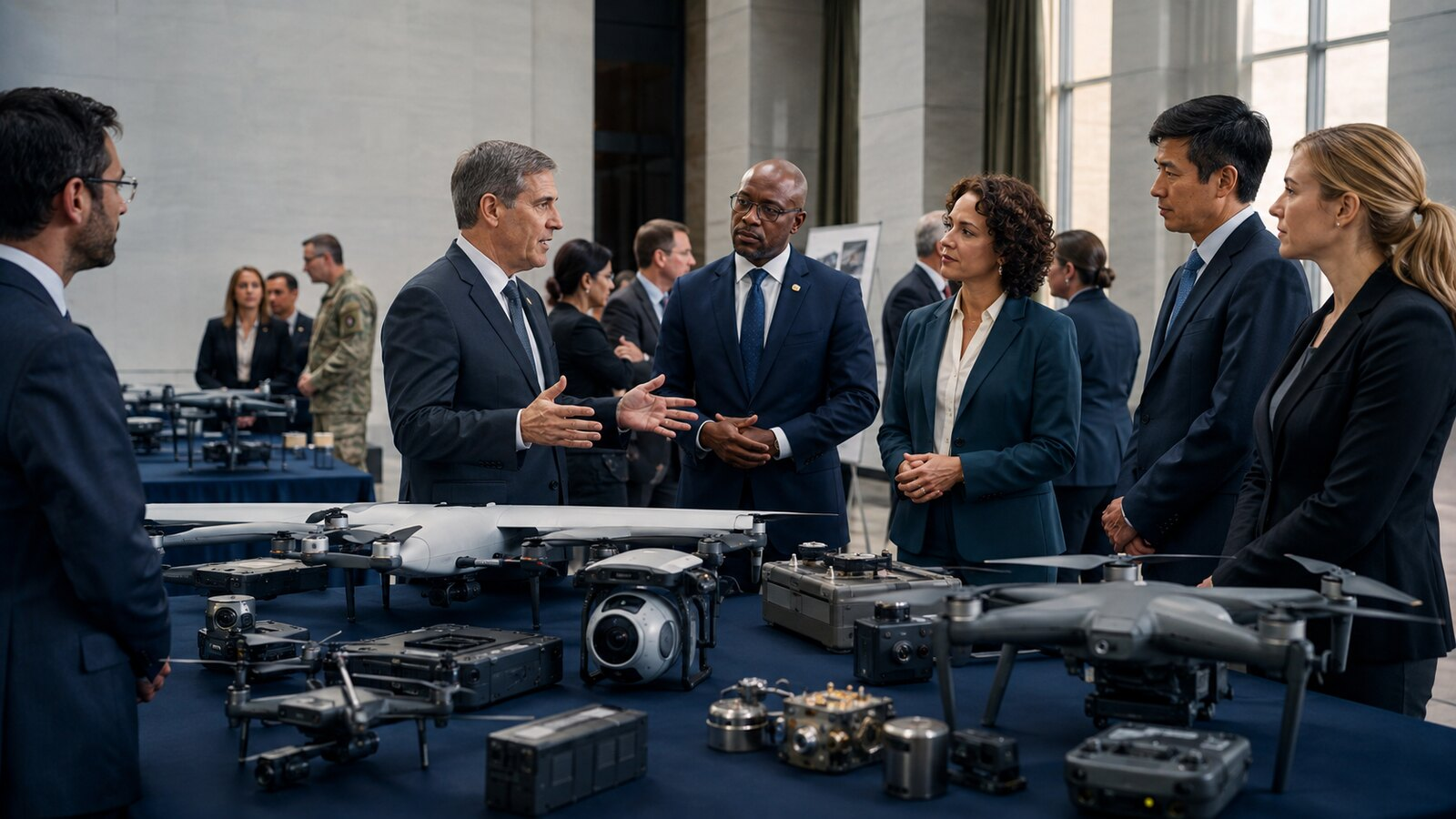
Nearly 100 government and industry representatives, including people from roughly 40 drone companies, met at the Eisenhower Executive Office Building on August 20 for the first White House “Drone Dominance” industry event. The meeting focused on domestic manufacturing, component supply chains and government procurement as new U.S. drone tariffs approach.
Who attended the White House drone meeting
Breaking Defense reported from the event that speakers included National Security Council Senior Director for Counterterrorism Sebastian Gorka, Under Secretary of Defense for Research and Engineering Emil Michael and Small Business Administration Administrator Kelly Loeffler.
“The cavalry arrived here to meet your cavalry in private industry to make sure that we are not drone sufficient, from parity, but drone dominant,” Michael told attendees, according to Breaking Defense.
After the opening remarks, participants met with representatives from the Commerce Department, Small Business Administration, Export-Import Bank, Department of Homeland Security, FAA and the Pentagon’s autonomy portfolio office. A White House official told Breaking Defense that attendees included suppliers of batteries, cameras, thermal sensors and motors—not only airframe manufacturers.
Why the tariff timing matters
The meeting came one week after President Trump signed an August 13 proclamation covering imported drones and components. Most of the new duties take effect September 3, while some less-sensitive components receive a 180-day delay. The rates and eligibility rules vary by product and country of origin, so operators should review the proclamation and applicable customs classifications rather than assume every import faces the headline rate.
China’s Commerce Ministry called for the tariffs to be withdrawn on August 20, the same day as the White House industry meeting. Our related coverage explains the Section 232 drone tariffs and potential supply-chain effects.
Part of a broader domestic-production push
The event follows the June 2025 “Unleashing American Drone Dominance” executive order, which directed federal agencies to promote U.S. drone manufacturing, procurement and exports.
Separately, the Pentagon’s Drone Dominance program is intended to spend about $1 billion over two years on small attack drones. Breaking Defense reported that the program’s public leaderboard listed 11 companies with agreements covering 24,320 aerial weapons after its first competition. A second competition at Fort Carson could determine which vendors share potential orders for as many as 60,000 additional platforms. Those figures describe planned or contracted procurement, not systems already delivered and fielded.
What commercial operators should watch
The meeting does not itself create grants, contracts or immediate new domestic supply. Its practical importance will depend on what follows: financing commitments, procurement awards, expanded component production and clear pathways for commercial manufacturers that do not primarily serve military customers.
Agricultural and industrial operators should monitor supplier notices, landed costs and component availability before the September 3 effective date. The key question is whether new U.S. capacity comes online quickly enough to offset higher costs or delays for affected imports.