The British Army has put a passive counter-drone detection network into operation at Warminster garrison. Project Halo Shield combines radio-frequency sensing with optical tracking, and UK Defence Innovation says it logged 29 drone-position alerts during its first 17 days. The useful takeaway is not that the base stopped 29 attacks—it did not—but that layered detection is moving from trials into routine site monitoring.
What Project Halo Shield deployed
UK Defence Innovation reported on September 14 that the British Army’s Experimentation and Trials Group moved Halo Shield from a November 2025 demonstration to an operational installation by March 2026. The government describes it as the first passive counter-drone detection system deployed at a British Army base.
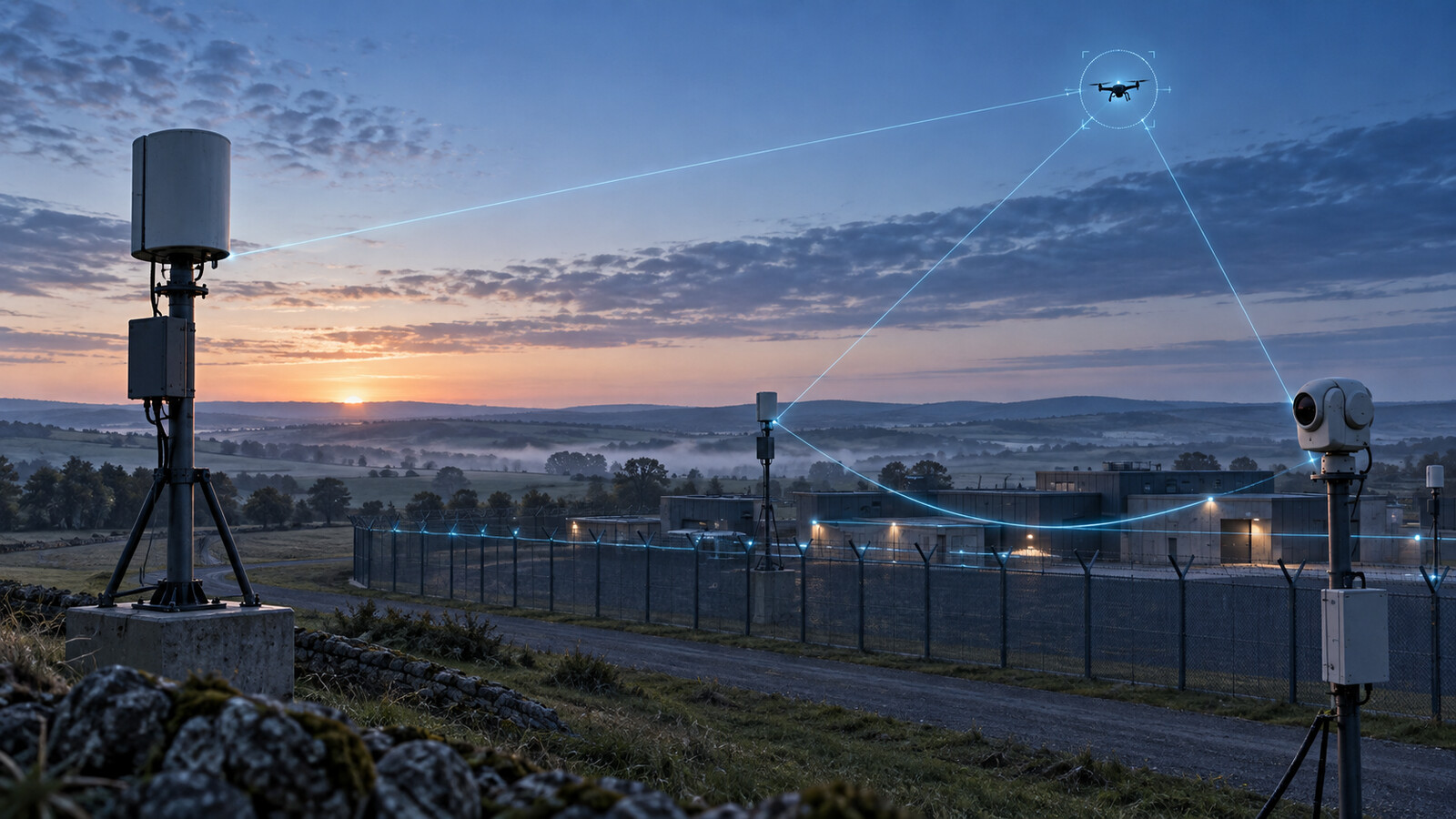
The deployment uses two complementary sensor layers. Three Dedrone radio-frequency sensors triangulate drone positions around the garrison, while a fourth RF sensor handles recognition and identification of the aircraft and controller when compatible signals are available. Quell’s SkySpyke provides hemispheric optical coverage, using automated processing to detect, track and visually classify airborne objects.
Forces News separately reported the Warminster deployment and described the system as a largely set-and-monitor capability. That corroborates the installation itself, but detailed performance figures still come from the UK government case study and participating suppliers rather than an independent test report.
What the 29 alerts do—and do not—prove
UKDI says Halo Shield recorded 29 drone-position alerts during the first 17 days of live monitoring, with detections as far as 5 kilometers away. None of those alerts represented a threat to the base. The Army also flew test drones against the system to look for weaknesses.
That is encouraging operational evidence, but it should not be rewritten as “29 hostile drones detected” or “zero false alarms.” The government’s wording says 29 position alerts and says none presented a threat; it does not publish a confusion matrix, the total number of aircraft in the area, weather conditions, aircraft types, detection probability or the number of false positives and missed detections.
The 5-kilometer figure is likewise a reported maximum, not a guaranteed detection radius. RF performance depends on the aircraft, protocol, terrain, antenna placement and radio environment. Optical performance depends on line of sight, lighting, weather, background clutter and target size. A useful procurement test would publish results across those variables rather than relying on a single headline range.
Why passive counter-drone detection matters
Passive sensors do not have to transmit radar or jamming energy to search the sky. RF receivers listen for control or telemetry signals, while cameras observe objects visually. That can make the equipment easier to deploy at a working base and reduces the spectrum-management burden associated with active emitters.
The tradeoff is that no passive sensor sees everything. A preprogrammed aircraft may not maintain a conventional control link for an RF sensor to detect. A small drone can also be difficult for a camera to distinguish from birds or clutter, especially at night or in poor weather. Pairing RF and optical sensors gives operators two different forms of evidence and a better opportunity to cross-check an alert.
Sensor fusion is especially important because detection is not the same as identification or attribution. An RF system may recognize a supported protocol and sometimes estimate controller location, but it will not automatically identify every aircraft or operator. Optical confirmation can show that an object is airborne without proving who launched it or whether it is authorized.
Detection is only the first layer of a response
Halo Shield, as publicly described, is a detection and tracking installation. The announcement does not say that the system autonomously jams, captures or destroys drones. It also does not disclose response times, staffing, alert thresholds or the procedures used to distinguish authorized Army flights from suspicious activity.
Those distinctions matter outside the military. Airports, utilities, stadiums and public-safety agencies may be able to detect an aircraft but lack authority to interfere with it. Our recent report on the second drone detection near Brussels Airport showed the same operational gap: technical evidence can strengthen an investigation without immediately identifying the pilot or supplying a lawful means of mitigation.
A mature counter-UAS plan therefore needs an alert-validation process, approved communications, identification of friendly aircraft, escalation rules, evidence retention and coordination with the authorities responsible for airspace and law enforcement. Buying sensors without defining those steps can produce a stream of alerts without a usable response.
What buyers should ask before copying the model
- What was the test population? Ask for aircraft types, flight profiles, signal protocols and authorized traffic.
- How were misses measured? An alert count alone cannot establish probability of detection.
- What happens without an RF link? Confirm how optical, radar or acoustic layers cover autonomous or radio-silent aircraft.
- How is an alert verified? Define who reviews it, how quickly and what evidence is retained.
- What action is legally available? Detection and mitigation have different technical and legal requirements.
What happens next for Halo Shield
UKDI says the Warminster installation is informing plans for wider passive detection across the defence estate. Future phases may add radar and acoustic sensors to the existing RF and optical layers. The wording is important: broader adoption is being considered and informed by the deployment; a nationwide rollout, quantity and budget were not announced.
The next meaningful evidence will be longer-duration data, controlled test results against varied targets, night and poor-weather performance, false-positive and missed-detection rates, and details on how alerts feed an operational response. Halo Shield is significant because it is installed and monitoring a real base—not because the available figures prove a finished, universal counter-drone solution.
Disclosure: This article contains no affiliate links or paid placement. System details are based on UK government reporting and are identified as supplier or government claims where appropriate. The featured image is an original AI-generated editorial illustration and does not depict Warminster garrison or actual Halo Shield equipment.