
Brussels Airport recorded a drone near its airspace for a second consecutive evening on September 12, this time through both visual observation and electronic detection. The repeat incident matters more than a single unconfirmed report: it gives investigators a technical record and shows how one small aircraft can interrupt a major airport. Authorities have not identified the drone, operator or motive, so attribution remains premature.
What changed in the second Brussels Airport drone incident
The material update occurred at about 8:00 p.m. local time Saturday. Belgian aviation outlet Aviation24 reported, citing skeyes spokesperson Kurt Verwilligen, that the aircraft was seen visually and registered by the air-navigation provider’s drone-detection equipment. Skeyes did not release the drone’s type, flight characteristics or operator, and an investigation is underway.
That differs from Friday evening’s event, when a drone was visually observed and runway traffic was interrupted for roughly half an hour. Reuters reported on September 12 that skeyes activated its drone procedure, which keeps affected runway traffic interrupted until 30 minutes after the last sighting. The aircraft disappeared before authorities could identify it.
A technical detection record can help establish time, location and movement more reliably than memory alone. It does not automatically reveal the pilot, intent or aircraft model. Public reporting has not established whether the two nights involved the same drone or operator.
Why an airport pauses traffic after a drone sighting
Near a runway, uncertainty is itself a hazard. Controllers may not know the drone’s altitude, heading, endurance or whether it will cross an arrival or departure path. A crewed aircraft on final approach has limited room to maneuver, while an aborted landing or diversion creates its own operational risks and costs.
The 30-minute period after the last sighting is therefore a safety buffer, not evidence that the drone remained over the runway for the entire closure. It allows time to confirm that the object has left the relevant area and to coordinate the runway’s return to service.
The response also illustrates why airport counter-UAS is a system problem. Detection must be connected to trained observers, air traffic control, airport security, police and a clear decision process. A sensor alarm alone cannot determine intent, and aggressive mitigation near an active airport can create interference or falling-debris hazards.
What electronic detection can—and cannot—prove
“Digital registration” describes evidence from detection equipment, but skeyes has not publicly identified the sensor type or released its data. Depending on the system, an airport may combine radio-frequency detection, radar, optical cameras or cooperative identification. Each method has limits.
- Radio-frequency sensors may detect or locate some control and video links, but autonomous or nonstandard aircraft may emit little useful information.
- Radar can track noncooperative objects, though birds, clutter and very small targets complicate classification.
- Optical and thermal cameras can help confirm that a target is an aircraft, but weather, darkness and line of sight constrain them.
- Remote identification can support accountability when a compliant aircraft is broadcasting, but a hostile, modified or malfunctioning drone may not cooperate.
Because the Saturday report includes both visual and electronic confirmation, the evidence is stronger than a lone public sighting. It still should not be stretched into claims about espionage, terrorism or state involvement without investigative findings.
The repeat disruption is the important warning
Belgium experienced a larger series of unexplained drone sightings around airports, military facilities and other sensitive locations in late 2025. Officials discussed possible foreign involvement at the time but acknowledged that proof was lacking. The same evidentiary discipline applies now.
For airport operators, two consecutive evenings raise practical questions: whether detection coverage is continuous, how quickly police receive location information, which runways can remain usable, and how evidence is preserved for investigation. For airlines, even a short interruption can create holding, diversion, crew-time and passenger-connection consequences.
The event also reinforces the operational lesson from our earlier airport-drone and BVLOS security update: identification and response procedures must mature alongside expanded drone operations. Legitimate commercial access to airspace depends on authorities being able to distinguish authorized flights from unknown ones quickly.
Rules for legitimate drone operations near Brussels
Brussels Airport states that unauthorized drone flights are prohibited in and around the airport because of the collision risk to arriving and departing aircraft. Its published drone guidance directs pilots to obtain prior authorization from skeyes. Skeyes’ Drone Service Application guidance explains the planning, confirmation and tactical coordination process for operations in the airspace it manages.
Those procedures are distinct from the unknown aircraft involved in this weekend’s incidents. Nothing publicly available indicates that either flight was authorized.
What happens next
The most useful next evidence will be an official investigative update identifying the detected flight path, aircraft type and operator, or establishing a connection between the two evenings. Authorities may also disclose whether Saturday’s electronic record helped locate a control signal or launch area.
Until then, the verified conclusion is narrow but consequential: Brussels Airport experienced repeat drone activity, and the second event produced both human and technical detection. The proper response is stronger investigation and coordinated airport protection—not speculation about who was responsible.
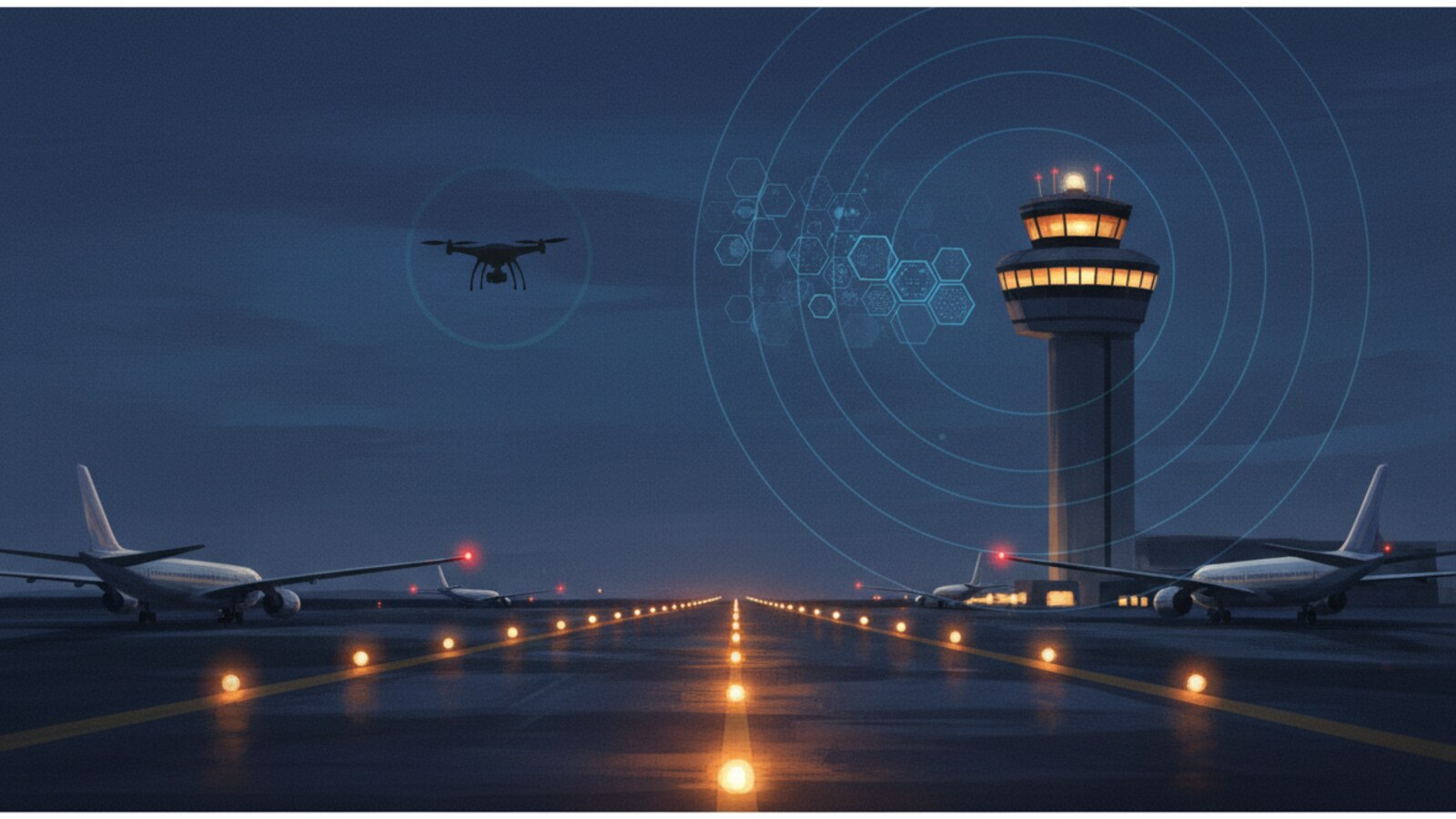
Disclosure: This article contains no affiliate links or paid placement. The featured image is an original AI-generated editorial illustration and does not depict either Brussels Airport incident or the unidentified aircraft.