
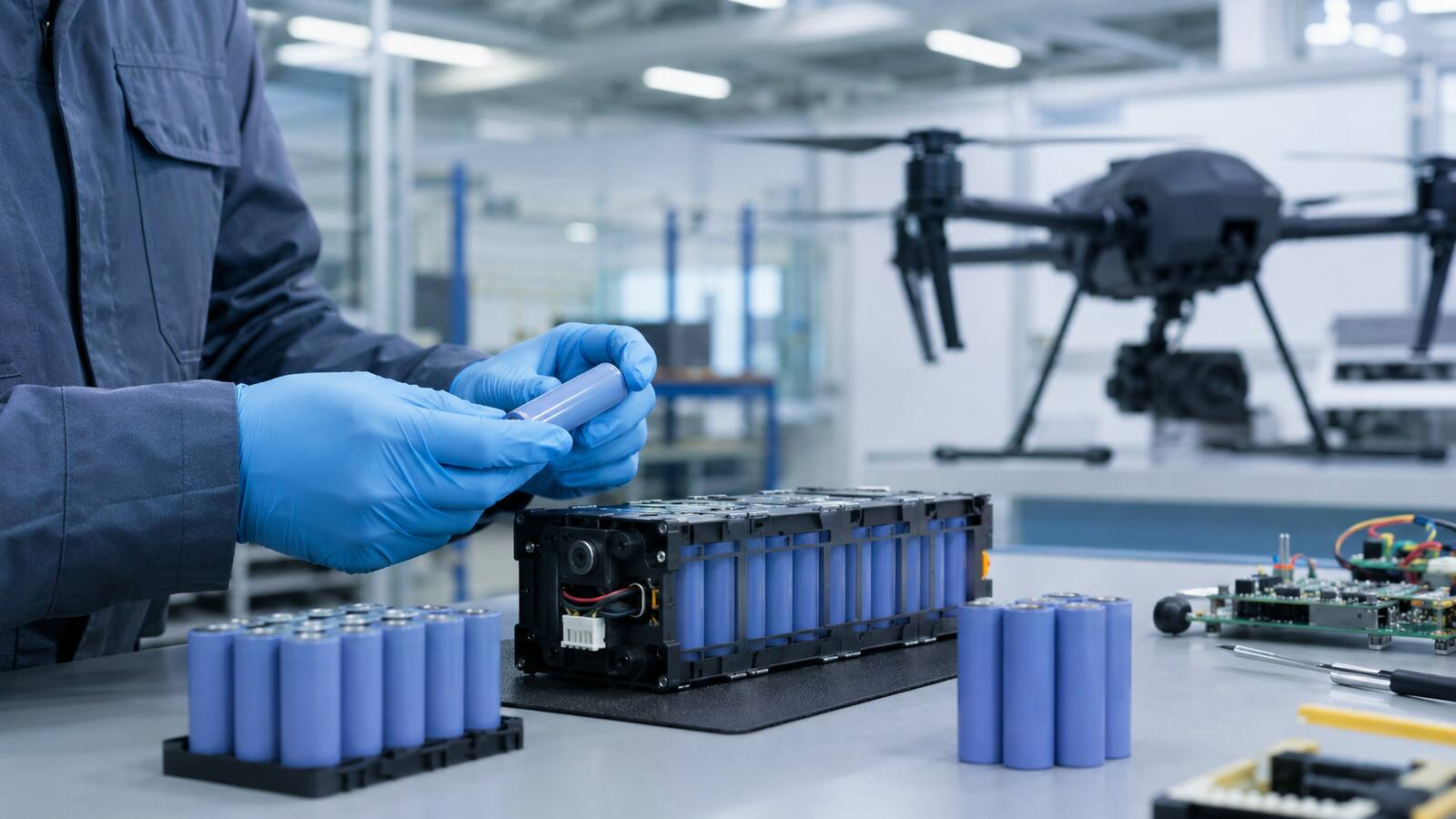
Drone manufacturers seeking U.S. defense work face a supply-chain test that reaches far below final assembly. A new UK battery-manufacturing push is drawing attention to where cells, cathodes, anodes and production technology originate—just as U.S. drone tariffs approach and Defense Department battery restrictions move toward a 2028 deadline.
Core takeaway: “Made in” claims at the aircraft or battery-pack level may not be enough. Manufacturers will increasingly need traceable evidence for the cells and functional materials inside their packs, especially when bidding for defense programs or seeking preferential tariff treatment.
Volklec puts drone cells inside the sovereignty debate
Coventry-based cell manufacturer Volklec is positioning British-made 21700 lithium-ion cells for drones, defense aerospace and other origin-sensitive applications. In an August 22 interview with ADS Advance, chief commercial officer Johan Andersson argued that assembling a drone or battery pack in the UK does not make its underlying supply chain sovereign.
The distinction is important. Battery packs contain cells, electronic controls and materials sourced through multiple tiers. Volklec says it has mapped alternatives for 97% of the bill of materials associated with its transferred cell technology, but those alternatives still require testing. That figure and the company’s qualification timelines are company statements, not an independent finding that the resulting supply chain is already compliant with every defense program.
Volklec’s current products are conventional cylindrical lithium-ion cells—not the solid-state or silicon-anode breakthroughs sometimes promoted in speculative drone coverage. The company lists a 5 Ah energy cell rated for 3C continuous discharge and a 5 Ah power cell rated for 12C/60A discharge. Those are manufacturer specifications; they do not establish a particular drone’s flight time, payload or endurance.
U.S. defense rules reach into battery materials and technology
Section 842 of the FY2026 National Defense Authorization Act adds a sourcing restriction for advanced batteries and cells acquired by the Defense Department, including batteries embedded in warfighting and support systems. The provision applies to new acquisition programs beginning January 1, 2028, standard batteries beginning January 1, 2029, and existing acquisition programs beginning January 30, 2031.
The statute generally directs the department to procure advanced batteries and cells whose functional components and technology are not owned, sourced, refined or produced by a foreign entity of concern. One statutory exception requires final assembly outside a foreign entity of concern, more than 95% of the cost of functional cell components from non-FEOC sources, and production without technology licensed from a foreign entity of concern.
The law defines functional cell components to include cathode materials, anode materials, separators, anode foils and other materials involved in energy storage. In practical terms, a drone company may need information that its pack assembler has not traditionally supplied. This is a procurement requirement for covered Defense Department acquisitions, not a general prohibition on private commercial operators using foreign-made batteries.
Section 232 tariffs add a nearer deadline
The battery discussion is arriving shortly before new U.S. drone tariffs take effect. The August 13 Section 232 proclamation sets a 100% tariff for listed UAS weighing more than 25 kilograms, UAS incorporating thermal imagers, docking stations and designated critical components. It sets a 25% rate for listed UAS weighing 25 kilograms or less. Those principal duties begin September 3, 2026.
A separate 25% duty on components listed in Annex III is scheduled for February 9, 2027. The proclamation also provides potential ceilings of 15% for qualifying products from specified allied economies and 10% for qualifying UK products, subject to detailed origin criteria and a Commerce Department determination process.
That does not mean every British-made cell or pack automatically receives preferential treatment. Companies will need to confirm the tariff classification, covered product list and applicable origin determination for the actual imported item. Our earlier coverage of the White House Drone Dominance summit explains the broader manufacturing policy behind the tariffs, while the latest weekly drone-news roundup tracks the policy alongside other major industry developments.
What manufacturers and commercial operators should do
Manufacturers pursuing U.S. government work should begin mapping the origin of battery cells, active materials, separators, foils, pack electronics and licensed production technology. Supplier declarations should be supported by records detailed enough for the specific solicitation and contracting requirements.
Commercial operators do not need to perform a defense-compliance audit on every flight battery. They should, however, expect supply choices, availability and replacement costs to shift as manufacturers qualify alternative components. Operators evaluating new platforms can ask whether the pack uses replaceable standard cells, how long replacement packs will remain available, and whether a battery change requires aircraft recertification, firmware changes or updated maintenance procedures.
What to watch next
The next meaningful evidence will be qualification data and signed supply agreements—not broad claims about sovereign technology. Watch for Commerce Department guidance on tariff-origin determinations, Defense Department implementation of the battery restrictions, and independently supported performance data from aircraft using newly sourced cells.
Volklec’s strategy illustrates the central challenge: domestic cell fabrication can reduce one dependency while materials, intellectual property and production equipment remain international. The emerging standard is therefore likely to be traceable allied sourcing rather than complete national self-sufficiency.