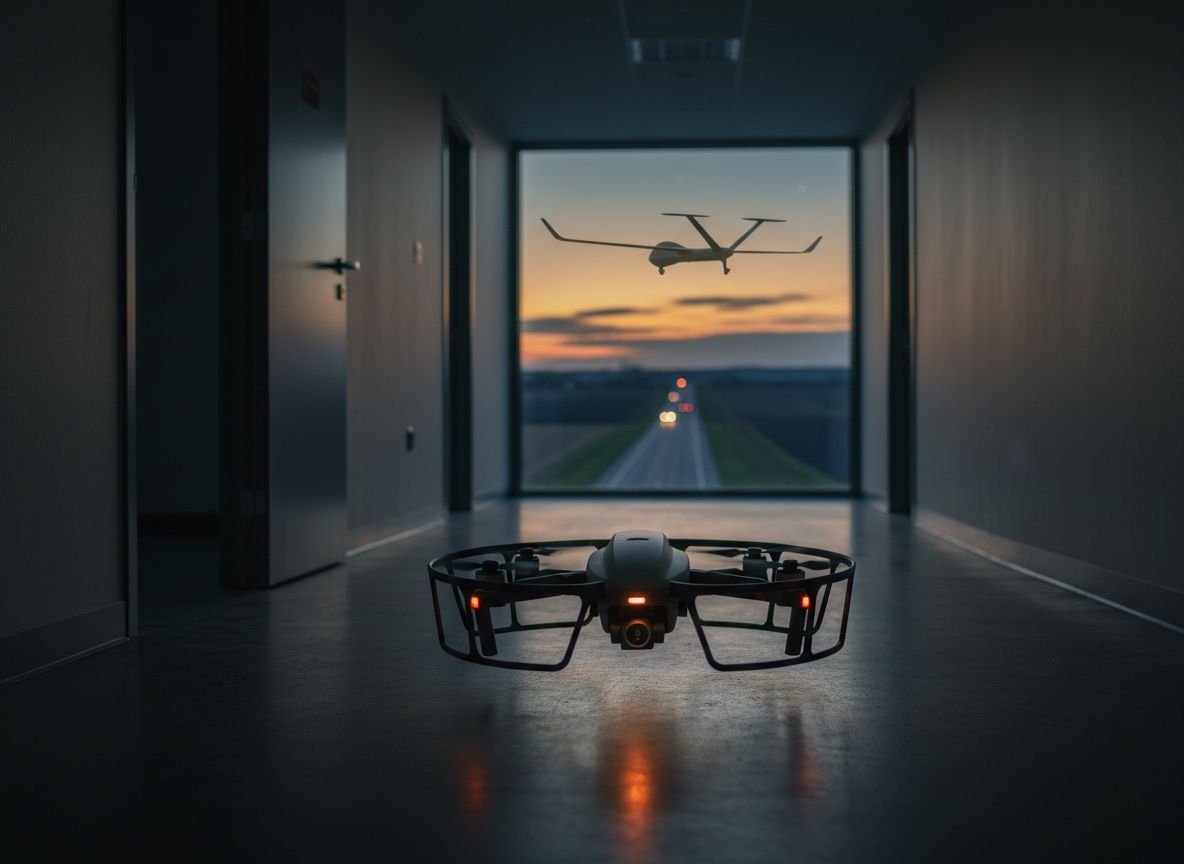
Skydio announced two new airframes at its September 2025 Ascend event — the R10, an indoor quadcopter for confined-space public safety work, and the F10, a long-range fixed-wing built for dock-based autonomous missions. The R10 reached general availability in 2026. The F10 took longer: at Ascend 2026 on September 23, Skydio re-introduced it as the F10 Lightrunner with a new MegaDock and a much higher spec sheet, and said it will deploy to customers in 2027. Together they round out a three-aircraft lineup built around Skydio’s Drone as First Responder (DFR) ecosystem, alongside the outdoor X10.
What problem each drone is solving
The X10 covers outdoor DFR missions well, but Skydio has been candid that its roughly 30-minute battery life and 31-inch frame make it a poor fit for indoor work or missions that need to cover dozens of miles. The R10 and F10 exist to close those two gaps rather than replace the X10: the R10 goes where the X10 is too big to fly, and the F10 goes farther than the X10 can reach.
Skydio R10 specifications
The R10 is a 10-inch by 10-inch quadcopter with built-in propeller guards, designed to be flown by officers with minimal drone experience through tight interiors like hallways, stairwells, and rooms during standoffs or active-shooter response.
| Spec | Value |
|---|---|
| Weight | 1.73 lb (785 g) |
| Dimensions | 10.4″ L x 10.3″ W x 2.4″ H |
| Flight time | Up to 20 minutes per battery; up to 3 hours in stationary Perch Mode |
| Camera | 4K, 1-inch sensor, 12.5MP stills, low-light optimized |
| Max horizontal speed | ~27 mph (12 m/s); ~18 mph with obstacle avoidance engaged |
| Startup time | Under 30 seconds |
| Control & software | Shares the X10 controller, Remote Ops, and DFR Command software |
| Price | $5,995 launch price (As of September 2026; U.S. dealers sell it as a contact-to-order special-order item) |
The shared controller and software stack is the more important spec than any single number on this table. An agency already running X10s can hand an operator an R10 without a second training cycle or a separate command interface — the same person can fly outdoor overwatch and indoor room-clearing from one dashboard.
Skydio F10 Lightrunner specifications
The F10 Skydio showed at Ascend 2026 is a substantially different aircraft from the one first previewed in 2025, which was pitched at 80+ mph and 90+ minutes. The figures below are Skydio’s published claims for the Lightrunner; it has not yet shipped, so none of them have been independently tested.
- Top speed: up to 100 mph
- Endurance: up to 120 minutes claimed
- Coverage: 30-mile operating radius (roughly 2,800 square miles from one dock)
- Weight: 15.4 lb (7 kg)
- Deployment: Robotic Takeoff and Landing (RTOL) from the MegaDock, which houses up to five F10s; airborne about 20 seconds after a dock trigger
- Sensors: telephoto camera (190mm equivalent), narrow camera (46mm equivalent), and FLIR Boson+ 640×512 thermal, in an off-center “SideEye” mount that keeps the wing out of frame
- Safety: integrated parachute; day/night operation and moderate-rain capability claimed
- Target missions: pursuits, rural emergency response, long linear infrastructure inspection
- Availability: customer deployments planned for 2027 (As of September 2026)
Skydio is pitching the F10’s endurance as a rural-response fix: in areas where a deputy’s drive time can run 45 minutes, a docked F10 could be airborne and on scene in a fraction of that, feeding video back before a unit arrives. That’s a mission profile the X10 simply can’t cover on a 30-40 minute battery.
How they compare to the rest of the market
The R10 isn’t the first indoor public-safety drone — companies building purpose-built indoor and infrastructure-inspection airframes have been in this niche for a while. Skydio’s pitch is less about a spec-sheet win and more about ecosystem lock-in: agencies that already standardized on X10 hardware, Axon integrations, and DFR Command get a second airframe with zero new software to learn. That’s a real advantage for a department scaling a program, and a non-factor for one evaluating indoor drones from scratch, where competing airframes deserve a look purely on their own specs and price.
On price, the R10’s $5,995 launch price (as of September 2026) sits well under the X10’s reported $16,000-$25,000 public safety deployment range (Skydio’s own CEO has put a bare X10 without cloud software near $15,000), which makes the R10 an easier add-on purchase for a department that already carries X10 licensing costs. The F10 Lightrunner and MegaDock don’t have public pricing yet, and dock-based fixed-wing systems in this category typically run well into six figures once the dock, licensing, and installation are included — that’s the number to press for before budgeting a rural DFR expansion.
Where these actually make sense
- R10 fits: existing X10/DFR agencies adding indoor capability for standoffs, welfare checks, and structure clears; critical-infrastructure operators needing confined-space inspection without a new training track
- R10 doesn’t fit: agencies with no existing Skydio investment who should shop indoor drones purely on price and spec against every option in the category, not just this one
- F10 fits: rural or large-jurisdiction agencies chasing response-time gaps, and utilities needing repeatable long-linear inspection from a fixed dock, that can plan procurement around a 2027 delivery
- F10 doesn’t fit: anyone who needs a production unit before 2027 — customer deployments haven’t started, and buyers should budget for the typical first-generation firmware and support bumps that come with a new airframe and dock
Bottom line
Neither drone is trying to win on raw specs — both are extensions of a platform strategy that rewards agencies already inside the Skydio ecosystem. The R10 is a low-friction, reasonably priced add for existing DFR programs; the F10 Lightrunner is a bigger bet on an unshipped airframe and dock that could meaningfully change rural response times if it reaches customers in 2027 as planned and holds its performance claims once independent reviewers get hands-on time with it.
Sources
- DroneDJ: Skydio R10 new indoor drone
- Commercial UAV News: Skydio Ascend 2025 R10, F10 drones
- UAV Coach: Skydio R10 and F10 launch coverage
- Skydio: R10 technical specifications
- Digital Camera World: Skydio R10 launch and pricing
- Skydio: F10 Lightrunner and MegaDock announcement (Ascend 2026)
- The Drone Girl: Skydio F10 Lightrunner specs
- DroneXL: Skydio X10 pricing and specs
- DroneXL: Skydio Series F funding and product line update
Leave a Reply