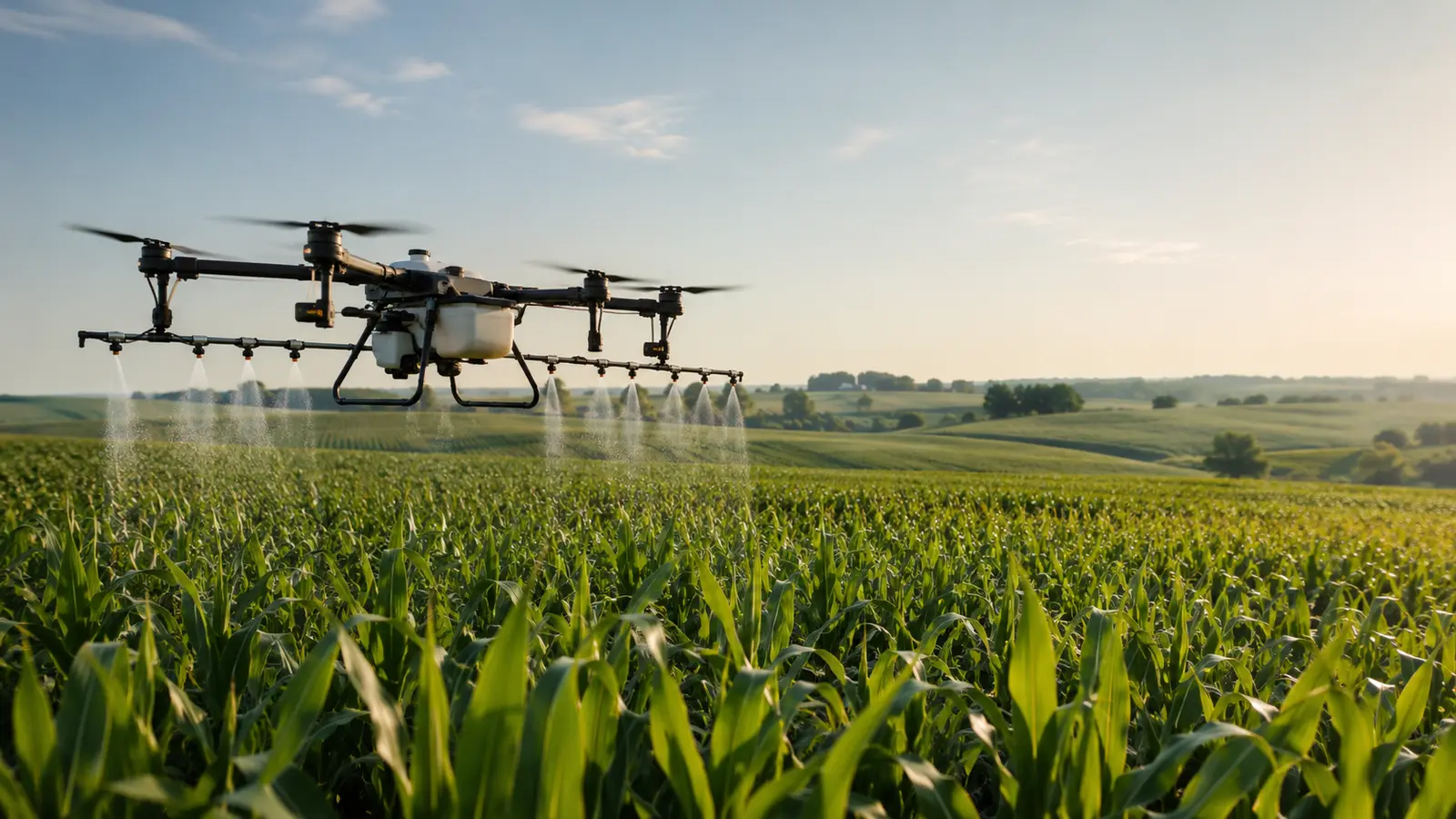
Agricultural spray drones have quickly evolved from experimental equipment into practical tools for farms and custom applicators. They can apply fungicides over mature corn, spot-treat weeds, seed cover crops, and reach fields that are too wet or difficult for conventional machinery.
Now, a new federal tariff program—combined with existing restrictions on foreign-made drones—is raising concerns about the future cost and availability of that equipment.
On August 13, 2026, President Donald Trump signed a proclamation imposing tariffs on imported unmanned aircraft systems and critical components. The highest rate, 100%, applies to drones weighing more than 25 kilograms at maximum takeoff weight and drones possessing certain sensitive capabilities, including thermal imaging.
That weight threshold encompasses many commercial agricultural spray drones once their payloads are included.
The tariffs do not take effect immediately. According to the White House, most will become effective 21 days after the proclamation was signed. Tariffs covering components considered less sensitive will generally take effect after 180 days. Certain countries and qualifying supply chains are also subject to lower rates.
For farmers and spray-drone businesses, however, the announcement adds another layer of uncertainty to a market already confronting significant regulatory change.
Why spray drones matter to agriculture
Conventional pesticide application usually relies on ground sprayers or manned agricultural aircraft. Both remain essential, especially when treating large acreages, but spray drones fill several important operational gaps.
Ground equipment cannot always enter a field after heavy rain without becoming stuck, compacting wet soil, or damaging crops. Spray drones can operate without driving through the field, allowing applications during narrow treatment windows when conventional equipment cannot move.
Purdue University Extension notes that drones can reduce site disturbance, soil compaction, and physical crop damage compared with ground equipment. They can also handle small, irregularly shaped fields and terrain that may be difficult or uneconomical for larger equipment.
Timing may be their greatest advantage. A delayed fungicide or pesticide application can reduce its effectiveness, particularly when a disease or insect problem is developing rapidly. A farmer-owned drone—or a nearby custom drone applicator—can sometimes respond without waiting for a larger aerial or ground-spraying service.
Spray drones are also useful for mapped spot treatments. Instead of applying a product across an entire field, an operator can treat selected areas where weeds or other problems have been identified. This can reduce unnecessary applications, although actual savings depend on the crop, product, field conditions, and quality of the application plan.
The tariff’s potential effect on equipment costs
The United States agricultural spray-drone market relies heavily on imported platforms and components. DJI Agras and XAG aircraft are among the most widely recognized systems in the sector, while batteries, motors, charging equipment, controllers, flight computers, and other critical parts often come from international supply chains.
A 100% tariff does not necessarily mean the final retail price of every affected drone will exactly double. Pricing will depend on inventory already in the country, importer decisions, country-of-origin rules, exemptions, manufacturer responses, and how costs are distributed among manufacturers, dealers, and buyers.
Nevertheless, the tariff creates a substantial potential cost increase for affected aircraft and components. Even when an operator already owns a drone, replacement batteries, motors, chargers, or control equipment can represent a significant portion of the system’s lifetime expense.
This is especially important in agricultural work because downtime can be as damaging as the purchase price. A failed component during a narrow application window may leave an operator unable to complete a treatment when it is most effective.
The FCC restrictions are a separate issue
The tariff proclamation arrives after the Federal Communications Commission added foreign-produced drones and critical components to its Covered List in December 2025.
That action generally prevents covered equipment from receiving new FCC equipment authorization, which is required before most wireless devices can be imported, marketed, or sold in the United States. It does not automatically ground drones that were previously authorized and legally purchased.
According to the FCC, already-authorized models may continue to be used. The more immediate concern is the future: new models, newly introduced components, and replacement-equipment supply may face increasing barriers unless they receive an exemption or qualify under an approved domestic or trusted-supply framework.
The FCC has also created limited exemptions and conditional-approval processes for certain equipment. The regulatory situation is therefore more complicated than a blanket prohibition on every foreign-made drone currently operating in America.
Independent operators may feel the pressure first
Small custom-application businesses are particularly exposed to abrupt changes in equipment costs.
These operators often serve farms that cannot justify purchasing their own drone or hiring a manned aircraft for a relatively small job. Their businesses depend on keeping multiple batteries, chargers, pumps, motors, nozzles, and other replacement parts available during the spraying season.
Higher acquisition and maintenance costs may force some operators to raise their per-acre rates. Others may delay purchasing new aircraft, keep existing equipment in service longer, or move toward platforms with more secure domestic supply chains.
Agricultural drone operations also involve more than buying an aircraft. Depending on the operation and aircraft weight, operators may need an FAA remote-pilot certificate, a Part 137 Agricultural Aircraft Operator Certificate, regulatory exemptions, aircraft registration, state pesticide credentials, insurance, support equipment, and application-specific training.
Can domestic manufacturing close the gap?
The administration says the tariffs are intended to strengthen national security, reduce dependence on foreign technology, and encourage investment in American drone production. The proclamation authorizes an onshoring program for companies investing in domestic drone and component manufacturing.
That could benefit the agricultural sector over the long term. American manufacturers such as Hylio already produce agricultural platforms, and other companies are working to establish domestic or allied-country supply chains.
The near-term challenge is scale. Domestic manufacturers must not only produce aircraft; they must also supply batteries, motors, electronics, software, replacement components, training, repairs, and dealer support at prices farms and small contractors can absorb.
Building that ecosystem will take time.
What agricultural operators should watch next
- The final tariff classifications for specific drone models and components
- The September effective date for the main tariff provisions
- Delayed implementation dates applying to certain components
- Department of Commerce guidance and possible exemptions
- FCC conditional approvals and Covered List updates
- Manufacturer announcements concerning U.S. production
- Parts availability and dealer-support commitments
The policy does not mean agricultural spray drones will disappear from American fields. Existing authorized equipment can continue operating, and domestic manufacturers now have a strong incentive to expand.
But the transition may be expensive. For agricultural operators who have already built businesses around imported platforms, the central question is no longer whether spray drones are useful. It is whether the supply chain and regulatory environment will allow them to remain affordable.
Sources
- White House fact sheet on the August 13 drone tariffs
- FCC announcement concerning foreign-produced UAS
- FCC Covered List guidance for drones and critical components
- FAA guidance for agricultural drone operations under Part 137
- Purdue University Extension: spray-drone capabilities and challenges
- Farm Progress reporting on agricultural supply concerns