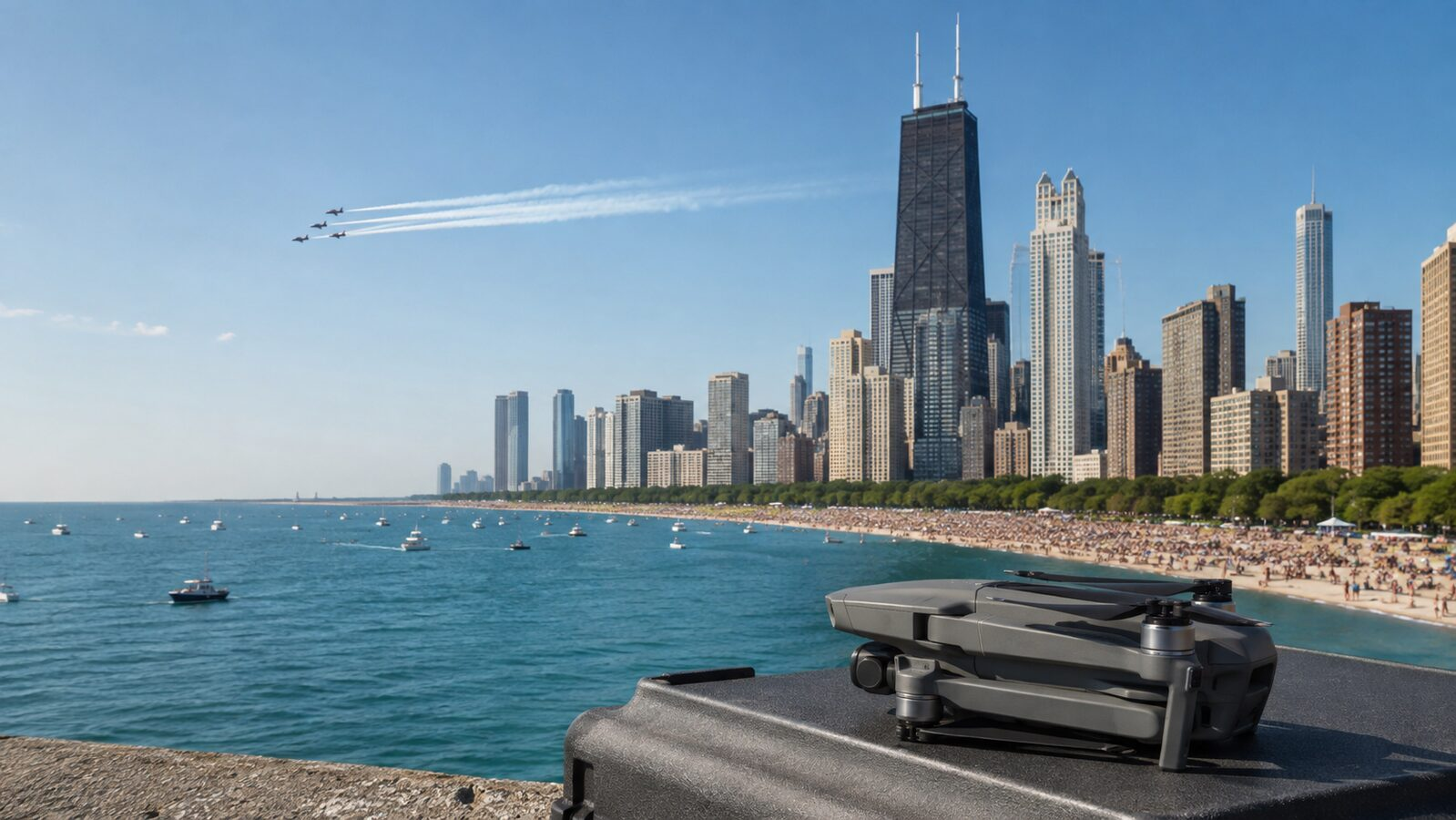
The 2026 Chicago Air and Water Show brings high-speed military and civilian aircraft to the Lake Michigan shoreline this weekend. It also brings a firm warning for drone pilots: during the active Temporary Flight Restriction, unauthorized drones cannot fly within five nautical miles of the show site.
The Federal Aviation Administration restriction, FDC NOTAM 6/2569, is active daily from 9:00 a.m. to 5:00 p.m. Central Daylight Time through Sunday, August 16. It extends from the surface through 16,000 feet mean sea level around the Chicago lakefront.
That means there is no low-altitude exception for a recreational flight, a quick photo, or an ordinary Part 107 job inside the restricted area. The City of Chicago separately lists personal and commercial drones as prohibited items at the North Avenue Beach event grounds.
The restriction at a glance
- FAA notice: FDC NOTAM 6/2569
- Location: Chicago lakefront, centered near the Air and Water Show site
- Radius: Five nautical miles
- Altitude: Surface through 16,000 feet MSL
- Active period: 9:00 a.m.–5:00 p.m. CDT daily, August 13–16, 2026
- Main show: 10:30 a.m.–3:00 p.m. Saturday and Sunday, August 15–16
The FAA’s live TFR entry is the controlling source. Times, boundaries, or conditions can change, so pilots should review the current NOTAM immediately before any operation rather than relying only on an article or saved screenshot.
What the Chicago TFR actually prohibits
A Temporary Flight Restriction temporarily limits aircraft operations inside a defined area. The FAA uses TFRs for safety, security, emergency response, major events, and high-speed aerial demonstrations.
The Chicago restriction applies to aircraft broadly, including drones. Recreational aircraft, FPV quads, camera drones, and commercial UAS cannot simply enter because they remain below 400 feet or because the pilot holds a Part 107 certificate.
LAANC authorization also does not override a TFR. LAANC addresses controlled-airspace authorization; a separate temporary restriction remains binding.
The NOTAM includes limited provisions for authorized operations coordinated through the controlling air-traffic facility. Those provisions should not be read as a general pathway for spectators, hobbyists, real-estate photographers, or other routine commercial operators.
The FAA explains that public-safety agencies, first responders, and certain media organizations may sometimes seek TFR access through its Special Governmental Interest process. Applicants must meet the applicable eligibility and coordination requirements. Permission must be obtained before flight.
Why even a small drone creates a serious hazard
The Air and Water Show’s flying environment is unlike an ordinary day along the lakefront. Authorized performers operate high-performance aircraft on tightly planned routes while support aircraft, parachute teams, air-traffic controllers, emergency services, and event personnel coordinate around a densely attended shoreline.
A small drone can be extremely difficult for a fast-moving pilot to see. The closing speed between an aircraft and a hovering quadcopter can leave almost no useful reaction time.
Consumer drones also contain hard components, motors, cameras, and lithium batteries. A collision with a propeller, rotor, windshield, canopy, control surface, or engine could damage the participating aircraft. Even if the crew remained in control, falling drone or aircraft debris could endanger spectators below.
The safest decision is therefore simple: spectators should leave their drones at home and capture the show from the ground.
What could happen after a TFR violation?
The FAA investigates reported TFR violations. Its published enforcement guidance says consequences can range from warnings and civil penalties to pilot-certificate suspension or revocation, depending on the circumstances.
Under the FAA’s updated 2026 enforcement policy, unsafe or unauthorized drone operations can result in civil penalties of up to $75,000 per violation. The agency can take enforcement action against both certificated and non-certificated operators.
Federal criminal charges or equipment seizure may also be possible when an operation implicates additional federal laws or authorized security actions. Those outcomes are not automatic for every airspace violation, but pilots should not treat the absence of an immediate confrontation as evidence that a flight went unnoticed or was legal.
Local rules can create additional problems. The City of Chicago prohibits personal and commercial drones from the North Avenue Beach event grounds, so bringing or launching an aircraft there may violate venue requirements even apart from the federal airspace restriction.
How to check the airspace correctly
- Review the FAA TFR list. The FAA’s live TFR system provides the controlling NOTAM, effective times, coordinates, altitude, and operating conditions.
- Use a current B4UFLY service. FAA-approved B4UFLY providers display airspace restrictions in a format designed for drone pilots.
- Check the complete flight area. Verify the takeoff point, intended route, recovery area, and any contingency path—not only the location where photographs would be taken.
- Check again immediately before launch. TFRs and NOTAMs can change after a flight was planned.
- Do not assume Part 107 or LAANC overrides the restriction. Neither creates blanket permission to enter an active TFR.
Does the restriction last all day?
No. The published TFR is active from 9:00 a.m. to 5:00 p.m. CDT on each listed day, rather than continuously around the clock.
That does not mean pilots should automatically launch near the show before or after the active period. Other controlled-airspace requirements, NOTAMs, local launch restrictions, operations over people, Remote ID rules, visual-line-of-sight requirements, and ordinary FAA regulations still apply. Event setup, crowds, boats, traffic, emergency activity, and changing restrictions can make nearby operations impractical or unsafe.
For anyone attending the event, leaving the drone at home avoids both the federal TFR and the city’s prohibition on drones at the grounds.
The responsible way to enjoy the show
The Chicago Air and Water Show is scheduled along the lakefront from Fullerton Avenue to Oak Street, with North Avenue Beach serving as its center. The U.S. Air Force Thunderbirds and U.S. Army Golden Knights headline the 2026 program.
Ground-based cameras with telephoto lenses can capture excellent images without placing another aircraft in the performance environment. Spectators should follow event rules, monitor weather and city updates, and leave aerial filming to the authorized crews.
The rule is straightforward: during the active TFR, keep unauthorized drones out of the five-nautical-mile area and leave the flying to the approved performers.