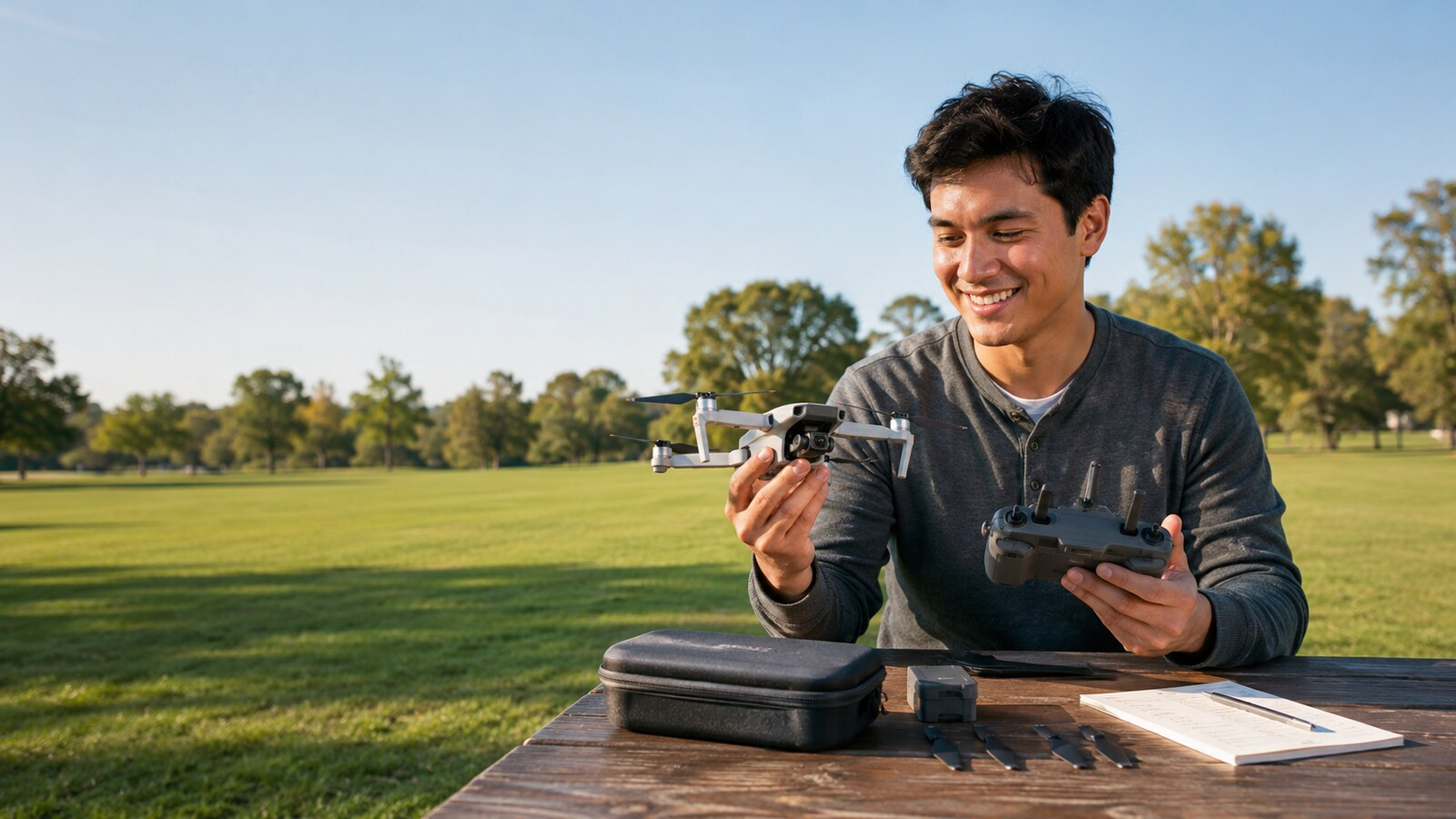
Buying your first drone should feel exciting—not like studying for an engineering final. The good news is that you do not need the longest range, the biggest megapixel number, or a suitcase full of accessories. You need a drone that matches the kind of fun you actually want to have.
This guide will help you choose without drowning in specifications. We’ll start with one easy question, explain the features that genuinely make flying easier, and finish with three beginner-friendly recommendations for different types of new pilots.
Short version: If you mainly want automatic videos of yourself, choose a small flying camera. If you want to explore the sky and take proper aerial photos, choose a GPS camera drone with a physical controller and a three-axis gimbal.
First, what kind of fun are you buying?
Forget brands for a minute. Picture your first three weekends with the drone. Which of these sounds most like you?
- “I want quick videos of hikes, family outings, or myself doing something cool.” Look for palm launch, propeller guards, automatic tracking, and simple preset shots.
- “I want to learn real drone flying and take smooth aerial photos and video.” Look for GPS, a dedicated controller, Return to Home, and a three-axis camera gimbal.
- “I might eventually use this for paid work.” Start with stable manual control, reliable batteries, good parts support, and a camera that produces usable deliverables—not merely the largest advertised resolution.
- “I want FPV racing.” That is a different branch of the hobby. A beginner camera drone will not teach you manual FPV flight, and an FPV setup is not the easiest first choice for casual photography.
The biggest first-drone mistake is buying for an imaginary future instead of the flying you will actually do. A $700 drone sitting in its case creates exactly zero fun.
The beginner features that are actually worth paying for
Drone boxes love impressive numbers. Beginners benefit more from a few boring-sounding features that quietly prevent bad days:
- GPS positioning: When you release the sticks, the drone should stop and hover instead of wandering off to investigate a tree.
- Reliable Return to Home: The aircraft can fly back when you press a button, lose signal, or reach a low-battery threshold. You still need to set a safe return altitude and verify the home point.
- A three-axis mechanical gimbal: This physically stabilizes the camera and usually matters more than an inflated camera-resolution claim. Electronic stabilization can help, but it is not the same thing.
- Clear battery information: A useful app should show remaining power and warn you early enough to return. Advertised maximum flight time is measured under favorable conditions; real flights are shorter.
- Easy-to-find batteries and propellers: A bargain drone stops being a bargain when one broken propeller grounds it for six weeks.
- Obstacle sensing, if your budget allows: Helpful, but never a force field. Thin branches, wires, low light, sideways movement, and high speed can still defeat sensors.
“Headless mode” is common on toy drones, but it should not drive a serious camera-drone purchase. Learning normal stick orientation on a stable GPS aircraft will serve you better.
The under-250-gram shortcut—and what it does not do
In the United States, recreational drones weighing less than 250 grams at takeoff are generally exempt from FAA registration. That makes the sub-250-gram category especially friendly for a first recreational aircraft.
There are two important catches. First, every recreational pilot still needs to complete the free FAA TRUST safety test and carry proof, even when the drone is tiny. Second, using any drone under Part 107—including a sub-250-gram model—requires registration and Remote ID compliance unless a specific exception applies.
Weight also includes what is attached at takeoff. A larger battery, propeller guard, light, or other accessory can push a 249-gram aircraft across the threshold. Check the actual takeoff configuration, not just the number on the front of the box.
Light drones are portable and surprisingly capable, but wind still matters. Your first flight should happen in a large open area on a calm day—not between houses with a gusty crosswind and an audience waiting for a dramatic launch.
Three beginner drones worth considering
These are not the only decent choices, and prices and U.S. availability can change quickly. They represent three useful starting points rather than a universal ranking.
DJI Neo: the easiest way to make flying feel like play
Price check: Compare the current aircraft-only and controller bundles before buying. Package contents, U.S. inventory, and final prices can change quickly.
The 135-gram DJI Neo is closer to a flying camera companion than a traditional aerial-photography platform. It can launch from your palm, run automatic shots without a controller, track a subject, and record stabilized 4K video. Full propeller guards make it less intimidating around a careful beginner.
- Best for: selfies, hiking clips, family outings, quick social video, and people who want results before mastering the sticks.
- Why beginners like it: tiny size, simple automated modes, palm takeoff, and multiple control options.
- Know before buying: DJI rates its battery for up to 18 minutes under controlled conditions, so practical sessions are short. It is not the best choice for long scenic flights or high-end aerial photography.
- Skip it if: your main goal is learning traditional controller-based flight or capturing the smoothest possible landscape footage.
DJI Mini 4K: the best first traditional camera drone for many people
Price check: Confirm the exact controller, battery count, warranty region, and delivery estimate. Similar-looking Mini packages can include different equipment.
The under-249-gram DJI Mini 4K gives beginners the familiar “real drone” experience: a dedicated controller, stable GPS hovering, automatic Return to Home, 4K/30fps recording, and a three-axis mechanical gimbal. DJI advertises up to 31 minutes of flight time and Level 5 wind resistance under its specified test conditions.
- Best for: first aerial photos, vacations, landscapes, and learning skills that transfer to larger camera drones.
- Why beginners like it: predictable controls, stable footage, useful automated shots, and an established accessory ecosystem.
- Know before buying: it does not provide the all-around obstacle sensing found on more expensive models. Return to Home cannot see every tree or wire for you.
- Skip it if: you mainly want hands-free tracking or you know that obstacle sensing is worth paying significantly more for.
Potensic ATOM 2: a capable non-DJI alternative
Price check: Compare the standard and multi-battery bundles using the manufacturer’s current U.S. listing, including shipping and warranty terms.
The under-249-gram Potensic ATOM 2 combines a three-axis gimbal with 4K HDR video, a 48-megapixel photo mode, subject-tracking features, and a manufacturer-rated maximum flight time of 32 minutes. It is a sensible option for buyers who want a traditional folding camera drone but prefer an alternative to DJI.
- Best for: new aerial photographers who want strong specifications and a conventional controller.
- Why beginners like it: compact design, stabilized camera, competitive bundles, and useful automated modes.
- Know before buying: Potensic explicitly states that the ATOM 2 does not have obstacle avoidance. Tracking modes should be used only in open areas.
- Skip it if: you want omnidirectional obstacle sensing or the deepest local accessory and repair ecosystem.
What about a premium first drone? Models such as the DJI Mini 4 Pro add omnidirectional obstacle sensing, advanced tracking, and higher-end video. They can be excellent, but their price and changing U.S. availability make them harder to recommend as the default first purchase. Buy one only if you already know why you need those features.
The starter kit that matters more than a giant bundle
You do not need every accessory on day one. A sensible first kit contains:
- The drone and its compatible controller, if it is a traditional camera drone.
- At least one spare battery—two if you plan trips away from charging.
- Spare manufacturer-approved propellers and the correct screws or tools.
- A quality microSD card that meets the manufacturer’s speed recommendation.
- A basic case that protects the gimbal and keeps loose batteries from being damaged.
- Optional accidental-damage coverage if replacement cost would make you afraid to practice.
Skip the giant filter collection, landing pad, range extender, mystery-brand charger, and suitcase of accessories until you know what your flying actually needs. Extra batteries usually create more enjoyment than extra gadgets.
Five things to check before pressing “Buy”
- Is it genuinely in stock? U.S. drone availability has been unusually changeable. Confirm the exact model, controller, warranty region, and delivery estimate.
- Who is actually selling it? Prefer the manufacturer or an authorized retailer with a clear return policy. Marketplace listings can mix U.S. inventory, gray-market units, used aircraft, and misleading bundles.
- Are batteries and propellers available separately? Check before buying the aircraft.
- Does the bundle include the controller you expect? Some small drones are sold without one, and screen-equipped controllers cost more than phone-based versions.
- Does the total still fit your budget? Include batteries, memory card, case, registration if required, and possible damage coverage.
Your first flight should be wonderfully boring
Before flying, complete TRUST, read the manual, update the aircraft at home, charge everything, inspect the propellers, check the airspace, and choose a large open field. Set a sensible Return to Home altitude and wait for the aircraft to confirm its home point.
Then do almost nothing impressive: take off, hover at eye level, make slow turns, move in a square, practice landing, and come home with plenty of battery. The goal of flight one is not cinematic footage. It is finishing with the drone, your confidence, and every nearby tree exactly where they started.
Once the box arrives, continue with our new drone pilot guide to your first 30 days for a practical path from unboxing to safe, confident flights.
Disclosure: All About UAVs may earn a commission from qualifying purchases made through links in this article, at no additional cost to you. Recommendations are based on the criteria explained here.
Sources and product information
- FAA: Recreational Flyers and TRUST Requirements
- FAA: Register Your Drone
- FAA: Remote Identification of Drones
- DJI Neo: Official Product Information
- DJI Mini 4K and Mini 2 SE: Official Product Information
- Potensic ATOM 2: Official Product Information
Reviewed September 7, 2026. Product specifications are based on manufacturer documentation. All About UAVs did not independently flight-test the recommended aircraft. Verify current specifications, pricing, availability, and FAA compliance before purchasing.