Practical takeaway: The DJI FlyCart 30 is a serious industrial transport aircraft, not an oversized camera drone. Its strongest case is repetitive cargo movement across steep, remote, or hazardous terrain where trucks, crews, or helicopters are slow or expensive. But a mission-ready system costs more than the airframe, and its 95 kg maximum takeoff weight places typical U.S. operations outside standard Part 107 rules. Buyers should validate the complete configuration, aircraft authorization, operating concept, training, and support before ordering.
This is an independent product analysis based on manufacturer documentation, regulatory sources, and current dealer listings. All About UAVs has not flight-tested this aircraft.
What the FlyCart 30 is designed to do
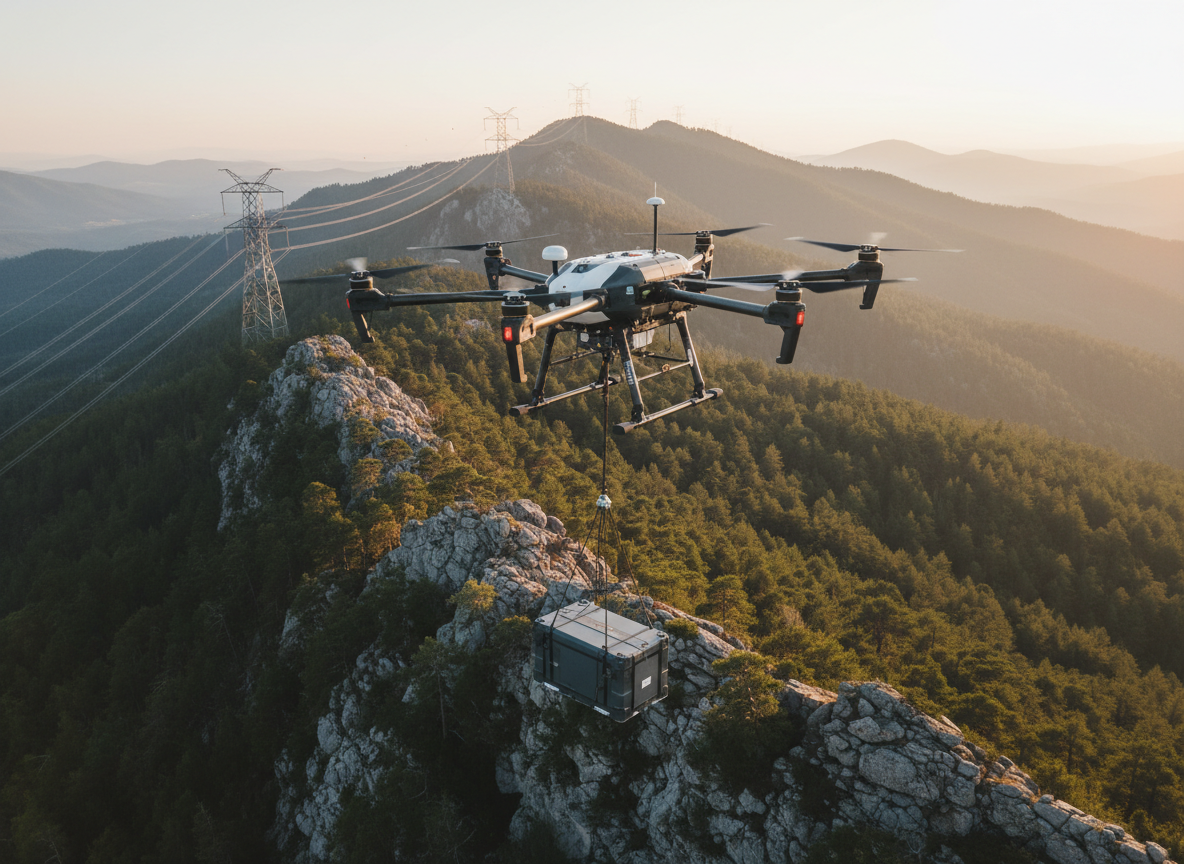
The FlyCart 30 is DJI’s purpose-built cargo multirotor for utilities, construction, forestry, emergency response, remote logistics, and other operations where a heavy load must cross terrain that is difficult or risky for people. It uses four coaxial arms and eight 54-inch propellers, folds for transport, and supports either a cargo case or an optional winch.
DJI publishes two distinct load configurations. In dual-battery mode, the maximum payload is 30 kg (66 lb); DJI reports up to 16 km (9.9 mi) of flight distance at that load and 28 km (17.4 mi) without payload. In single-battery mode, capacity rises to 40 kg (88 lb), but DJI reports only 8 km (5 mi) at maximum load. Those range figures were measured at sea level, in windless controlled conditions, at 15 m/s, so they are planning ceilings—not expected field performance. The official specifications also list 18 minutes of hover time at maximum weight in dual-battery mode and eight minutes in the 40 kg single-battery configuration.
Specifications that matter in the field
- Aircraft weight: 42.5 kg without batteries; 65 kg with two DB2000 batteries
- Maximum takeoff weight: 95 kg at sea level, including cargo
- Maximum horizontal speed: 20 m/s (about 45 mph), under DJI’s stated test conditions
- Operating temperature: −20°C to 45°C (−4°F to 113°F)
- Weather protection: manufacturer-rated IP55 aircraft and winch protection
- Wind resistance: manufacturer maximum of 12 m/s (about 27 mph)
- Transmission: DJI O3, advertised to 20 km under FCC conditions with unobstructed line of sight and ordinary interference; optional 4G enhanced transmission depends on local service and rules
- Cargo case: EPP and aluminum construction with weighing capability
- Winch: sold separately; 20 m cable, weighing, swing control, and ground-contact release
The airframe is substantial: DJI lists 65 kg (143 lb) with two batteries before cargo. That affects transport vehicles, loading procedures, launch-site controls, crew size, and emergency planning. IP55 is useful protection against dust and water jets under a standardized test; it is not a promise that every mission is safe in heavy rain, icing, salt exposure, or severe weather.
Cargo case or winch?
The cargo case is the simpler choice when the aircraft can land at both ends and the load fits within the box. The winch makes more sense where landing is impossible or undesirable, such as steep rights-of-way, towers, forest clearings, or controlled industrial sites. DJI specifies a 5–30 kg winch payload with two batteries and 5–40 kg with one.
Winching adds its own operating risks: suspended-load swing, snagging, rotor wash, people entering the drop zone, and shifting centers of gravity. Automatic release and swing control can help, but they do not replace a site-specific lifting plan, exclusion zone, trained ground personnel, reliable communications, and clear abort criteria.
Safety systems—and their limits
The FlyCart 30 combines forward and rear active phased-array radar, binocular vision, an FPV camera, ADS-B reception, dual batteries, and a parachute. DJI’s specifications list the parachute’s minimum deployment altitude as 60 m (197 ft), with a descent speed of no more than 6 m/s at sea level in no wind. That means the parachute should not be treated as a universal safeguard for low-altitude cargo work.
Likewise, dual batteries provide redundancy, but DJI does not promise that every battery or propulsion failure will end safely. The 40 kg configuration uses a single battery, trading redundancy and range for payload. Prospective operators should ask DJI to document failure responses, maintenance intervals, battery retirement criteria, parachute servicing, and any required life-limited-part replacements.
U.S. regulatory and procurement considerations
Part 107 applies to small unmanned aircraft weighing less than 55 pounds at takeoff. The FlyCart 30 itself exceeds that threshold with batteries, so a Remote Pilot Certificate alone does not authorize normal operation. A U.S. operator should discuss the intended mission with the FAA and qualified aviation counsel to determine the applicable aircraft certification, exemption, operating authority, registration, and airspace requirements. Beyond-visual-line-of-sight work separately requires appropriate FAA authority; long-range radio capability does not create permission to fly BVLOS. Start with the FAA’s waiver guidance, while recognizing that this aircraft may require a different pathway than Part 107.
There is also an FCC supply-chain question. Since December 2025, foreign-produced drones have been on the FCC’s Covered List, which blocks new equipment authorizations but still allows previously authorized models like the FlyCart 30 to be imported and sold. In July 2026, however, the FCC sought comment in PS Docket 26-189 on prohibiting continued importation and marketing of previously authorized foreign “military-grade” drones—a category that includes aircraft weighing 55 pounds or more at takeoff. The comment period closed September 2, 2026, and no final rule had been adopted as of October 9, 2026. The proposal would not ground aircraft already in users’ hands, but if adopted it could affect future purchases, replacement aircraft, and parts supply. Buyers should ask dealers in writing how they would support batteries, spares, and repairs under that scenario.
Organizations subject to domestic-content, cybersecurity, federal procurement, or covered-equipment rules must also complete their own compliance review. The product’s availability through U.S. dealers does not establish eligibility for every public-agency program.
Price, availability, and true ownership cost
DJI does not publish a U.S. list price on its product page and says availability is limited to selected countries and regions. As of October 2026, one U.S. dealer advertises a $22,738 basic package containing the aircraft, four DB2000 batteries, and one C8000 charger, while other listings show lower aircraft-only prices or require a quote. Because bundles differ, treat any online number as a dated lead rather than a comparable quote.
A realistic budget should include the chosen cargo system, batteries, charger and suitable electrical service, remote controller, spare propellers and parts, cases or transport fixtures, training, insurance, regulatory work, maintenance, parachute servicing, cellular connectivity, DeliveryHub or other software costs, site surveys, and additional staff. Electrical energy is only a small part of operating cost.
Benefits, limitations, and alternatives
The FlyCart 30’s appeal is integration: aircraft, cargo handling, sensing, controls, and fleet software come from one ecosystem. For repetitive short routes with expensive ground access, it may reduce exposure hours and cycle time. DJI DeliveryHub adds route planning, multi-aircraft monitoring, live status, and operational records, but buyers should confirm licensing, connectivity, data location, access controls, and offline behavior.
The limitations are equally material: regulatory complexity in the United States, short maximum-weight endurance, high battery and charging demands, limited public independent testing, and dependence on a proprietary ecosystem. Weather, density altitude, reserve requirements, routing, suspended-load procedures, and maintenance can reduce practical payload or range substantially.
Credible alternatives depend on the mission rather than headline payload. A Freefly Alta X may suit operators needing an open, payload-flexible heavy-lift platform, while aircraft from specialist cargo-UAS manufacturers may offer different certification or integration pathways. Ground vehicles, cable systems, contracted helicopters, or smaller drones making multiple trips may still win when utilization is low. For broader industry context, see All About UAVs’ delivery and logistics coverage.
Who should buy it—and who should skip it
Shortlist the FlyCart 30 if your organization has repeatable heavy-cargo routes, measurable labor or helicopter costs, controlled operating sites, aviation-compliance support, trained crews, and enough utilization to justify a complete system. Require a demonstration using your payload, altitude, route, reserve policy, weather limits, and delivery method.
Skip or delay it if the business case depends on maximum advertised range and payload occurring together, if you expect ordinary Part 107 rules to cover the mission, or if the budget only accounts for the aircraft. Occasional or poorly defined missions may be better served by a contractor.
Conclusion
The DJI FlyCart 30 is a capable heavy-lift logistics platform with a clear role in difficult industrial transport. Its specifications are impressive, but the purchasing decision turns on authorization, duty cycle, field-tested reserves, service support, pending FCC import rules, and total system cost. The right next step is not a simple online order: it is a payload-specific demonstration, a written mission-ready quote, and a documented regulatory and safety plan.
Disclosure: All About UAVs has no material relationship with DJI for this article. No affiliate links are included. Manufacturer specifications are identified as claims and were not independently flight-tested by All About UAVs.
Leave a Reply