Uber and Zipline announced a U.S. drone-delivery partnership on August 17, 2026, with first Uber Eats deployments planned for later this year. The companies say they aim to reach one million drone deliveries per day by the end of 2029. That figure is an ambitious company target—not an independent forecast or guaranteed operating milestone.
Uber is also making an undisclosed strategic investment in Zipline. The arrangement would place Zipline delivery inside Uber Eats, giving customers in supported service areas a drone option without requiring a separate ordering app.
What Uber and Zipline Announced
According to Uber’s official announcement, the service will begin in existing Zipline markets and target expansion into dozens of U.S. cities. The companies did not disclose the investment amount, a complete city list, delivery pricing, or binding annual volume commitments.
Uber describes the partnership as part of a hybrid network that can assign orders to human couriers, sidewalk robots, or drones. Zipline would provide the aircraft and delivery operation while Uber Eats supplies the consumer marketplace and order flow.
How Zipline’s Delivery System Fits the Plan
Uber says customers in eligible areas will receive orders through Zipline’s autonomous delivery service in roughly five to ten minutes. That delivery-time claim comes from the companies and will depend on merchant preparation, service radius, weather, aircraft availability, and local operating approvals.
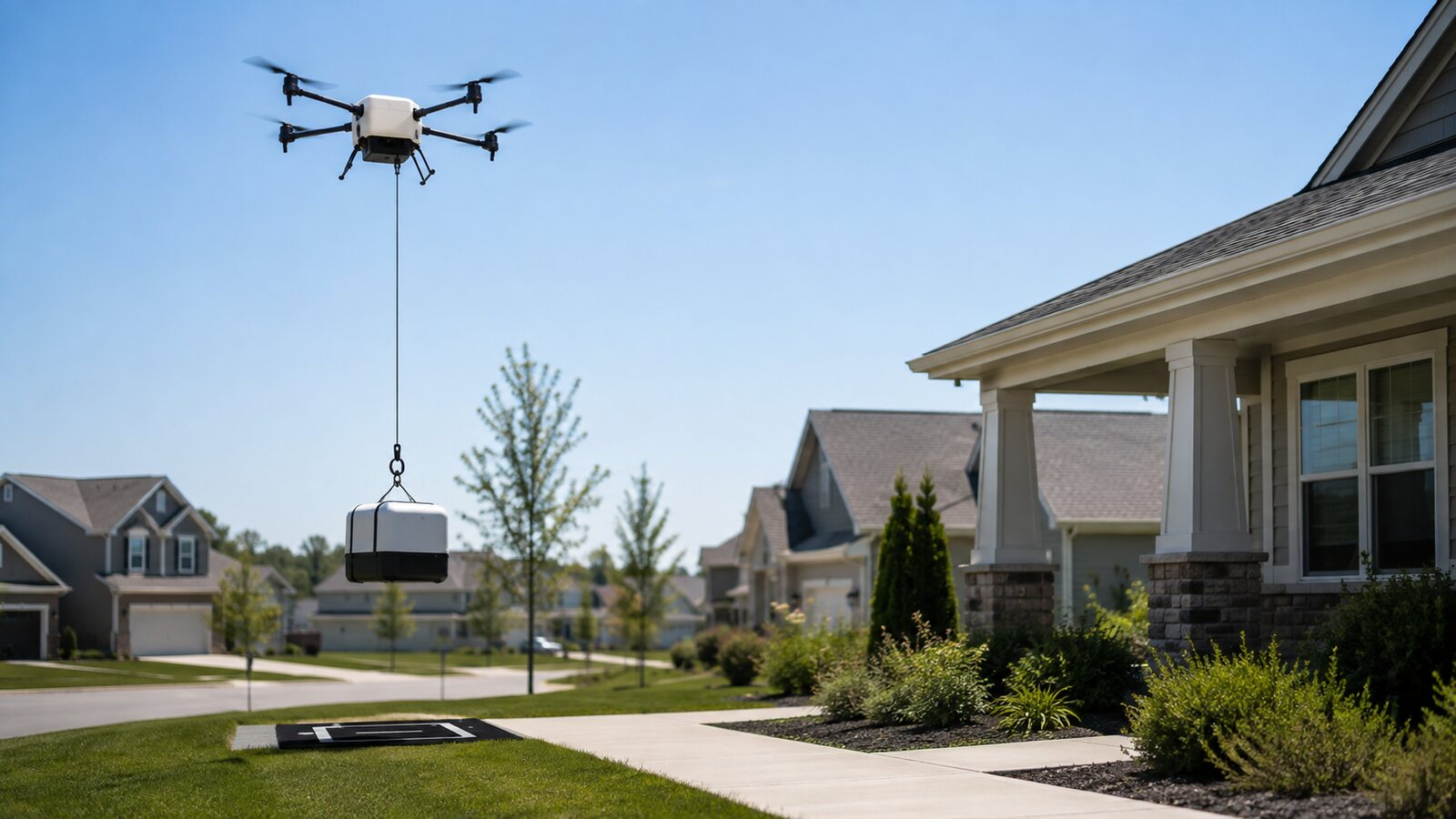
Zipline’s newer residential system uses an electric aircraft and a tethered delivery device that lowers an order into a designated area while the aircraft remains above the property. The partnership announcement does not promise that every Uber Eats order or market will use drone delivery.
How Large Is the One-Million-Per-Day Goal?
Uber reports that Zipline has completed more than 2.7 million deliveries and currently makes one delivery somewhere in its global network about every 20 seconds. That works out to roughly 4,320 deliveries per day at the stated current pace.
A sustained rate of one million deliveries per day would be about 231 times that worldwide pace. The comparison illustrates the scale of the companies’ goal, but it does not account for future fleet growth, additional launch sites, regulatory approvals, or changes in demand.
What the Regulatory Path Actually Looks Like
Large-scale drone delivery does not have to wait for a final Part 108 rule. Zipline already holds an FAA Part 135 air-carrier certificate and operates under existing exemptions and approvals. The FAA’s environmental-review records show that expanding the company’s Platform 2 operations still requires federal review and authorization for specific operating areas.
A future Part 108 framework could create a more standardized path for routine beyond-visual-line-of-sight operations, but today’s delivery networks can expand under the existing Part 135, exemption, airspace-authorization, and environmental-review processes. National UAS Traffic Management infrastructure may support higher traffic density, but it is not accurate to present a completed nationwide UTM system as a current legal prerequisite for every delivery.
What to Watch Next
The most useful checkpoints are the first named launch markets, the service boundaries approved by the FAA, merchant participation, customer pricing, actual delivery volume, and how often drone delivery is offered inside Uber Eats. Those measurements will show whether the 2029 goal is becoming an operating plan or remains primarily an ambition.
The partnership also adds another major platform to the U.S. delivery-drone contest. All About UAVs previously examined how DoorDash is building its own drone-delivery capability, creating a different mix of platform control and aviation responsibility.