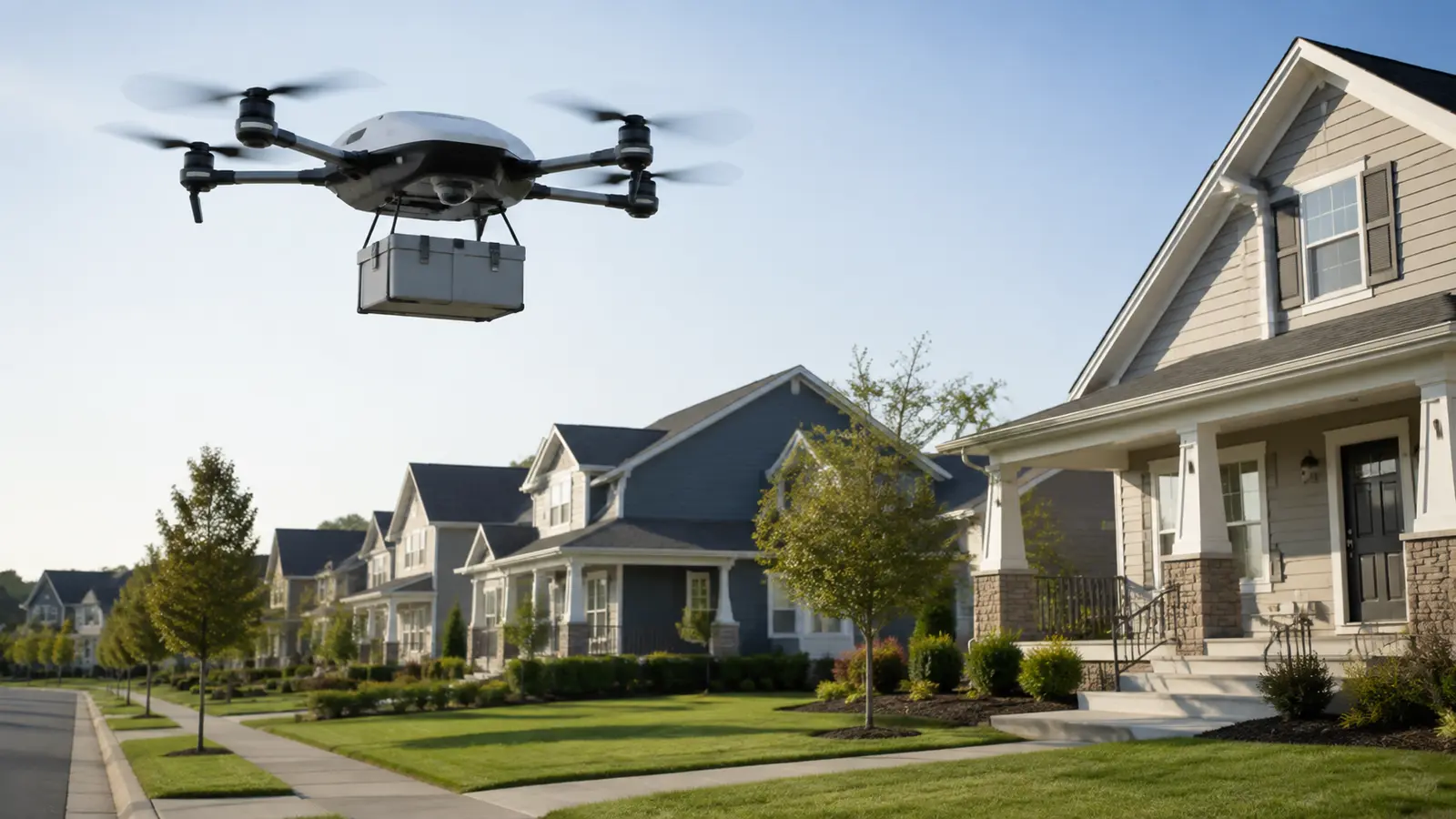
DoorDash is no longer limiting its role in drone delivery to connecting customers with third-party aircraft operators.
On July 29, the company announced that it had earned Federal Aviation Administration authorization to operate as an air carrier under Part 135 and was launching DoorDash Air, an in-house drone delivery program developed by DoorDash Labs.
DoorDash describes itself as the eighth U.S. drone operator to obtain this certification, joining a short list that includes Wing, UPS Flight Forward, Amazon Prime Air, Zipline, Causey Aviation Unmanned, DroneUp, and Drone Express.
The certification does more than add another delivery option to the DoorDash app. It allows DoorDash to begin operating its own aircraft and building a vertically integrated delivery system encompassing the drone, ground infrastructure, merchant handoffs, dispatching, maintenance, and safety operations.
Commercial DoorDash Air deliveries are expected to begin in fall 2026, according to a company spokesperson quoted by Business Insider. The company has not yet disclosed the initial market, aircraft specifications, payload capacity, or exact service radius.
From marketplace operator to air carrier
DoorDash already has extensive experience offering drone delivery through partnerships with operators such as Wing and Flytrex. The company says those partnerships have produced tens of thousands of drone deliveries.
DoorDash Air adds a first-party operator to that network rather than replacing its partners. DoorDash says it intends to continue working with outside drone companies while using its own aircraft to address delivery scenarios that are not well served by existing options.
That distinction is important. DoorDash is not simply buying aircraft and assigning them orders. It is developing the operational infrastructure required to function as an FAA-certificated air carrier.
Part 135 is the only current regulatory pathway through which small drones can carry another party’s property for compensation beyond the pilot’s visual line of sight. The FAA certification process includes five phases and evaluates an operator’s aircraft, maintenance program, operating procedures, safety systems, facilities, and personnel.
Certification alone does not grant unrestricted permission to fly anywhere. DoorDash will still need the applicable exemptions, aircraft approvals, operating-area authorizations, risk assessments, environmental reviews, and other permissions required for its specific aircraft and routes.
DoorDash Labs is building more than a drone
DoorDash Air is being developed by DoorDash Labs, the company’s robotics and autonomy division. It is the same organization responsible for Dot, DoorDash’s sidewalk delivery robot.
The company says its aircraft is designed and built in the United States, with most of its components made domestically. DoorDash has not yet released detailed images or technical specifications, but it describes the aircraft as purpose-built for gaps in local commerce that are not fully covered by its partners’ short- and long-range systems.
The visible aircraft may ultimately be the least complicated part of the operation.
“We want drone delivery to work for any merchant, anywhere. We’re building the full stack to make that possible from the ground infrastructure to the drone itself, and the handoff systems that make it work together seamlessly.”
Harrison Shih, head of DoorDash Air
DoorDash is developing systems for real-time inventory reconciliation and merchant handoffs at locations such as drive-through lanes, rooftops, and rear entrances. These systems must move an order from a restaurant or store into an aircraft without interfering with existing staff workflows.
That is one of the central challenges facing drone delivery. Flying a package autonomously is only useful if merchants can load it efficiently and customers have an eligible delivery area where it can be received safely.
Targeting the three-to-five-mile delivery gap
DoorDash says it has processed more than 10 billion lifetime orders, giving the company a considerable amount of data about where delays occur.
According to its 2025 data, more than 20% of DoorDash orders traveled between three and five miles. Those orders took nearly 25% longer than shorter deliveries, largely because matching them with an appropriate Dasher took longer.
Mid-range deliveries can pull drivers away from areas with dense concentrations of restaurants and stores. They also require more travel before the driver can accept another order.
DoorDash sees drones as a potential answer to this particular problem. An aircraft can travel directly between two points without following the road network or waiting in traffic. Moving eligible mid-range orders to drones could also allow human Dashers to concentrate on shorter deliveries and orders that require direct customer interaction.
The company reports that its drone deliveries through partner programs averaged approximately 25 minutes during 2025. DoorDash also says some locations participating in those partner pilots experienced roughly 30% growth in DoorDash order volume, with that increase continuing during the nine weeks after launch.
Those figures are promising, but they should be interpreted carefully. They are internal DoorDash estimates from selected partner locations—not results from the still-unlaunched DoorDash Air service. The performance of the first DoorDash-operated markets will provide a clearer measure of whether those gains can be repeated at scale.
One platform, multiple delivery modes
DoorDash Air will operate within the company’s broader Autonomous Delivery Platform. This system is intended to select an appropriate delivery method based on considerations such as speed, cost, destination, and customer experience.
The available modes include:
- Human Dashers, who will continue handling the vast majority of deliveries, including large orders, apartment buildings, and situations requiring direct handoff.
- Dot robots, which are intended for shorter ground deliveries where sidewalk access makes robotic transport practical.
- DoorDash Air drones, designed in-house for selected aerial delivery missions.
- Partner-operated drones and autonomous vehicles, including services supplied through companies such as Wing and Flytrex.
This hybrid approach is more practical than attempting to force every order onto a single type of vehicle. A drone may be ideal for a small three-mile restaurant order going to a suburban home, but unsuitable for a large grocery order, an apartment without an approved delivery area, or operations during unsafe weather.
DoorDash’s advantage may therefore come less from any individual aircraft than from its ability to assign millions of orders across a network of humans, robots, and aircraft.
What happens next
The FAA certificate gives DoorDash the regulatory foundation to operate its own commercial drone delivery service. The next test will be translating that authorization into routine operations.
Before DoorDash Air can expand broadly, the company must demonstrate reliable aircraft performance, establish local operating areas, coordinate with regulators and communities, develop merchant infrastructure, and show that the economics work beyond selected pilot locations.
It will also need to address the familiar constraints facing drone delivery: payload limitations, weather, noise, suitable drop locations, airspace restrictions, customer acceptance, and the cost of maintaining distributed launch infrastructure.
DoorDash has not abandoned human couriers or its existing drone partners. Instead, it is positioning DoorDash Air as another layer within a larger delivery network.
That may be the program’s most consequential feature. DoorDash is not betting that drones will replace doorstep delivery as we know it. It is betting that software can decide when a person, ground robot, partner aircraft, or DoorDash-operated drone is the best tool for each individual order.