
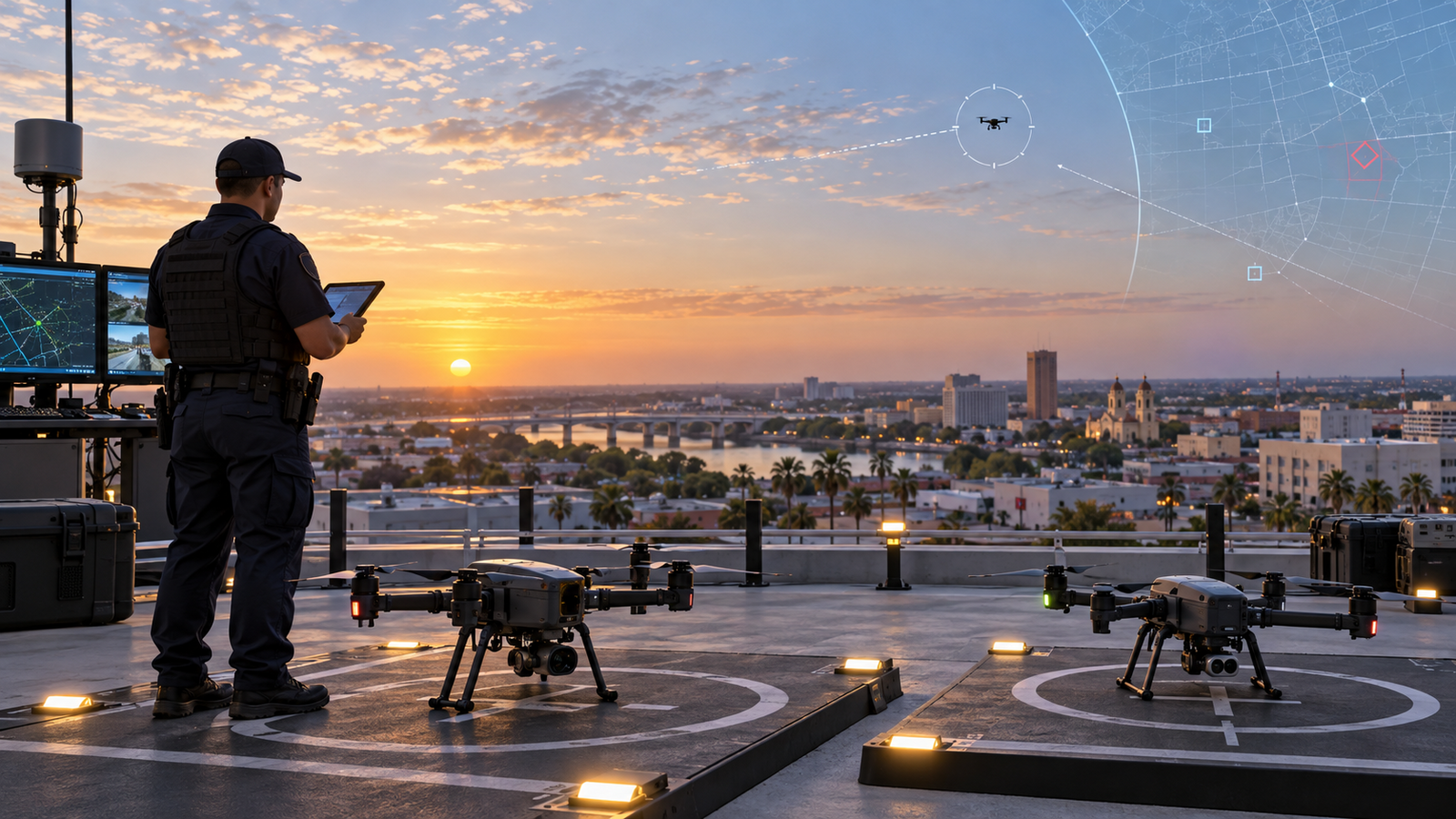
The takeaway: The Laredo, Texas, City Council voted Oct. 5 to ratify submission of an estimated $11.1 million Department of Justice grant application that could help double the police department’s drone fleet from eight aircraft to sixteen and add counter-UAS technology. The decision is meaningful for public-safety drone programs, but it is not a funding award or purchase order. The application covers a much broader mix of personnel, behavioral-health services, equipment and technology, and DOJ expects to select only two to four cities nationwide.
What Laredo approved
The official city record for Resolution 2026-R-216 authorizes the city manager to ratify Laredo’s application to the Justice Department’s FY2026 Model Cities Initiative. The estimated request is $11.1 million over 36 months, with no required local match. The city says there is no financial impact unless an award is made.
The Laredo Morning Times reported on October 10 that Police Chief Miguel Rodriguez told the council the proposed spending would primarily support expanded drone operations, including additional aircraft, counter-drone technology, drone operators and investigative support specialists. He said the department currently has eight drones and wants to grow the fleet to sixteen.
The same reporting says the application also includes mental-health personnel and services for crime victims. Neither the city’s public resolution nor the local account provides a drone-specific budget, vendor list, aircraft models, counter-UAS architecture or procurement schedule. The entire $11.1 million therefore should not be described as drone funding.
An application is several steps short of deployment
The Justice Department’s application document describes approximately $300 million in total funding, only two to four anticipated awards and a 36-month award period. Finalists must present their plans to DOJ leadership. Selected recipients then face review of a detailed implementation plan and final budget, with funds released as milestones are completed.
That process leaves several gates between council approval and an operational fleet. Laredo must first be selected, then agree on a final budget and conditions, return to the council for detailed spending approval and complete the normal procurement and implementation work. Rodriguez said an award decision is expected in December and that the city could still decline the grant if it finds the final requirements unacceptable.
For UAV readers, the distinction prevents a common procurement error: proposed capacity is not deployed capacity. No additional aircraft has been purchased through this application, no counter-drone system has been selected and no new flight authority has been granted.
What doubling a police-drone fleet actually requires
Expanding from eight to sixteen aircraft is more than a hardware purchase. A sustainable program needs trained remote pilots, recurrent proficiency, maintenance and battery controls, secure evidence handling, clear dispatch criteria, privacy rules, incident reporting and adequate supervision. Aircraft availability also depends on whether the department is buying identical replacements, specialty indoor drones, thermal platforms or dock-based systems.
The added operator positions may be as consequential as the aircraft. Public-safety drone programs can struggle when trained pilots perform UAS duties only as an additional assignment. Dedicated staffing can improve readiness, but it also raises questions about shifts, workload, certification, visual-observer requirements and whether the program is intended for scheduled missions or continuous Drone as First Responder coverage.
Our review of Skydio’s public-safety drone lineup explains why agencies should evaluate the complete system rather than an airframe alone. Software licensing, connectivity, docks, spares, training, warranties, data retention and integration with computer-aided dispatch can materially change the cost and operating model.
Counter-UAS funding needs an even clearer scope
“Counter-drone technology” can mean detection, classification, tracking, pilot-location tools, command software or an actual mitigation capability. Those functions are not interchangeable. Detection equipment may improve situational awareness without giving a local department legal authority to jam, seize or destroy an aircraft.
The public record reviewed for this article does not identify the proposed counter-UAS equipment or how it would be used. Until the city releases a detailed plan, it would be premature to infer radio-frequency jamming, interceptor drones, kinetic defeat or any other mitigation method. A defensible procurement should specify the threat, required coverage, expected false-alarm performance, data retention, interoperability and the legal authority available to the operator.
Federal oversight and local concerns
DOJ describes Model Cities as a cooperative agreement rather than a simple block grant. Its application states that the department expects substantial involvement in project development and implementation. It also requires local-government certifications and multi-agency partnerships.
That structure drew opposition during Laredo’s council debate. Residents and attorneys raised concerns about federal influence and immigration-related conditions. Rodriguez said the application does not fund automated license-plate readers, does not include a 287(g) agreement and is not intended for civil immigration enforcement. Those assurances address what Laredo says it proposed; they do not eliminate the need to review final award conditions before acceptance.
What to watch next
The next material development will be DOJ’s selection decision, expected in December according to the police chief. If Laredo advances, the useful documents will be the final award, approved budget, implementation plan and procurement records. Those should reveal how much funding is actually allocated to aircraft, staffing, counter-UAS tools and supporting infrastructure.
For now, Laredo’s vote shows that municipal drone programs are moving beyond small equipment line items toward larger, integrated public-safety proposals. The plan could substantially expand the department’s UAS capacity, but the verified status remains narrow: the city has approved an application, not received $11.1 million or ordered eight more drones.
Sources and disclosure
- City of Laredo Resolution 2026-R-216
- Laredo Morning Times: council approval and police-chief statements
- Department of Justice FY2026 Model Cities Initiative application
- Department of Justice program announcement
Featured image: AI-generated conceptual editorial illustration for All About UAVs. It does not depict Laredo equipment, an awarded grant or a completed deployment. No affiliate links, sponsorship or paid placement are included.
Leave a Reply