
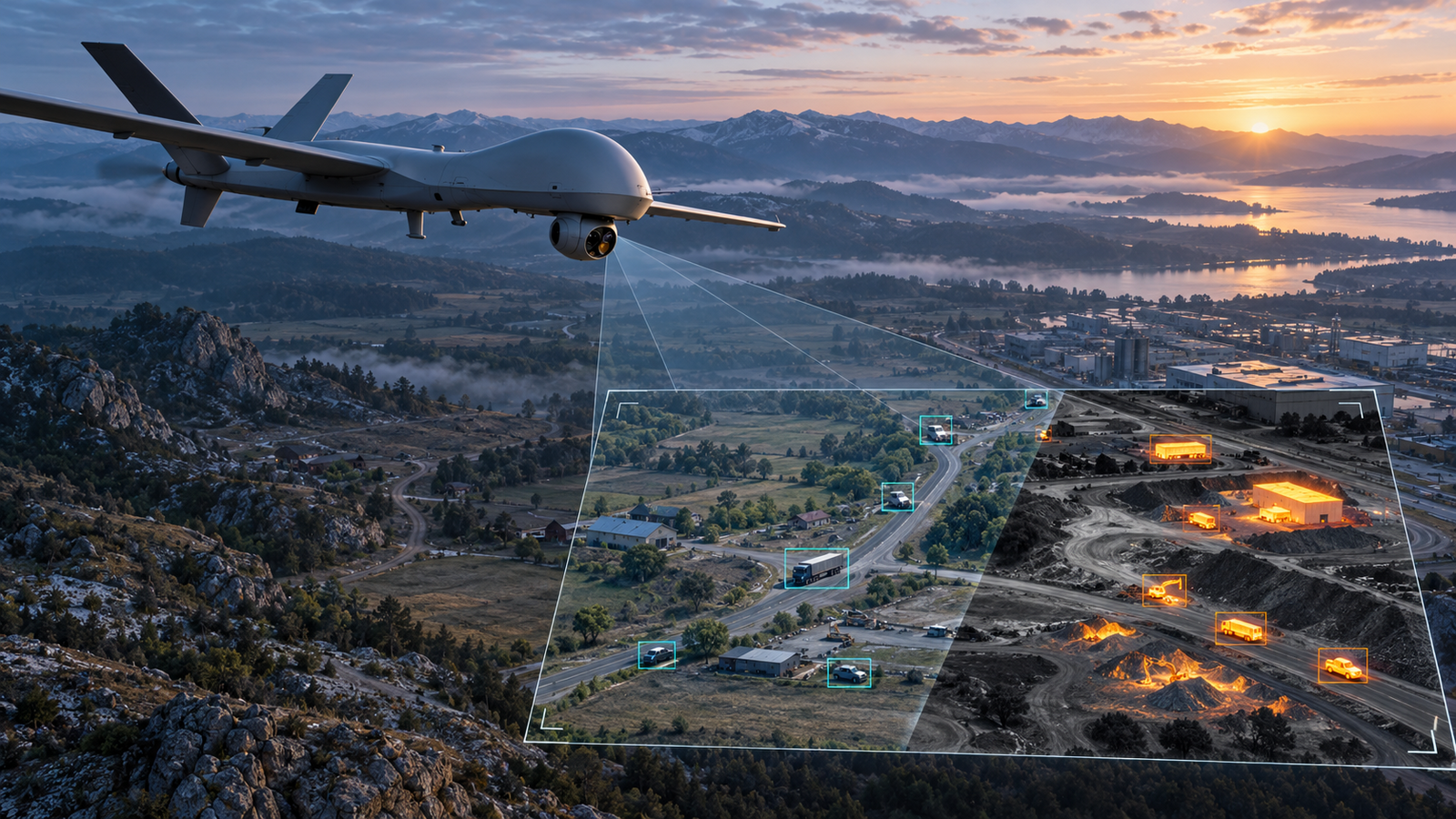
The takeaway: Teledyne FLIR OEM launched Prism A-ISR on October 6, adding onboard air-to-ground detection, classification and tracking software for drones and other aerial platforms. The product is notable for processing visible, midwave-infrared and longwave-infrared imagery on embedded NVIDIA and Qualcomm hardware. However, the public material contains manufacturer specifications—not independent flight-test results—and does not disclose detection range, tested accuracy, false-alarm rates or operational customers.
Prism A-ISR moves multispectral analysis onboard
Teledyne FLIR announced Prism A-ISR on October 6 as an embedded software module for uncrewed aircraft systems and other airborne intelligence, surveillance and reconnaissance platforms. The company says the software can detect, classify and track multiple ground objects in real time using visible electro-optical, midwave-infrared (MWIR) and longwave-infrared (LWIR) sensor data.
The practical design choice is edge processing. Instead of sending every frame to a remote server for analysis, the aircraft’s embedded computer can process sensor data close to where it is collected. That can reduce dependence on a high-bandwidth link and shorten the time between observation and a software-generated track. It does not eliminate the need for command-and-control connectivity, human oversight, secure data handling or a well-integrated flight system.
According to the Prism A-ISR product page, the software is designed for NVIDIA Orin NX/AGX and Qualcomm 8550 platforms. It accepts 14-bit infrared data, supports Teledyne FLIR Boson+ and Neutrino camera families as well as selected third-party infrared and visible cameras, and can provide bounding boxes, class labels, confidence values, timestamps and track IDs. Teledyne FLIR lists people, vehicles and boats among the default object classes.
What the specifications do—and do not—show
The manufacturer publishes several useful integration figures. It lists approximately 10 milliseconds of inference time, a default of 16 simultaneously tracked targets, visible-video processing up to 4 megapixels at frame rate, and average power below 12 watts with a maximum below 15 watts. Those numbers describe a supported configuration or software requirement; they should not be read as guaranteed aircraft-level performance across every camera, processor, lens and mission profile.
Detection performance depends on more than inference time. Target size in pixels, lens focal length, altitude, viewing angle, motion, atmosphere, scene clutter, thermal contrast and processor loading all affect whether an object is found and whether a track remains stable. The product page says classification above 60 percent confidence requires at least a 10-by-10-pixel target, while thresholds are configurable. A configurable confidence score is not the same thing as a measured probability of correct identification.
Teledyne FLIR also says denoising, super-resolution, electronic stabilization and dehazing can improve image quality, extend detection range and reduce false alarms. These are company claims. The materials reviewed do not provide receiver-operating-characteristic curves, precision and recall results, false alarms per hour, track-loss rates, environmental test conditions or comparisons against another system. No independent evaluator or flight-test report was identified.
Why multispectral support matters
Visible and thermal sensors provide different information. Visible imagery can preserve color and familiar scene detail in good lighting. LWIR can reveal temperature differences without visible illumination, while cooled MWIR systems can support longer-range or higher-performance sensing in some configurations. Combining those streams can give developers more options across day, night, haze and complex backgrounds, but “multispectral” does not automatically mean the software fuses every sensor into one authoritative identification.
The architecture also matters for integration. Prism A-ISR is software, not a complete drone, camera payload or approved operational system. Developers still need compatible sensors, compute hardware, power and thermal management, stabilized pointing, time synchronization, interfaces to the autopilot or mission computer, cybersecurity controls and validation for the intended use. All About UAVs’ review of Skydio’s R10 and F10 sensor package similarly explains why payload specifications must be evaluated as part of an entire aircraft and workflow.
Custom models add flexibility—and validation work
Teledyne FLIR says developers can use its AIMMGen synthetic-data service to create models for additional object classes. Synthetic imagery can help cover rare targets, viewpoints or environmental conditions that are difficult to collect, and it can shorten the early development cycle. It also creates a validation obligation: teams must confirm that a model trained with simulated data performs acceptably on representative real sensor imagery and does not inherit unrealistic assumptions from the generated scenes.
For public-safety, inspection or defense users, the resulting detections should be treated as decision support unless the complete system has been validated for a more demanding role. A bounding box can direct an operator’s attention, but it does not establish identity, intent or legal authority to act. Human review, documented thresholds and a process for handling ambiguous or conflicting outputs remain essential.
What to watch next
DRONELIFE reported that Teledyne FLIR plans to demonstrate Prism A-ISR at the Association of the United States Army annual meeting in Washington, D.C., October 12–14. A trade-show demonstration may clarify the user interface and integration path, but it will not by itself establish performance in operational flight conditions.
The most useful next disclosures would be independent airborne test data, sensor and processor configurations, detection distance by target type, accuracy and false-alarm measurements, track persistence during occlusion, power and thermal performance, aircraft integrations and named operational evaluations. Until then, Prism A-ISR is best understood as a newly available embedded perception toolkit with detailed integration specifications and plausible bandwidth advantages, not as proof of autonomous mission performance.
Sources and disclosure
- Teledyne FLIR OEM: Prism A-ISR launch announcement (Oct. 6, 2026)
- Teledyne FLIR OEM: Prism A-ISR product page and specifications
- DRONELIFE: Prism A-ISR launch coverage (Oct. 6, 2026)
Featured image: AI-generated editorial illustration by OpenAI for All About UAVs. It is a conceptual scene, not a photograph of Prism A-ISR in operation, and does not depict verified performance. No affiliate links, sponsorship or paid placement are included.
Leave a Reply