The takeaway: ARK Electronics has launched the Jetson PAB V3 Modalix Bundle, a compact drone edge AI package pairing its ARKV6X flight controller with a SiMa.ai Modalix machine-learning module, according to a product listing and trade-press report published September 23, 2026. The package could simplify prototype work for teams building onboard vision, navigation or autonomy features, but the headline compute figure is not a measure of real-world mission performance. Buyers still need to solve power, cooling, wiring, sensor, software and validation work before the hardware becomes an operational system.
What ARK launched
The newly listed ARK Jetson PAB V3 Modalix Bundle combines four main components: ARK’s Jetson PAB V3 carrier, an ARKV6X flight controller, a SiMa.ai Modalix system-on-module, and a heatsink with a fan. The company’s product page currently lists the bundle from $1,897.20 to $2,764.20, depending on options.
ARK says the Modalix module can deliver 50 trillion operations per second, or 50 TOPS, while consuming less than 10 watts. The assembled package measures 132.3 by 61.2 by 38.7 millimeters and weighs 196.5 grams without the optional solid-state drive. Built-in eMMC storage is included, and a 480 GB M.2 NVMe SSD is offered as an option. Unmanned Systems Technology reported the release on September 23.
Those specifications place the product between a bare autopilot and a finished autonomy system. The ARKV6X handles conventional flight-control duties, while the companion processor is intended to run higher-level workloads such as computer vision or machine-learning inference. Keeping those functions on separate processors can protect core stabilization and navigation tasks from demanding AI workloads, although the safety of any implementation depends on the complete architecture and its testing.
Why low-power drone edge AI matters
Processing sensor data onboard can reduce dependence on a high-bandwidth connection to the ground. In a well-designed UAV, edge computing may support object detection, visual navigation, inspection triage or local filtering of large image streams. Lower power consumption is especially valuable on small aircraft because every watt affects heat management and potentially endurance.
However, ARK’s “under 10 watts” figure applies to the Modalix module, not necessarily to the complete avionics package, its cameras, storage, radios or the aircraft. Likewise, 50 TOPS is a vendor-stated peak compute figure. It does not disclose inference latency, model accuracy, memory bottlenecks, sustained thermal performance or the energy used per completed task. Operators should benchmark their own models with the sensors, software stack and environmental conditions they plan to fly.
This distinction matters because two processors with similar theoretical ratings can produce different results when running the same model. Model optimization, precision, memory bandwidth and software support often matter as much as the headline number. The product announcement does not provide independent flight-test data, application benchmarks or a published comparison based on a common workload.
Integration details may determine the real cost
The primary product page identifies several practical limitations. UART2 is available as a console, but UART1 between the Modalix module and flight controller is listed as nonfunctional. USB and Ethernet communication are supported. The Modalix side does not provide CAN, although the flight controller’s existing CAN connections remain available. PCIe availability also depends on the selected video configuration.
The flight controller connects through two 40-pin Molex Pico-Clasp connectors. ARK says users will need a custom harness or breakout boards, and no JST-GH harness is included. A suitable 5-volt power module is also required. These are not unusual conditions for development hardware, but they mean the package is not a drop-in replacement for a complete aircraft avionics system.
Engineering teams should budget for wiring design, electromagnetic compatibility checks, camera drivers, time synchronization, thermal testing, vibration testing and fault handling. They also need to decide what happens if the companion computer stalls, overheats or produces an incorrect inference. A flight controller can remain stable while a higher-level autonomy function fails, but only if command authority, timeouts and fallback behavior are designed correctly.
Where the bundle may fit
The most plausible early users are UAV developers and systems integrators that want a compact platform for onboard perception without assembling every board separately. Potential applications include infrastructure inspection, mapping, research aircraft and experimental navigation systems. Production operators should treat those as use cases to validate, not capabilities conferred by purchasing the hardware.
That modular approach resembles the broader design logic behind aircraft such as the Inspired Flight IF800 Tomcat: payload flexibility can shorten development work, but integration responsibility stays with the operator or integrator. Neither modular hardware nor an AI accelerator creates regulatory approval, beyond-visual-line-of-sight authority or a safety case by itself.
What to watch next
The useful next evidence would be application-level benchmarks and flight-test results. Buyers should look for sustained power and temperature measurements, supported camera and model pipelines, end-to-end inference latency, documented failure modes and examples of the autopilot safely rejecting stale or invalid companion-computer commands.
ARK describes the ARKV6X as based on open Pixhawk standards and compatible with PX4 by default, with ArduPilot available to flash. Those claims help define the intended development ecosystem, but software compatibility still needs to be confirmed for the exact firmware, middleware and peripherals in each aircraft.
For UAV readers, the release is best understood as a potentially useful integration shortcut—not a finished autonomous-drone product. Its value will depend less on the TOPS number than on whether developers can turn the hardware into a reliable, thermally stable and testable flight system.
Sources
- ARK Electronics: ARK Jetson PAB V3 Modalix Bundle product page
- Unmanned Systems Technology: “ARK Electronics Introduces Modalix-Based Jetson PAB V3 Bundle” (Sept. 23, 2026)
- ARK Electronics: ARKV6X flight controller product page
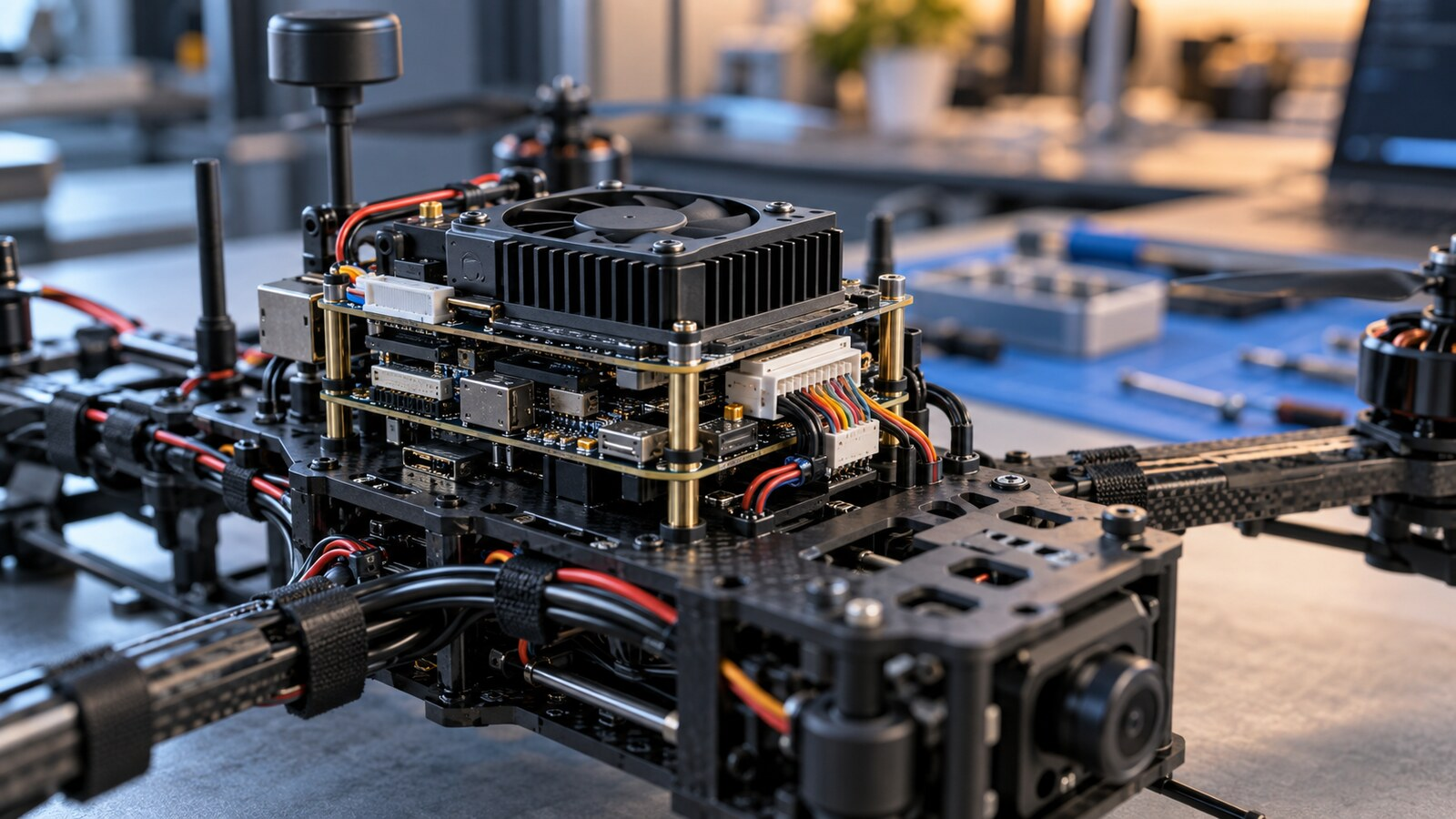
Disclosure: This article contains no affiliate links and is not sponsored. The featured image is an original AI-generated editorial illustration and does not depict the specific ARK product.