
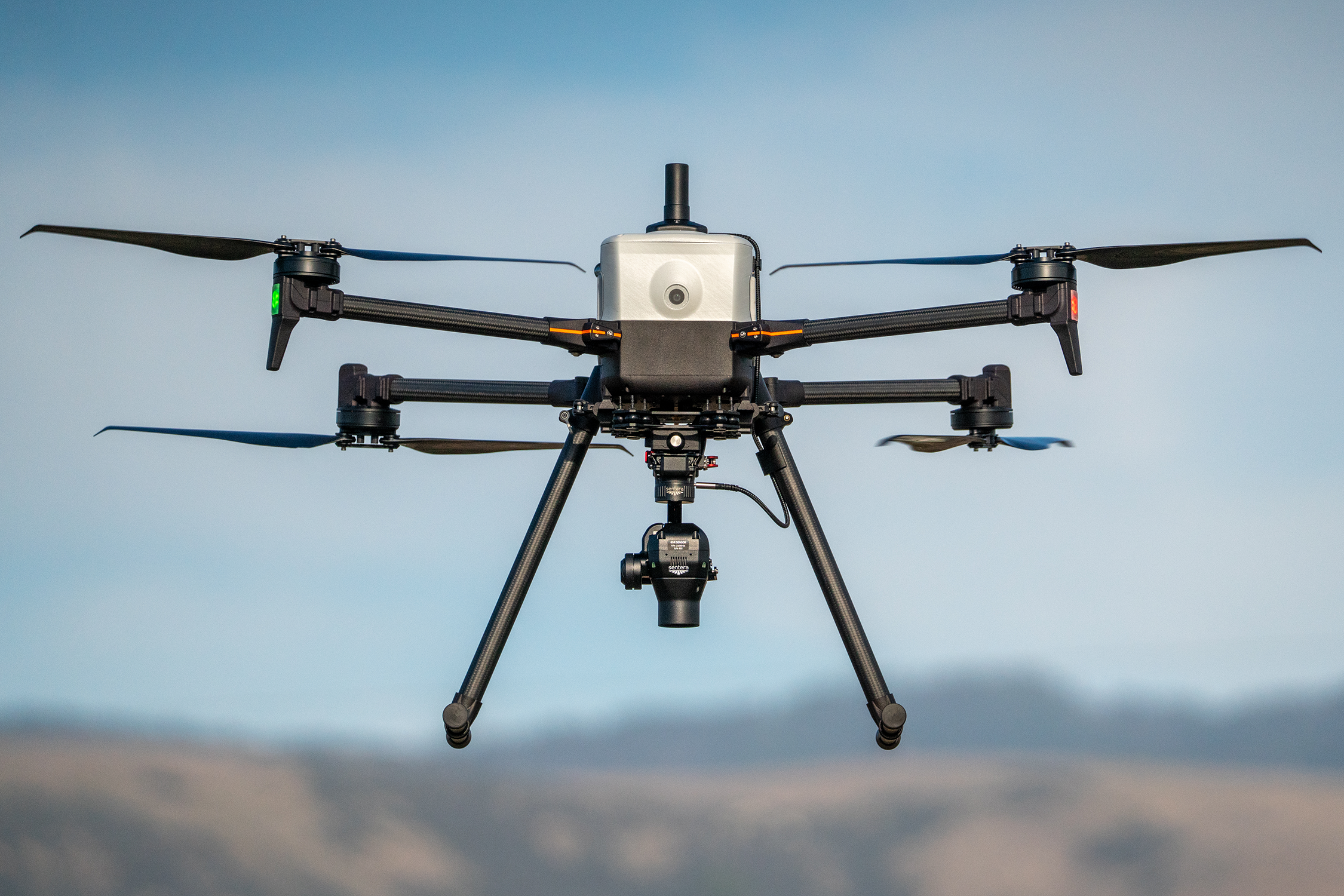
Bottom line: The Inspired Flight IF800 Tomcat is a serious medium-lift platform for U.S. organizations that need to carry mapping cameras, thermal sensors, LiDAR, or custom payloads without depending on a closed payload ecosystem. Its strongest case is mission flexibility and domestic procurement compatibility—not bargain pricing. Buyers should request a mission-specific quote and evaluate the complete system, because payloads, batteries, charging, training, software, and support can matter more than the airframe alone.

What the IF800 Tomcat is designed to solve
Many enterprise drone programs eventually outgrow fixed-camera aircraft. A survey team may need a high-resolution RGB camera one day and LiDAR the next; a utility may alternate between thermal inspection, zoom imaging, and specialized hardware. The IF800 Tomcat is Inspired Flight Technologies’ folding, American-made quadcopter for those programs.
The platform uses an adjustable payload rail and tool-free mounting system rather than locking the operator to one camera. Inspired Flight lists optical, EO/IR, multispectral, LiDAR, and specialized sensor integrations. That makes the IF800 less like a camera drone and more like a field vehicle whose value depends on the payload and workflow attached to it.
Verified specifications that matter
According to the current Inspired Flight product page, the IF800 has a 6.6-pound maximum payload capacity, a maximum gross takeoff weight of 25.3 pounds, and a weight of 18.7 pounds with batteries. Its folded dimensions are roughly 14.2 by 17.4 by 7.8 inches, although the full transport case with aircraft and controller is listed at about 40 pounds.
- Maximum flight time: up to 54 minutes, a manufacturer maximum that should not be treated as loaded mission endurance.
- Maximum airspeed: 49 mph.
- Wind rating: 10 m/s sustained, with 12 m/s gusts—about 19 knots sustained and 23-knot gusts.
- Service ceiling: 14,000 feet with no payload, decreasing to 6,500 feet with the full 6.6-pound payload.
- Flight stack: CubePilot Cube Blue H7 with triple-redundant IMUs, dual Here4 GNSS/compass modules, and ArduPilot Copter software.
The source report incorrectly described the aircraft as a PX4 platform. Inspired Flight’s product page and documentation identify ArduPilot. The report also overstated the continuous wind capability and listed the battery-equipped weight too high. Those differences are operationally important when planning reserves, payloads, and weather limits.
Payload flexibility is the real selling point
The IF800 supports professional payloads such as the 61-megapixel Sony ILX-LR1, Sentera agricultural sensors, Gremsy visual/thermal gimbals, and several LiDAR systems. Inspired Flight’s mounting system includes positive locks and center-of-gravity adjustment, while payload connections support power and data integration.
This is useful for survey firms, utilities, research organizations, and public agencies that want one fleet platform to serve several contracts. The practical advantage is not simply swapping a camera quickly. It is reducing the number of aircraft types that must be maintained, trained, documented, and supported.
That flexibility also creates integration responsibility. A payload that fits mechanically is not automatically mission-ready. Buyers should verify the exact mount, power budget, data interface, flight-time expectation, vibration isolation, metadata workflow, software compatibility, and support responsibility for every proposed sensor.
Battery and field-operation tradeoffs
The aircraft uses two IB388 smart batteries. Dealers describe them as hot-swappable, allowing a ground crew to replace packs without shutting down the system between missions. That can reduce restart time, but it does not mean batteries can be changed while the aircraft is airborne.
Temperature deserves careful attention. The marketing specification lists an aircraft operating range down to -20°C, but the current Inspired Flight manual warns that the safe operating ambient range for the IF800 and IB388 battery is -10°C to 45°C. Operators should follow the more conservative documented battery limit unless Inspired Flight provides configuration-specific guidance.
Each battery is a substantial asset, and two are required per flight. A commercial package should therefore include enough paired packs for the intended sortie rate, the correct charger, safe transport and storage equipment, a cycle-tracking process, and a replacement budget. A dealer specification places expected battery life at roughly 150 to 300 cycles, making battery management part of total ownership cost.
Security and procurement: useful, but not absolute
Inspired Flight markets the IF800 as NDAA-compliant, made in the United States, and Blue UAS cleared. Those credentials can simplify purchasing for federal, defense, and other security-conscious organizations. The official Blue UAS program is now transitioning its cleared-list administration from the Defense Innovation Unit to the Defense Contract Management Agency, so procurement teams should verify the aircraft and exact configuration against the current authoritative list at purchase time.
Blue UAS status does not create “zero risk” of unauthorized data transmission, as the source report claimed. Security still depends on controller configuration, radios, payloads, mobile devices, cloud services, user accounts, firmware, and operating procedures. Buyers should perform their own cybersecurity and supply-chain review.
Price, alternatives, and total ownership cost
Public online pricing is restricted and the IF800 is generally sold by quote. One dealer page references a $29,500 base figure but requires prospective buyers to request current configuration pricing. Treat that number as a lead, not a complete acquisition price. A useful quote should separate the aircraft, controller, charger, battery pairs, payload, integration kit, software, training, support plan, spares, case, and warranty.
The closest comparison depends on the mission. The Freefly Astro family is a strong U.S.-built alternative for modular mapping payloads. Skydio X10 emphasizes autonomy and integrated inspection sensing rather than heavy third-party payload flexibility. DJI’s Matrice 350 RTK offers a mature payload ecosystem and broad commercial adoption, but procurement restrictions can remove it from consideration for some government and regulated buyers. See our broader guide to NDAA-compliant drone alternatives.
Regulatory considerations
At 25.3 pounds maximum takeoff weight, the IF800 remains within the FAA’s small-UAS weight range, but ordinary commercial missions still operate under Part 107 unless another authority applies. The platform’s redundancy and communications may support a strong operational case, but they do not automatically authorize beyond-visual-line-of-sight flight. BVLOS operations outside current rule allowances require appropriate FAA approval. Teams should also assess operations over people, night operations, Remote ID, controlled airspace, and any payload-specific hazards.
Who it is for—and who should skip it
Consider the IF800 if your organization needs interchangeable high-value sensors, prefers an American-made platform, faces NDAA or Blue UAS procurement requirements, and can support enterprise training and maintenance. Surveying, infrastructure inspection, research, precision agriculture, and public-sector programs are the clearest fits.
Skip it if one integrated camera already covers the mission, autonomous close-quarters obstacle avoidance is the top priority, or the budget cannot support payload integration and lifecycle costs. Smaller operators should secure recurring work before buying a configurable platform of this class.
Recommendation: Shortlist the IF800 for modular, procurement-sensitive enterprise programs, then demand a payload-specific demonstration and written configuration quote. Buy the complete mission system—not the 54-minute headline.
Disclosure: This article contains no affiliate links. All About UAVs did not receive or test the aircraft. Photographs in this article were provided by Inspired Flight Technologies and are used with permission. Inspired Flight did not sponsor, review, or control the article’s independent editorial conclusions.