
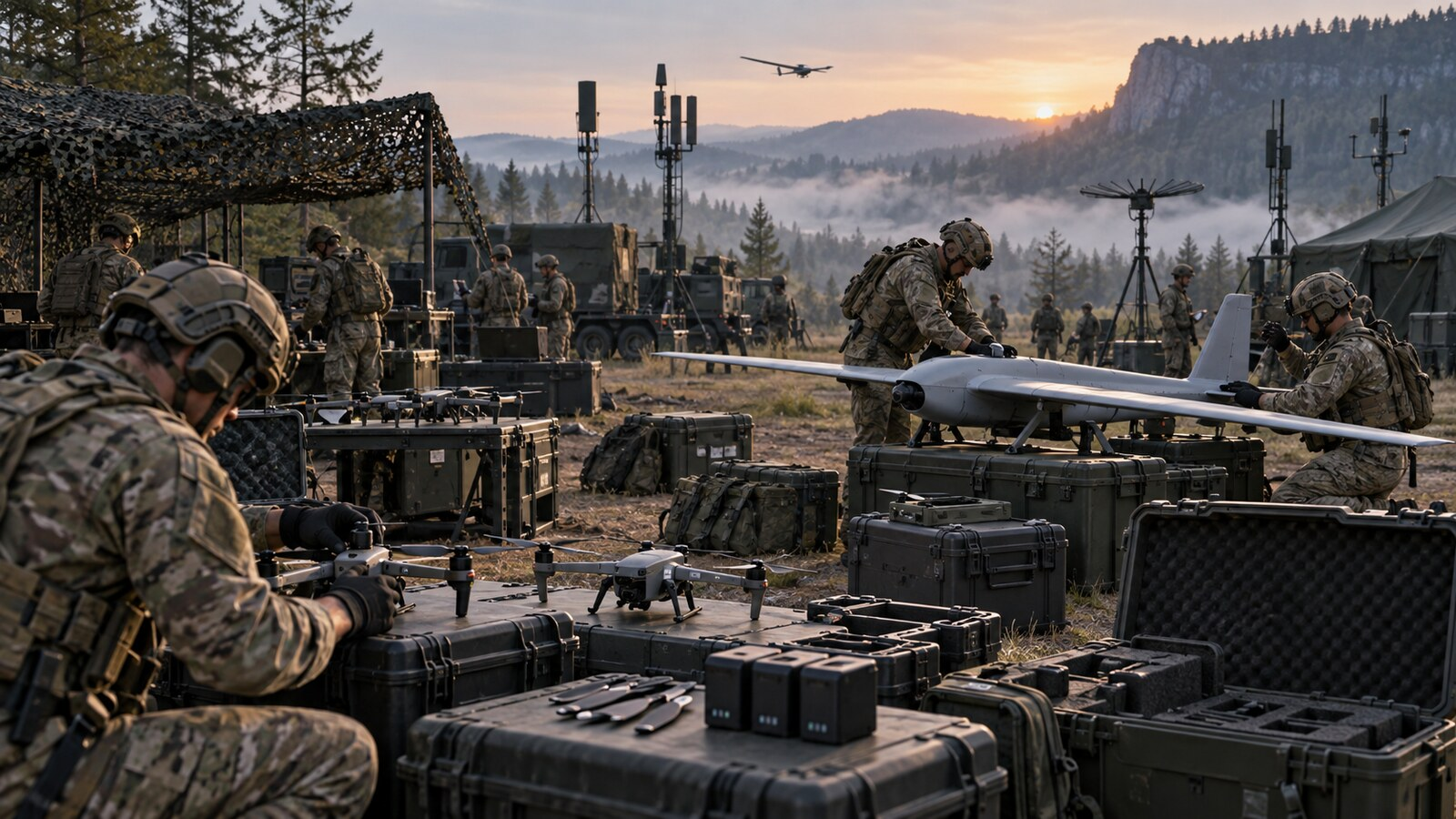
Army officials say Saber Junction 26 employed about 1,900 autonomous systems, including 1,000 described as consumable. The most important takeaway is not that every system was an aircraft—the public breakdown does not support that conclusion—but that drones were trained as a high-volume, replaceable capability rather than a scarce specialty asset. An official Army recap separately confirms 14 UAS platforms used across reconnaissance, situational awareness, targeting and fires.
What the Army disclosed about Saber Junction 26 drones
Business Insider reported on September 20 that U.S. Army units used approximately 1,900 autonomous systems during Saber Junction 26 in Germany. The report was based in part on a media roundtable transcript with senior Army leaders.
Maj. Gen. Christopher Norrie, acting commander of U.S. Army Europe and Africa, gave the 1,900-system figure. Brig. Gen. Terry Tillis, commander of the 7th Army Training Command, said 1,000 were consumable and described their employment as being similar to munitions: systems could be used to create an effect without an expectation that each would return for repeated missions.
The terminology needs care. “Autonomous systems” is broader than “unmanned aircraft,” and the available transcript excerpt does not provide a platform-by-platform count. This article therefore does not describe all 1,900 systems as drones or claim that 1,000 aircraft were actually destroyed. “Consumable” describes how systems were categorized and intended to be used, not a confirmed loss total.
The official exercise record confirms UAS integration at scale
An official Army account published through DVIDS confirms that the 173rd Mobile Brigade Combat Team (Airborne) used 14 different unmanned aircraft system platforms across multiple echelons. The brigade integrated those UAS into reconnaissance, situational awareness, targeting and the employment of fires.
The exercise ran at the Joint Multinational Readiness Center in Hohenfels, Germany, from August 15 through September 13. According to the Army, the brigade completed more than 288 hours of continuous combat operations during ten days and trained through joint forcible entry, defensive and offensive phases alongside German, Polish and Kosovo formations.
Those details matter because they show more than a technology demonstration. The aircraft were incorporated into a sustained brigade-level training environment with command-and-control, maneuver, fires, protection, logistics and an active opposing force. The official report does not identify every UAS model, sortie count, loss rate or mission-success rate, so it cannot support a platform performance ranking.
Why consumable drones change operations and procurement
Treating some small systems as consumable changes the planning problem. A unit cannot rely only on a few expensive aircraft maintained like traditional aviation assets. It needs recurring inventory, trained operators, charged batteries, replacement parts, secure software loads, spectrum planning and a way to move systems forward fast enough to match operational demand.
It also shifts the useful measure from the price of one airframe to the cost of producing a repeatable effect. A low-cost drone may still be operationally expensive if it requires excessive setup, fails in electronic warfare, cannot share data, or consumes scarce batteries and radio channels. Conversely, an aircraft that is not recovered can still be useful if it supplies timely reconnaissance, forces an adversary to reveal a defense, or supports a larger mission.
The exercise provides an operational complement to the Pentagon’s expanding acquisition effort. All About UAVs previously examined the Gauntlet 2 vendor selections and the planned 60,000-aircraft buy. That article focused on procurement intent and unanswered contract details. Saber Junction adds evidence of how units are beginning to train with larger inventories, but it does not prove that the Gauntlet 2 aircraft were used in this exercise or that any named vendor met a particular performance threshold.
The unanswered questions are the useful ones
The headline quantities are significant, but operators and suppliers need a more detailed denominator. The Army has not publicly broken the 1,900 autonomous systems into aerial, ground or other categories. It has not disclosed how many of the 1,000 consumable systems were launched, lost, recovered, jammed, damaged or held in reserve.
- Mission reliability: How many sorties achieved their assigned reconnaissance, targeting or communications task?
- Electronic-warfare resilience: Which failures came from jamming, navigation disruption, radio congestion or operator workload?
- Logistics: How many batteries, replacement airframes and repair parts were needed per day?
- Training burden: How many operators and maintainers were required to keep systems available across continuous operations?
- Interoperability: How consistently did UAS data move into command-and-control and fires workflows across multinational units?
Answers to those questions would help distinguish inventory volume from usable combat capacity. They would also give manufacturers better evidence about which improvements matter most: lower cost, faster setup, stronger links, modular payloads, repairability or easier integration with existing systems.
What UAV readers should watch next
The next meaningful update will be a formal Army lessons-learned release, a platform list, verified sortie and attrition data, or a procurement action tied to exercise results. Until then, the responsible conclusion is narrower: Saber Junction 26 confirms that a brigade trained with 14 UAS platforms, while Army leaders described a much larger pool of autonomous systems and a substantial consumable category.
That is still an important change. Drone scale is becoming a logistics, training and data-integration problem—not merely an aircraft-selection problem. The organizations that solve replenishment and workflow integration will be better positioned than those that focus only on airframe specifications.
Disclosure: This article contains no affiliate links or paid placement. The featured image is an original AI-generated conceptual illustration and does not depict the actual Saber Junction 26 exercise, participants or aircraft.