The takeaway: the Pentagon’s second Drone Dominance “Gauntlet” moved a large group of small-drone vendors closer to production orders after a substantially tougher military evaluation. Reporting indicates the selected pool could receive orders totaling about 60,000 aircraft, but that number should be treated as a planned procurement—not as completed contracts, funded quantities by vendor, or delivered systems.
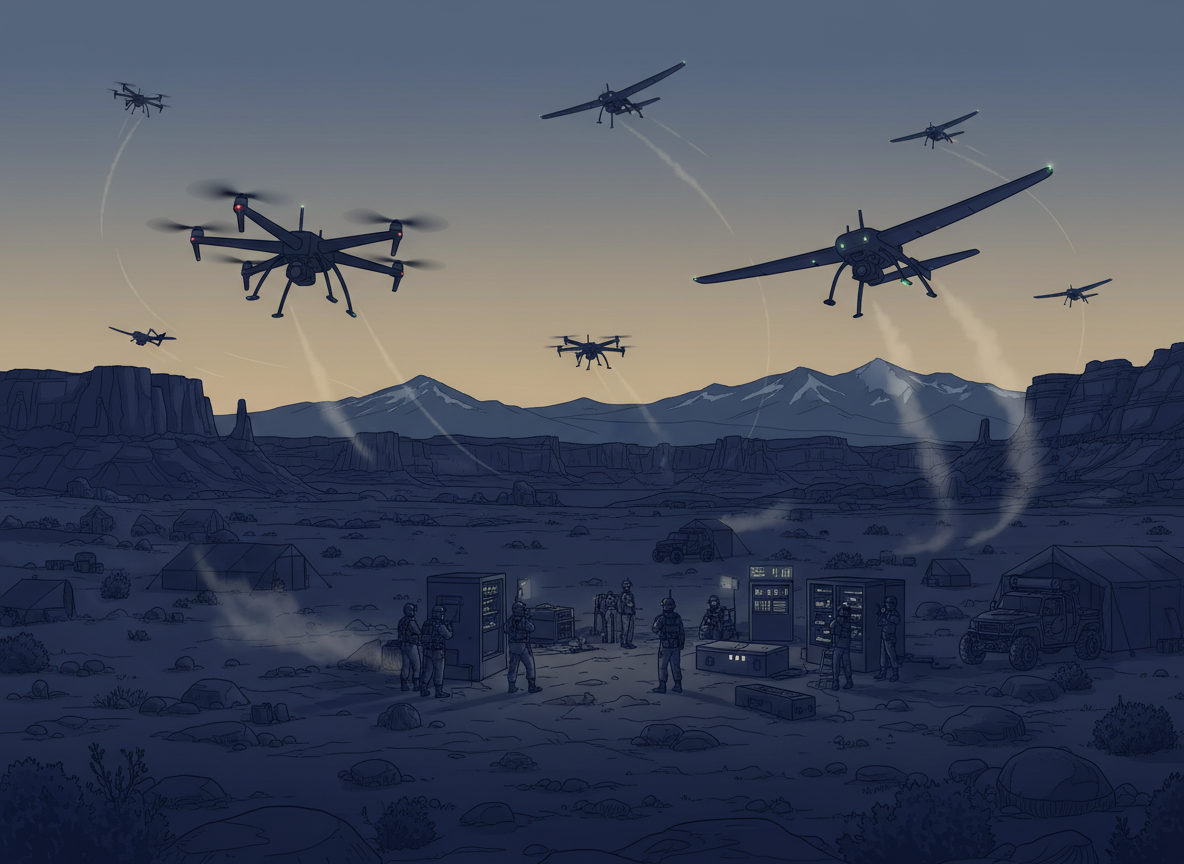
Disclosure: This article is based on current program information and reporting; All About UAVs did not attend the evaluation or test any participating aircraft. The featured image is an original editorial illustration, not a photograph from Gauntlet 2. No affiliate links are included.
What happened in Gauntlet 2
The Defense Department’s Drone Dominance Program recently completed its second competitive evaluation at Fort Carson, Colorado. According to DefenseScoop’s September 18 report, citing Defense Innovation Unit disclosures, military operators flew 1,858 sorties across 23 platforms submitted by 19 companies.
The evaluation covered two mission areas: deep strike and close-quarters battle. Officials said all 11 platforms evaluated at long distance reached 15 kilometers. That is a meaningful improvement from the first Gauntlet, when only 24% of the tested aircraft reportedly reached 10 kilometers. It does not, by itself, establish combat effectiveness, electronic-warfare resilience, reliability at scale, or performance with every payload.
The reported deep-strike leaderboard was led by Perennial Autonomy, followed by Hyperscale, Neros, Skycutter and Swarm Defense Technologies. Neros led the close-quarters group, followed by ORQA US, XTEND Reality, Vector and ModalAI.
What the 60,000-drone figure means—and does not mean
DefenseScoop reports that the department plans to buy about 60,000 drones from the selected vendor pool. The official Drone Dominance program website confirms the larger acquisition framework: an iterative $1 billion effort intended to purchase more than 200,000 small drones by 2027. It also says Gauntlet 1 resulted in orders for 30,000 aircraft.
The official program page does not currently provide a vendor-by-vendor allocation for the reported 60,000-aircraft Gauntlet 2 plan. Public material reviewed for this update also does not disclose final contract values, unit prices, funded quantities, delivery milestones, acceptance criteria, or how orders will be divided between deep-strike and close-quarters systems.
That distinction matters. Selection in an evaluation establishes access to a procurement pathway; it is not the same as receiving the full anticipated order. The program says Naval Surface Warfare Center Crane holds contracting authority and issues prototype delivery orders based on Gauntlet results. Actual production will therefore depend on individual orders, funding, compliance reviews, manufacturing capacity and successful delivery.
Why this matters to the U.S. drone industry
The Drone Dominance model is designed to create a recurring demand signal rather than fund a single exquisite platform. Repeated competitive rounds allow the department to test commercial and emerging suppliers, identify improving systems, place orders and then run another challenge as technology changes.
For manufacturers, the opportunity is substantial but demanding. Tens of thousands of low-cost aircraft require reliable motors, batteries, radios, navigation components, flight controllers, airframes and payloads. Vendors must demonstrate not only prototype performance, but also supply-chain traceability, repeatable quality, production yield, training, spares and field support.
Officials characterized the second-round aircraft as cheaper, more capable and more closely tied to the American industrial base than the first group. That remains an attributed government assessment. Useful independent measures will include awarded unit prices, domestic component content, delivery acceptance rates, failure rates, operator feedback and whether suppliers can increase output without degrading quality.
What the testing results do not yet prove
Range is only one part of military suitability. A platform that reaches 15 kilometers in a controlled evaluation may behave differently under radio-frequency interference, poor weather, degraded navigation, difficult terrain, heavy payloads or rapid field handling. Public summaries do not provide enough detail to compare probability of mission success, terminal accuracy, resistance to countermeasures or total lifecycle cost.
The phrase “one-way attack drone” also covers systems with different airframes, control architectures, payloads and tactical roles. Readers should not treat the listed companies or leaderboard positions as evidence that every product is interchangeable—or that every participant received the same size order.
What comes next
The program lists Gauntlet 2.5 for October 2026, focused on a bomber-platform mission. Gauntlet 3 is expected roughly six months after Gauntlet 2, followed by a fourth and final planned phase. The website cautions that dates can change and that companies not selected in one phase may compete in later rounds.
The most important next evidence will be contracting data: named recipients, order values, quantities, delivery dates and acceptance results. Until those appear, the accurate conclusion is that Gauntlet 2 produced a measurable improvement in tested range and identified leading vendors for a large planned purchase—but the 60,000-aircraft procurement remains a reported plan whose final distribution and execution are not yet public.