
Disclosure: All About UAVs has not flown or independently tested the U050 Capa-X. This assessment is based on current Airbus documentation, the company’s September 10, 2026 announcement, FAA guidance, and clearly identified third-party reporting. Airbus has not sponsored this article and has no editorial approval.
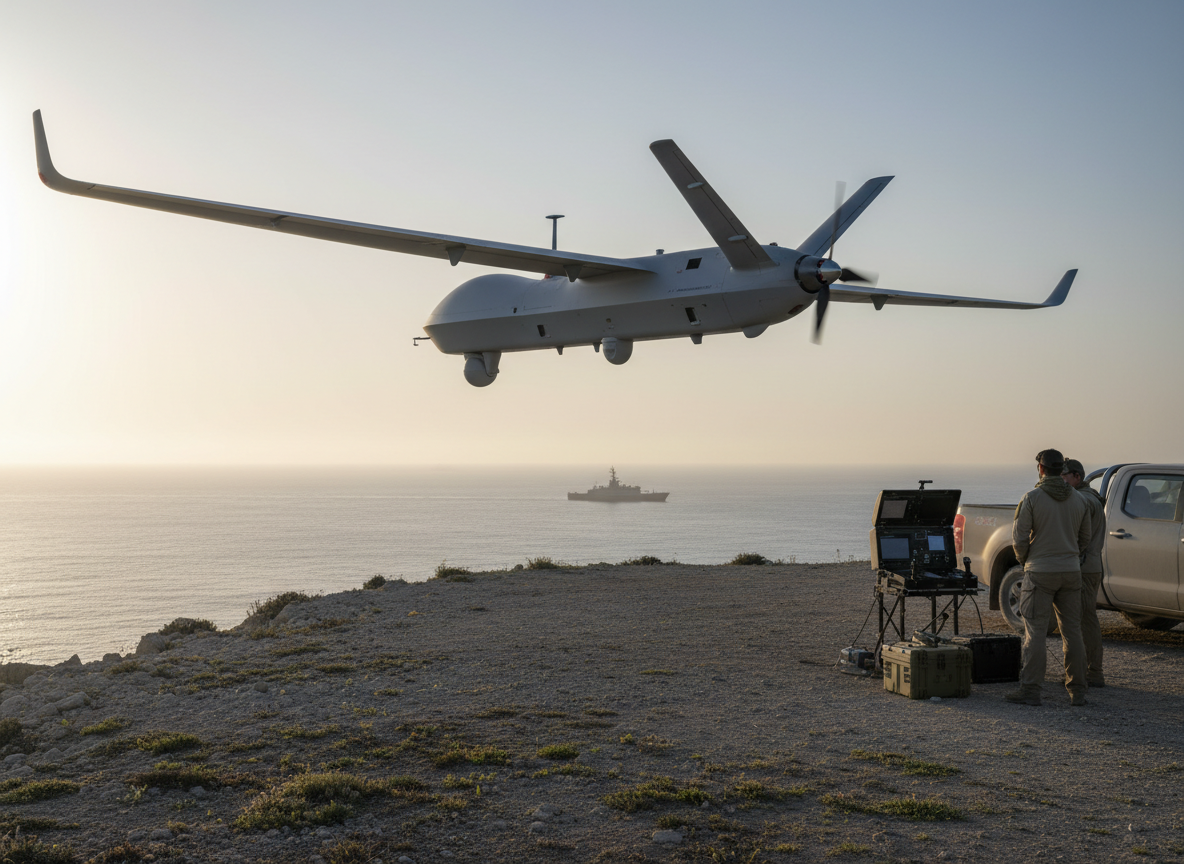
The Airbus U050 Capa-X is not a drone most U.S. operators can order from an online storefront or fly under an ordinary Part 107 certificate. It is a 120-kilogram tactical VTOL aircraft designed around military, security, and public-service missions, with a modular payload bay and advertised endurance beyond ten hours. For the right government buyer, that combination could bridge the gap between small field drones and much larger tactical systems. For everyone else, the unanswered questions—price, U.S. availability, certification, support, and exact mission configuration—matter more than the headline specifications.
Who the Capa-X is intended for
Airbus positions Capa-X for armed forces, special units, and civil or “parapublic” organizations conducting missions such as intelligence, surveillance and reconnaissance; target tracking; border surveillance; search and rescue; fire monitoring; communications support; and electronic warfare. That makes it a program-level system for government agencies and prime contractors—not a normal commercial inspection platform.
The strongest public evidence of real customer interest is the French program. On September 10, Airbus announced an additional order from France’s Aeronautical Maintenance Directorate for four systems, each containing two aircraft, following an initial system acquired at the end of 2025. Two systems are intended for the French Navy and two for the French Army, with delivery scheduled for 2027. Airbus says the order followed land and sea evaluations during 2025 and early 2026.
What Airbus currently verifies
- Maximum takeoff weight: 120 kg (about 265 pounds)
- Maximum payload: up to 20 kg (about 44 pounds), with two or three payloads carried at once
- Advertised endurance: more than 10 hours; Airbus’s FAQ specifies up to 10 hours with a 10 kg payload, dropping as payload and mission profile change
- Operational range demonstrated in the French evaluation: 100 km (Airbus’s product page does not list a maximum range)
- Maximum speed: 150 km/h in the short-wing configuration
- Maximum ceiling: 3,000 meters
- Aircraft length: 4 meters (Airbus’s current product page does not list a wingspan)
- Advertised deployment time: less than 20 minutes
- Takeoff and landing: dedicated VTOL system with four electric twin-rotor units; launches and recovers from an area as small as 10 m x 10 m without a runway or launch equipment
These are manufacturer specifications, not results from our testing. Importantly, Airbus’s French-order announcement separates the maximum claim from demonstrated performance: the evaluated configuration achieved seven hours of endurance while carrying two payloads and operating at a 100 km range. That seven-hour result is more useful than treating every maximum as simultaneously available.
The platform page also references a short-wing configuration, an under-fuselage bay for sensor integration or cargo, and operation in challenging or GNSS-denied environments; a beyond-line-of-sight data link is standard, while satellite communications are still described as under examination. Airbus does not publicly provide enough detail to quantify resistance to jamming, sensor detection ranges, encryption standards, or performance with each payload. Those capabilities must therefore be treated as configuration-dependent manufacturer claims until a buyer receives program documentation and a representative demonstration.
Configuration and mission capabilities
The French baseline combines an optronic pod for imagery intelligence with a signals-intelligence capability. Airbus says the architecture can accept new capabilities as requirements evolve. That flexibility is potentially valuable, but “modular” does not mean every advertised payload is included, qualified, exportable, or available to every customer.
A serious procurement team should ask for the exact air vehicle, propulsion and wing configuration; ground-control station; data link; payloads; software licenses; training; spares; deployment equipment; and support package in its quote. The original market report described a pneumatic catapult and recovery gear, but Airbus’s current public page describes a dedicated VTOL system that needs no runway or launch equipment. We found no primary-source basis for presenting a catapult as standard Capa-X equipment.
Price and availability
As of October 2026, Airbus publishes no list price, standard bill of materials, U.S. delivery timeline, or public purchasing channel beyond a sales-contact form. That is normal for a configurable defense system, but it prevents a credible total-cost estimate. Acquisition cost would likely extend beyond the aircraft to payloads, ground equipment, training, documentation, spares, sustainment, data-link integration, and regulatory work. Any price cited without a configuration and support scope would be misleading.
The September 2026 French order proves a production and delivery pathway for that customer; it does not establish general U.S. commercial availability. U.S. buyers should request confirmation of export authorization, domestic support, repair turnaround, data hosting and cybersecurity, radio-frequency approvals, and component origin before placing the system on a shortlist.
U.S. regulatory and procurement reality
At 120 kg maximum takeoff weight, Capa-X is far above the 55-pound ceiling for ordinary Part 107 small-UAS operations. A U.S. civil operator would need a different FAA authorization and airworthiness pathway appropriate to the aircraft and mission. Government use may qualify for a public-aircraft framework and Certificate of Waiver or Authorization, but public ownership alone does not make every flight a public-aircraft operation. Beyond-visual-line-of-sight missions, controlled airspace, data links, spectrum use, and the intended operating area add further approval questions.
Radio-equipment rules add another layer. Since December 2025, the FCC’s Covered List has included foreign-produced drones and critical drone components, which blocks new FCC equipment authorizations for them unless a product receives a Conditional Approval after a Department of War or Department of Homeland Security review. Capa-X is designed and built in Europe, and Airbus does not appear on the published exemption lists we reviewed. Separately, the FCC’s pending PS Docket 26-189 proposal would restrict importation and marketing of certain previously authorized foreign “military-grade” drones—including aircraft of 55 pounds or more—while keeping importation for U.S. government use permitted. The comment period closed September 2, 2026, and no final rule had been adopted as of October 10, 2026. Federal buyers are therefore less exposed than state, local, or commercial buyers, but every buyer should get Airbus’s written position on U.S. radio authorization for the exact configuration.
Defense and public-safety buyers must also verify procurement requirements against the exact delivered configuration. The market report’s claim of a supply chain “immune” to U.S. ITAR restrictions or Asian-component embargoes is too absolute. European design may be strategically attractive, but export controls, cybersecurity requirements, domestic-content rules, component origins, and agency-specific approved-product policies still require written verification.
Limitations and ownership questions
- What configuration produced the advertised ten-hour endurance, and with what payload and reserve?
- Which configurations and payloads are currently orderable in the United States?
- What is included in a deployable system and its initial spares and training package?
- Which GNSS-denied, electronic-warfare, and multi-sensor functions are operationally qualified today?
- What airworthiness evidence, maintenance program, life limits, and technical publications accompany the aircraft?
- What are the data ownership, encryption, update, and cybersecurity arrangements?
- Where will U.S. repairs, operator training, and through-life support be performed?
Alternatives
The closest alternatives depend on the mission rather than one specification. AeroVironment’s JUMP 20 addresses persistent tactical ISR with VTOL convenience. Schiebel’s Camcopter S-100 serves maritime and land missions with a rotary-wing architecture. Smaller systems such as the EagleNXT eBee VISION or TAC operate in a very different payload and endurance class but demand far less logistical and regulatory infrastructure. Readers comparing smaller fixed-wing options can see our eBee VISION and TAC assessment; procurement teams should also review our overview of NDAA-oriented alternatives.
The market report claimed quieter operation, lower hourly maintenance cost, and advantages over named rivals. We found no comparable primary data supporting those conclusions, so they are not part of this recommendation.
Recommendation
Capa-X is worth a preliminary conversation for defense, maritime-security, border-surveillance, and large public-safety programs that need persistent sensing, modular payloads, and a relatively compact deployment footprint. Airbus’s French evaluation and follow-on order are meaningful signals, especially the demonstrated seven-hour dual-payload mission and two-pickup logistical footprint.
It is not yet possible to recommend the system as a U.S. purchase from public information alone. A qualified buyer should require a mission-specific demonstration, an exact configuration and support quote, representative data products, regulatory planning support, and written confirmation of U.S. availability and sustainment. Until those points are documented, the sensible verdict is shortlist for formal evaluation—not purchase on specifications alone.
Sources
- Airbus U050 Capa-X product page and technical data
- Airbus: French Armed Forces order U050 Capa-X, September 10, 2026
- Airbus: European Defence Agency M2UAS contract, March 4, 2026
- FAA commercial UAS guidance
- FAA public-aircraft UAS guidance
- FCC Covered List FAQs: UAS and UAS critical components
- Federal Register: FCC PS Docket 26-189 request for comment, August 3, 2026
- Naval Technology coverage of the French order
- Asia Pacific Defence Reporter: Airbus Helicopters wins new Capa-X order (initial system bought end of 2025)
Leave a Reply