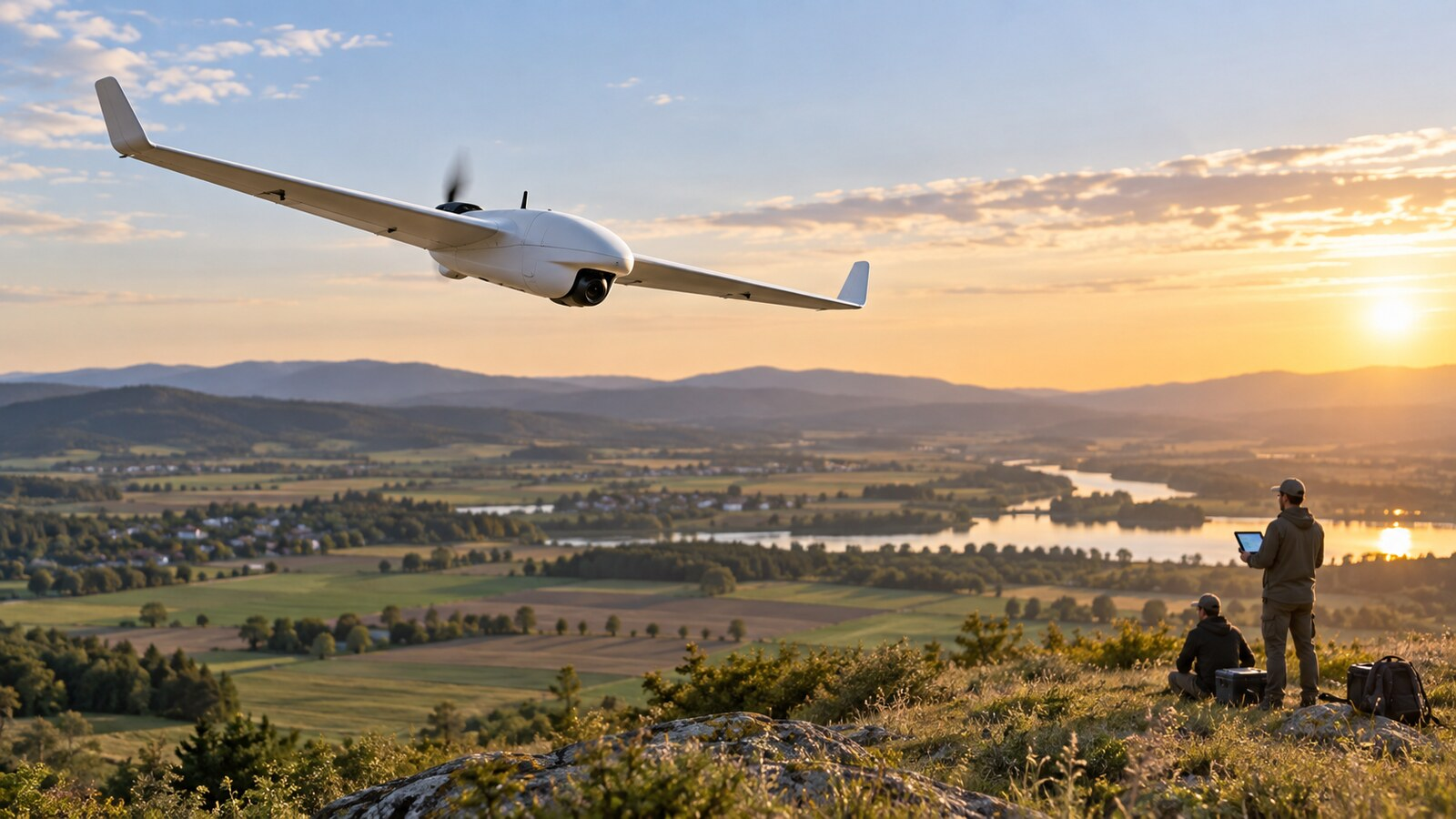
The practical takeaway: EagleNXT’s eBee VISION and eBee TAC are specialized fixed-wing aircraft for teams that need longer coverage and range than a typical multirotor can provide. Their hand-launched, backpack-portable design is compelling for defense, public safety, and wide-area operations, but these are mission systems—not general-purpose camera drones. Buyers should evaluate the complete package, training, communications, payload, support, and regulatory requirements before comparing them on endurance alone.
What the eBee VISION and eBee TAC are designed to do
The eBee family traces its roots to senseFly’s mapping aircraft and now sits within EagleNXT’s portfolio. The basic proposition is straightforward: a lightweight fixed-wing aircraft uses aerodynamic lift more efficiently than a multirotor that must continuously expend energy to hover. That makes the eBee format useful when the mission involves a long corridor, broad search area, perimeter, or repeated passes over a large site.
The eBee VISION is positioned around live intelligence, surveillance, and reconnaissance. The eBee TAC is aimed at tactical mapping and field operations. Although the names are often discussed together, buyers should not assume identical payloads or capabilities. The selected camera, radio configuration, control software, and procurement package determine what the system can actually deliver.
The advantage: endurance without a runway
EagleNXT advertises flight endurance of up to 90 minutes for the relevant eBee configurations. That is a manufacturer maximum, not a guarantee for every mission. Wind, temperature, battery condition, altitude, payload, flight profile, and reserve settings all affect usable time.
Even with that qualification, the fixed-wing advantage can be substantial. A hand launch avoids the runway or catapult associated with larger fixed-wing systems, while automated landing reduces the field footprint needed for recovery. For a crew surveying a long right-of-way or observing a broad training area, fewer landings can mean less interruption and more consistent coverage.
The tradeoff is equally important: fixed-wing aircraft cannot hover over a structure or hold a perfectly stationary viewpoint. They also need a suitable launch and recovery area. Trees, uneven ground, people, vehicles, and obstacles can make a theoretically small landing zone impractical.
Sensors and live-video capability
The eBee VISION is marketed with daylight and thermal imaging intended for day-and-night observation. EagleNXT describes a 32× combined zoom capability and integration with tactical tools such as ATAK. The system also supports standardized video metadata intended to place imagery into a broader command-and-control workflow.
Those features matter most when the aircraft is one component of an operational system. A high zoom figure by itself does not establish identification performance. Image stability, atmospheric conditions, slant range, target contrast, operator display, compression, and the division between optical and digital magnification all affect what an operator can reliably see.
Thermal cameras can detect temperature differences in darkness and some visually degraded conditions, but they do not “see through” dense vegetation, walls, or every form of smoke and fog. Agencies considering search-and-rescue or wildfire applications should validate the payload against representative conditions rather than treating thermal imagery as an all-weather guarantee.
Blue UAS status and cybersecurity
The report identifies the platform with the U.S. Department of Defense’s Blue UAS ecosystem. That can be important for government buyers seeking systems that have completed a recognized cybersecurity and supply-chain review. However, buyers should verify the current model and configuration directly against the Defense Innovation Unit’s current Blue UAS Cleared List at the time of procurement. A brand name, earlier listing, or related model is not a substitute for checking the exact aircraft and component configuration being purchased.
Where these aircraft fit best
- Defense and training: portable ISR, route observation, perimeter coverage, and exercise support where long dwell time matters.
- Public safety: searches over open or lightly obstructed terrain, disaster assessment, and long linear missions—subject to agency policy and airspace approval.
- Infrastructure: corridors such as pipelines, transmission routes, coastlines, and transportation assets where hovering is less important than efficient coverage.
- Mapping and agriculture: related eBee mapping configurations can collect large-area photogrammetry and multispectral data, although buyers should distinguish those payloads and workflows from the VISION live-ISR package.
Limitations and ownership costs
EagleNXT does not present these systems as ordinary retail purchases with a simple consumer price. Prospective customers should expect quote-based procurement. The meaningful comparison is total deployed capability: aircraft, payload, controller, radios, software licenses, spare batteries, cases, training, support, warranty, repairs, and any integration work.
Communications range also deserves careful scrutiny. A technical radio limit is not the same as legal operating range or dependable performance in terrain, foliage, buildings, or congested spectrum. In the United States, most civil operations still require compliance with FAA operating rules, including visual-line-of-sight requirements unless the operator has applicable authority for a different operation. Public aircraft or defense use may follow a different approval framework, but procurement does not itself grant airspace access.
Landing wear is another practical consideration. A field-recoverable foam-and-composite airframe may tolerate operational use well, but repeated belly or steep landings can still place wear on the fuselage, propeller area, sensor, and control surfaces. Buyers should ask for inspection intervals, repair procedures, parts lead times, and demonstrated turnaround time after damage.
How it compares with the alternatives
A multirotor such as the Skydio X10 is generally the stronger format for hovering, close structural inspection, precise positioning, and obstacle-rich environments. A larger tactical fixed-wing platform may offer more communications options, payload capacity, or endurance, but at the cost of weight, logistics, and price. VTOL mapping aircraft simplify takeoff and landing while preserving efficient cruise, although they introduce additional motors and transition complexity.
The eBee’s niche is portability plus fixed-wing efficiency. It is most attractive when a small team must carry the system, launch quickly, and cover more ground than a multirotor comfortably can. It is less attractive when the job demands hovering, inspection within a tight structure, heavy payloads, or recovery in a heavily obstructed area.
Who should buy it—and who should skip it
Consider it if your mission repeatedly involves wide areas or long corridors, your crew values backpack portability, and live video or tactical integration is central to the requirement. Before buying, arrange a demonstration that replicates your terrain, weather, communications environment, and recovery constraints.
Skip it if most of your work involves close inspections, stationary observation, confined sites, or inexpensive visual documentation. A capable multirotor will usually be easier to deploy and better matched to those jobs.
The bottom line is that the eBee VISION and TAC should be evaluated as complete operational systems. Their advertised endurance and portable fixed-wing design are meaningful advantages, but the right buying decision depends on verified payload performance, communications reliability, landing practicality, support, and the authority to conduct the intended mission.
Editorial disclosure: This article is an independent marketplace analysis based on manufacturer information and public sources. All About UAVs did not perform hands-on testing, and no affiliate links are included.