
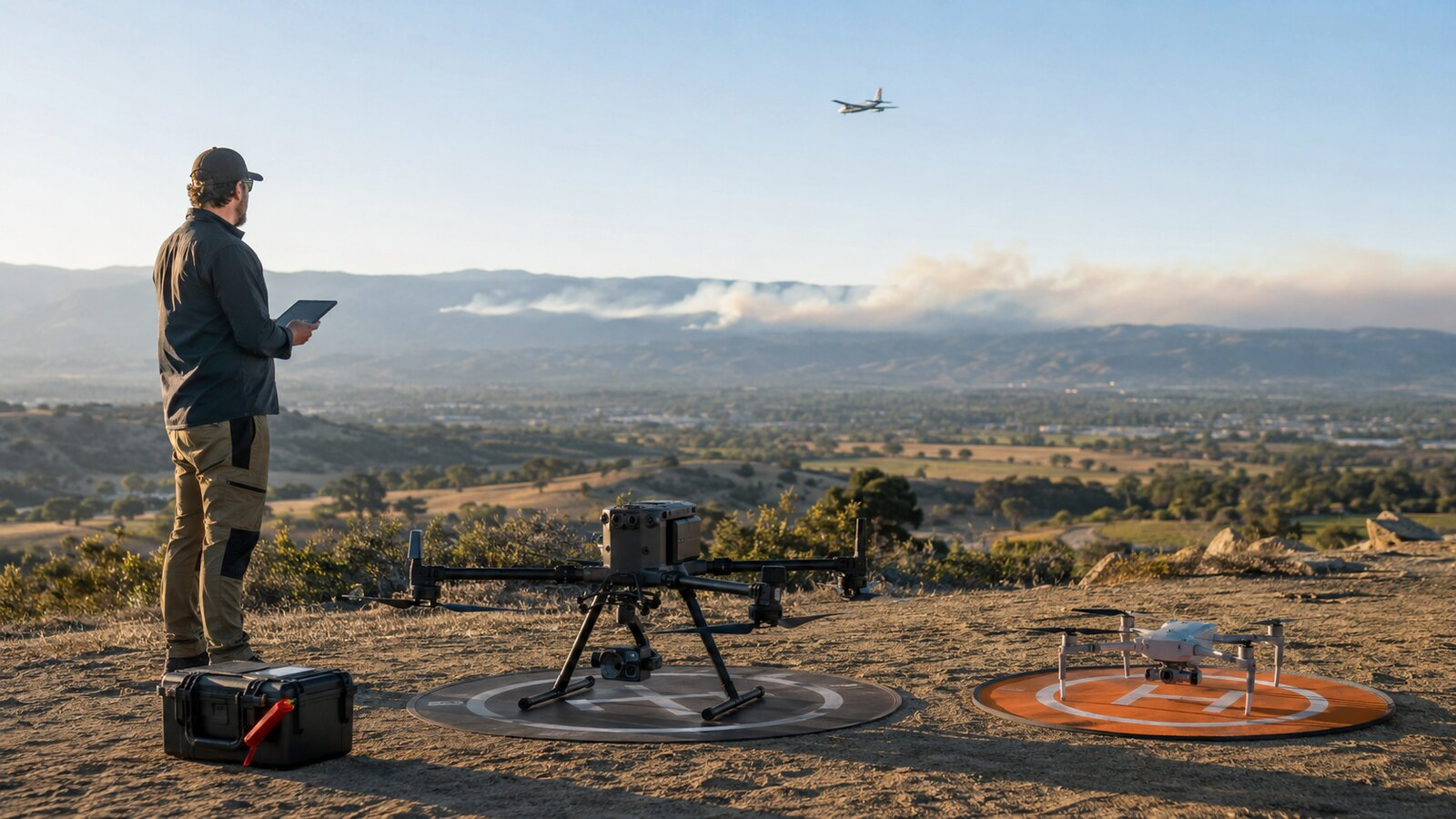
This week’s practical takeaway: delivery precision still matters, the FCC is considering new restrictions on certain foreign-produced UAS equipment, and wildfire agencies are again warning pilots that one unauthorized drone can stop aerial firefighting.
Here are four verified UAV developments that merit attention without overstating what has—or has not—changed.
Amazon Prime Air Drops a Package Into a Texas Pool
An Amazon Prime Air drone released a customer’s package into a backyard swimming pool in Richmond, Texas. Local reporting published August 20 identified the customer as Lindsey Austen and included Amazon’s response that incidents of this kind are rare and reviewed to improve the service.
The incident does not establish a systemwide reliability rate, but it illustrates why delivery-site validation and precise release-point control matter as Amazon expands Prime Air. Amazon’s broader expansion plans deserve separate scrutiny from one highly visible mishap. Read the original FOX Local report and All About UAVs’ earlier analysis of competing drone-delivery models.
FCC Proposal Raises Questions About Covered UAS Equipment
The Federal Communications Commission is seeking comment in PS Docket No. 26-189 on restricting the importation and marketing of certain foreign-produced “military-grade” UAS and critical components. This is a proposal, not an adopted prohibition, and it would regulate equipment authorization and marketing rather than directly create a new FAA flight rule.
The proposal’s definitions have prompted concern that some civilian systems—potentially including synchronized fleets and certain sensing components—could fall within its scope. Those consequences remain contested and should not be presented as settled until the FCC completes the proceeding. Review the FCC’s official notice and All About UAVs’ background on FCC equipment-authorization risks for drone buyers.
Oregon Warns Drone Pilots Away From Wildfire Airspace
On August 20, the Oregon Department of Aviation and Oregon Department of Emergency Management warned that an unauthorized drone near an active wildfire can force firefighting aircraft to stop operating until the airspace is clear.
The agencies advised pilots to check Temporary Flight Restrictions before every flight and keep drones grounded near active fires, including at night and on weekends. Their notice lists possible consequences of up to $75,000 in civil fines, up to 12 months in federal prison, equipment confiscation, and permanent revocation of pilot certificates. Exact penalties depend on the conduct and legal authority involved; the operational advice is simpler: if there is a wildfire nearby, do not launch without explicit authorization. See the joint Oregon safety notice.
DJI Highlights Onboard AI Development
DJI’s 2026 Enterprise Drone Onboard AI Challenge recognized five Best Onboard AI Model winners and ten Industry Application Excellence winners. The competition centered on algorithms designed for DJI enterprise platforms, including the Matrice 4 and 4D series, Dock 3, Matrice 400, and Manifold 3.
The awards are evidence of DJI’s developer-ecosystem strategy, not independent proof that every winning model has been commercially deployed or validated for a customer’s mission. DJI’s own rules state that real-world commercial results were not required. The official challenge page provides the platform requirements, judging structure, awards, and limitations.
What Operators Should Do This Week
- Delivery operators should treat release-zone validation and exception handling as measurable safety and service-quality controls.
- Buyers and manufacturers should follow the FCC docket itself instead of treating stakeholder interpretations as final rules.
- Pilots should check FAA TFR information immediately before flying anywhere near wildfire activity.
- Enterprise teams evaluating onboard AI should ask for mission-specific validation, failure modes, hardware requirements, and regulatory fit—not merely an award label.
Sources
- FOX Local: Amazon drone drops package into swimming pool, August 20, 2026.
- FCC: Proposed restrictions on certain foreign-produced UAS equipment, PS Docket No. 26-189.
- Oregon OEM and ODAV: Unauthorized drones banned over wildfires, August 20, 2026.
- DJI: Enterprise Drone Onboard AI Challenge 2026.