
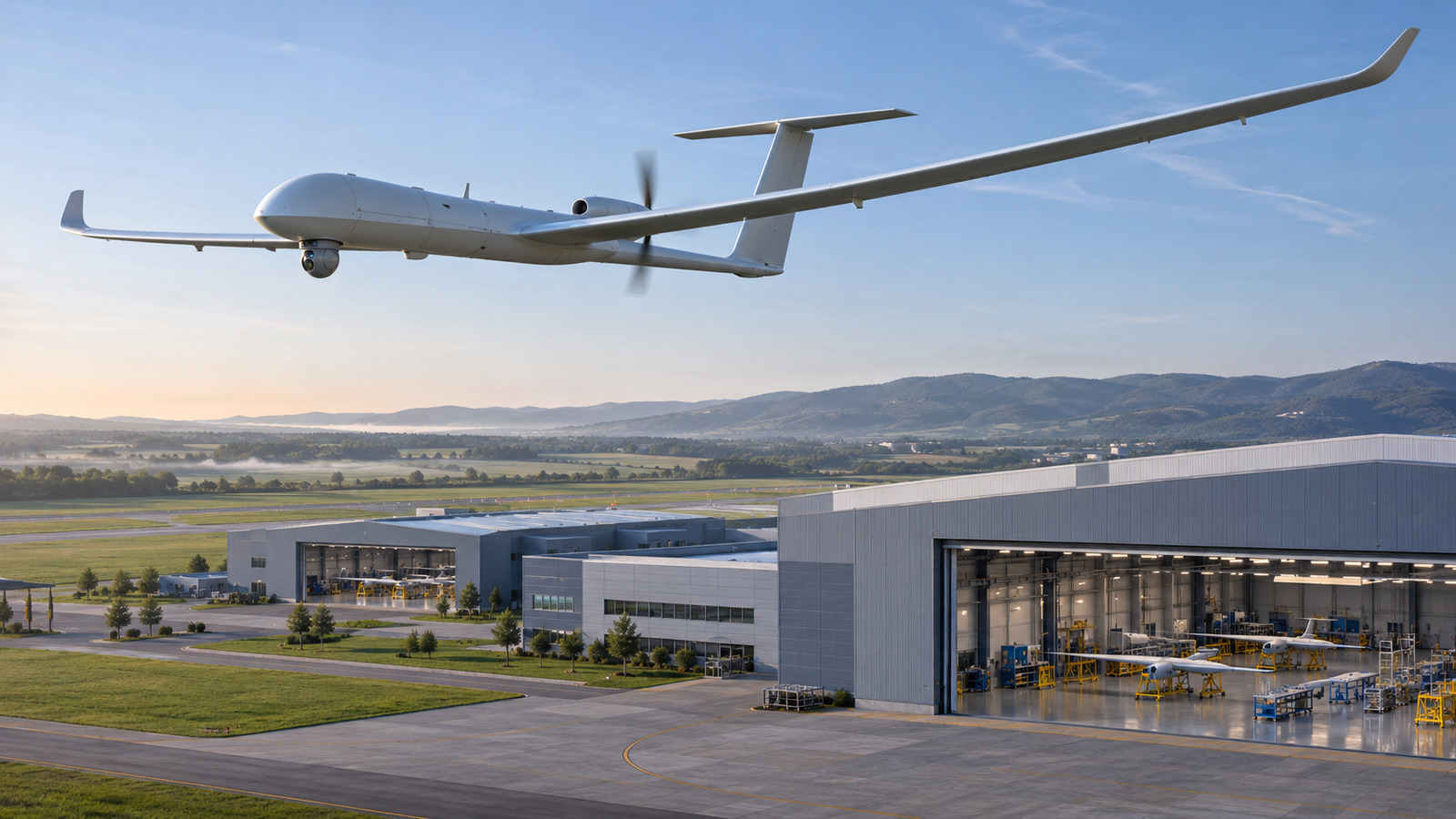
The takeaway: Ondas announced on November 5, 2026 that it signed a definitive agreement to acquire Stemme, a German manufacturer and maker of the certified S12 airframe used as the foundation for DZYNE’s ULTRA long-endurance reconnaissance drone. The acquisition could give Ondas more control over an important supplier as it tries to raise ULTRA output, but the transaction has not closed, the purchase price is undisclosed and the company’s target of 10 aircraft per month by 2028 remains a production plan—not demonstrated capacity.
What Ondas agreed to buy
Ondas announced on November 5 that it entered a definitive, all-cash agreement to acquire 100% of Stemme GmbH. According to the company announcement, Stemme builds the S12 composite aircraft that serves as the underlying airframe for ULTRA, the Uncrewed Long-Endurance Tactical Reconnaissance Aircraft developed by DZYNE Technologies with the Air Force Research Laboratory.
The transaction is expected to close in the first quarter of 2027, subject to regulatory approvals and customary closing conditions. Ondas did not disclose the acquisition price, financing terms or a termination fee. Until closing, Stemme remains a separate supplier, and the announcement should not be treated as a completed acquisition.
Stemme operates engineering, production and maintenance facilities in Strausberg and Pasewalk, Germany. Ondas says those sites total about 135,571 square feet and currently operate at approximately 25% of production capacity. Those utilization and capacity figures are supplier-reported; the announcement does not provide audited production records, current aircraft output by model or an independent factory-capacity assessment.
The ULTRA production target is ambitious—and still forward-looking
Ondas says it wants to increase ULTRA output to 10 aircraft per month by 2028. Defense Daily reports current production at about two aircraft per month—a baseline that does not appear in Ondas’ own release. Ondas also describes 345,000 square feet of planned U.S. production space intended to localize airframe work and shorten supply lines.
Neither statement means that capacity exists today. The release does not identify a U.S. factory address, construction status, equipment installation, workforce, production certification, capital budget or customer order supporting the full rate. Defense Daily’s November 6 report independently confirms the planned acquisition and the 10-aircraft monthly goal, while also noting that financial terms were not disclosed.
For a composite aircraft, increasing output involves more than adding floor space. Tooling, molds, cured structures, flight controls, engines, avionics, payload interfaces, quality records and qualified labor all have to reach the same rate. Airworthiness approvals and Stemme’s FAA Part 145 repair-station authority are useful existing capabilities, but they do not automatically approve a future U.S. production line or military configuration.
Why control of the airframe supplier matters
Vertical integration can reduce coordination risk between aircraft design, airframe production and mission-system changes. If the deal closes, Ondas would own the company producing ULTRA’s core airframe rather than buying it from an outside supplier. That could improve scheduling visibility and make engineering changes easier to coordinate across the civil-aircraft foundation and the uncrewed military system.
It also creates execution risk. Ondas would be responsible for a German manufacturer with civil-aircraft customers, regulatory obligations, maintenance activities and facilities that extend beyond ULTRA. Raising military output while preserving certification, quality and aftermarket support will be a more demanding measure of success than announcing a production target.
All About UAVs has previously covered Ondas subsidiary Cyberhawk’s multi-year infrastructure-inspection agreement. The Stemme transaction is a different part of the company’s strategy: it is aimed at owning aircraft manufacturing capacity rather than expanding a drone-services contract.
ULTRA is operational, but manufacturer specifications still need context
AFRL’s own ULTRA program page says the aircraft was conceived by AFRL’s Center for Rapid Innovation and developed with DZYNE Technologies, with an endurance capability exceeding 80 hours while carrying more than 400 pounds of payload—though an accompanying photo caption notes that reaching that figure depends on payload and ongoing upgrades. Public reporting on the program’s 2024 unveiling cited similar endurance figures and described early ULTRA flights supporting operations in the U.S. Central Command area.
Ondas’ current release uses a more conservative description of more than 70 hours of endurance and more than 400 pounds of payload capacity. Those specifications remain company descriptions, not a public operational test report covering reliability, mission availability, weather limits, payload-specific endurance or cost per flight hour.
The broader customer need is real. On July 9, 2026, the Air Force said it is defining requirements for more modular, lower-cost and more rapidly produced uncrewed ISR and strike systems that will inform the MQ-9 Reaper’s successor. That policy direction helps explain Ondas’ manufacturing pitch, but it does not guarantee ULTRA orders at the planned factory rate.
What this does—and does not—change for buyers
A completed Stemme acquisition could give Ondas more control over schedule, supply-chain decisions and design changes. It could also support domestic-source objectives if meaningful airframe work is actually established in the United States.
But corporate ownership does not by itself make every component domestic, make ULTRA eligible for every procurement program or establish a production rate. Buyers will still need configuration-level information on component origin, cybersecurity, maintenance, export controls, airworthiness, data rights and mission-system integration.
What UAV readers should watch next
- Closing evidence: Regulatory approval and transaction completion before treating Stemme as an Ondas subsidiary.
- Financial terms: Purchase price, financing and expected capital spending have not been disclosed.
- U.S. factory details: A named site, equipment plan, hiring schedule and certification path would make the onshoring claim measurable.
- Production proof: Delivered aircraft, quality results and sustained monthly output matter more than nominal floor space.
- Customer demand: Firm orders and funded quantities are needed to connect the 2028 target to an actual backlog.
The planned acquisition is strategically coherent: Ondas wants to control the certified airframe supplier behind an operational long-endurance platform. The next test is execution. Closing the deal, funding the production buildout and delivering aircraft at a repeatable rate will determine whether the announcement becomes manufacturing capacity rather than another aerospace expansion target.
Sources and disclosures
- Ondas acquisition and production announcement — November 5, 2026
- Defense Daily acquisition report — November 6, 2026
- Air Force Research Laboratory ULTRA program page
- U.S. Air Force uncrewed-airpower requirements report — July 9, 2026
Independent fallback research was used because today’s Drive brief was unavailable. All About UAVs has no disclosed material relationship with Ondas, DZYNE, Stemme or the organizations named. No affiliate links, sponsorship or paid placement. The featured image is an AI-generated conceptual illustration, not a photograph of the companies, ULTRA, an actual factory or an Air Force operation. General information, not procurement, legal or investment advice. Corrections: help@allaboutuavs.com.
Leave a Reply