
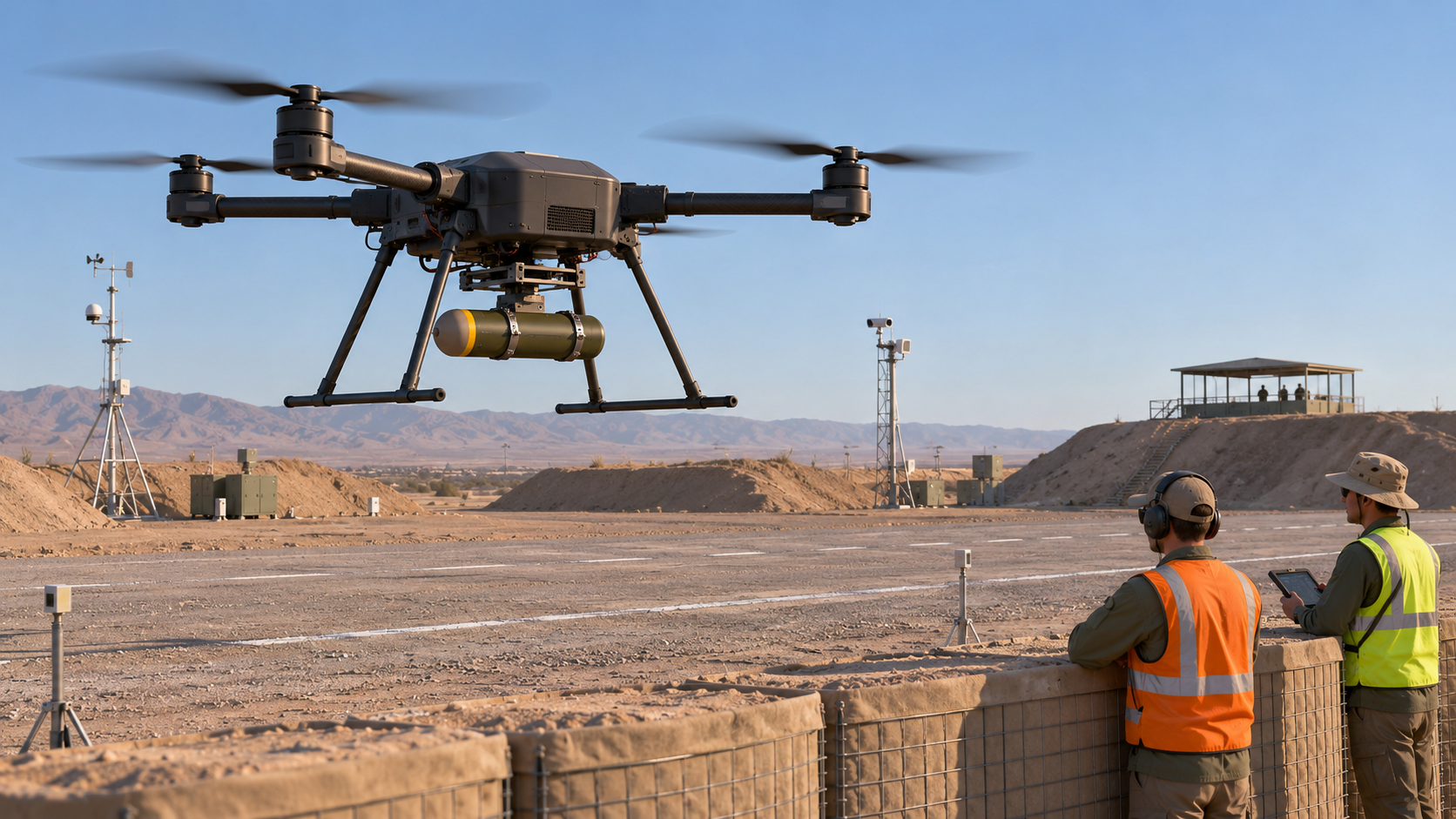
The U.S. Army says a new clip-on kit successfully converted a standard 60 mm mortar round for release from a moving unmanned aircraft, with the round orienting correctly and detonating inside the intended target area. The live test is a meaningful technical milestone, but it is not yet a fielding decision or an operational capability announcement.
What the Army tested
The Army Combat Capabilities Development Command Armaments Center published new details November 4 about the Munitions Air-dropped Lethal Effects Tool, or MALET. The device is a removable conversion kit intended to let unmanned aircraft release existing mortar ammunition rather than requiring a purpose-built drone munition.
According to the Armaments Center, the most recent live test used a 60 mm mortar round released from a UAS while the aircraft was moving. The Army says the round stabilized in the correct orientation and detonated within the desired target area. Earlier test drops at multiple Army facilities were used to mature the kit’s fuze function and safety elements.
That description establishes a successful live-drop result under test conditions. The Army announcement does not disclose the aircraft model, release altitude, airspeed, miss distance, environmental conditions, number of attempts or statistical reliability. It therefore should not be read as proof of operational accuracy across platforms or missions.
How MALET changes a standard mortar round
MALET adds the fuze function and aerodynamic stability needed for an aerial drop. The Army describes the installation as non-destructive: the kit can be attached without permanently modifying the mortar cartridge and removed if the round is not used, allowing the ammunition to return to its conventional role.
The initial work covers 60 mm and 81 mm mortar rounds, which the Army selected because they were mature and aligned with the payload capacity of larger UAS. Engineers say the architecture may be adaptable to other munitions, but the Army has not identified those concepts publicly or announced that additional configurations have completed comparable testing.
The distinction matters. MALET is not itself a complete armed drone. It is one component within a wider payload-and-release architecture that must also account for the aircraft, carriage hardware, release mechanism, fire-control process, operator authorization, target identification, communications and applicable rules of engagement.
Why the test matters
Using ammunition already present in Army inventories could reduce the need to establish a separate supply chain for every UAS-delivered effect. A removable kit could also preserve flexibility: commanders could retain mortar rounds for their traditional launch systems when an aerial mission is cancelled or a drone is unavailable.
That logistical argument remains a program objective, not a demonstrated cost saving. The Army has not published unit pricing, integration labor, required storage controls, training hours or maintenance demands. It has also not said whether the kit will be compatible with multiple aircraft families without platform-specific certification.
The test also reflects a broader effort to standardize payload integration. In July, soldiers at Project Convergence Capstone 6 evaluated MALET as part of the Picatinny Common Lethality Integration Kit alongside the AUDIBLE weapon-release system and Gunslinger fire-control software. Those soldier touchpoints can expose handling and workflow problems that engineering trials alone may miss.
What happens next
The development team plans to distribute the kit at major military exercises for additional soldier feedback. DEVCOM says it is also working with industry, user and acquisition organizations with the aim of transitioning the technology for scaling and fielding.
- Not yet disclosed: a program of record, production award, fielding quantity or operational unit.
- Still to verify: repeatability, accuracy across release conditions and compatibility with different UAS.
- Safety questions: qualification standards, arming safeguards and procedures for aborted missions.
- Acquisition questions: kit price, production capacity and the division of responsibility between government and industry.
For UAV readers, the important development is narrower than the headline idea of a “drone mortar.” The Army has shown that a removable conversion device can support a live 60 mm release from a moving aircraft under controlled test conditions. Turning that result into a dependable field capability will require further qualification, soldier evaluation, platform integration and an acquisition decision.
Bottom line
MALET has progressed from an integration concept to a successful live-drop demonstration. That is a measurable engineering result and a reason to follow the program. It is not evidence that the kit has entered production, been fielded to combat units or achieved a published operational accuracy standard.
Sources and disclosure
Primary sources: U.S. Army DEVCOM Armaments Center announcement, November 4, 2026, and DEVCOM’s Project Convergence Capstone 6 report. Independent cross-check: Geopolitiki, November 4, 2026.
All About UAVs has not tested MALET or the associated UAS. Test results and system descriptions attributed to the Army are official claims that have not been independently reproduced. The featured image is an original AI-generated editorial illustration; it does not depict MALET, the live test or a specific aircraft. The Army did not sponsor, review or control this article.
Leave a Reply