
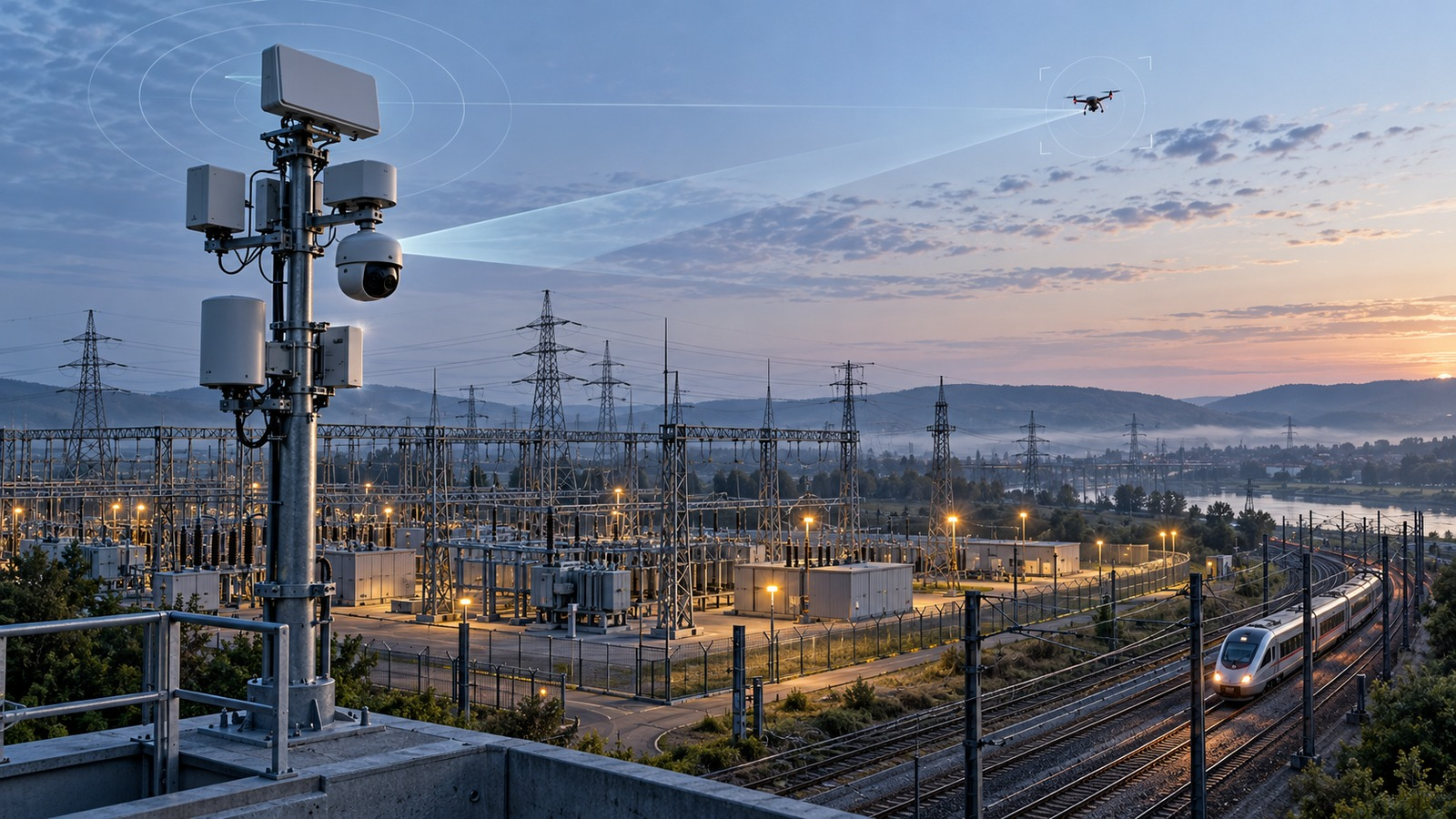
The takeaway: Under a French law enacted in August 2026, selected operators of vital infrastructure—and their authorized contractors—may now use approved counter-drone measures near protected sites under defined conditions, according to an October 21 Reuters investigation. It is not a general right for utilities or private security teams to jam, seize or shoot down drones. Across Europe, governments are still deciding who may act, what systems may be used and who carries liability when an intervention causes harm.
France’s critical-infrastructure counter-drone powers are limited
A Reuters investigation published October 21 describes a widening European debate over whether utilities, rail operators and other critical-infrastructure organizations should receive powers traditionally held by police or military forces. France is the clearest current example because its parliament enacted an expansion in August.
The relevant French law, Article 25 of Law No. 2026-791, amended the country’s internal-security framework. The official text provides for operators designated as responsible for infrastructure of vital importance, and in some cases their authorized providers or subcontractors, to be permitted to use systems that render an uncrewed aircraft inoperative or neutralize it.
Several conditions matter. The authority concerns an imminent threat to the security of a protected vital site or prevention of a drone overflight in a designated zone containing that site. The site’s protection plan must cover that purpose, and the equipment must be among the systems approved through the applicable government process. Those limits make the framework a controlled delegation—not permission for any facility owner to improvise a response.
Detection, jamming and physical interception are different decisions
Counter-drone discussions often compress several functions into one phrase. Detection may involve radar, radio-frequency sensing, acoustic equipment or cameras. Identification and tracking add another layer. Taking control of a drone, disrupting its communications, forcing it to land or physically intercepting it are active measures with different technical risks and legal consequences.
Reuters reports that French evaluations include electronic jammers and interceptor drones, with government-linked testing intended to catalogue approved systems. The article says three system integrators and 17 counter-drone systems had been catalogued at the time of reporting. That does not mean every listed technology is approved for every operator, location or response.
A system’s availability also does not answer the decision question. Operators still need a process for distinguishing an authorized inspection flight from a hostile or negligent aircraft, escalating the alert and determining who may order an intervention. Automation can shorten response time, but it cannot erase the need for accountable authority and documented rules of engagement.
Europe is not adopting one uniform rule
The European picture remains uneven. Reuters reports that Germany continues to treat active counter-drone response as a policing function while its interior ministry reviews how infrastructure operators or third parties might participate. Austria has announced plans to extend powers, and Poland has authorized designated security units to act within drone-restricted zones around certain energy infrastructure.
Other operators are wary. Finnish utility leaders quoted by Reuters argued that neutralization should remain a police or military responsibility. Their concern is practical as well as legal: bringing down a drone can injure people, damage property, interfere with lawful aviation or destroy evidence needed to identify the operator.
The European Commission’s February counter-drone action plan calls for stronger detection, testing, procurement coordination and protection of critical infrastructure. But European-level coordination does not automatically give a private operator national authority to use a jammer or interceptor. Each jurisdiction’s laws, approvals and spectrum rules still control.
What infrastructure operators should learn from the French model
The immediate lesson is to separate capability planning from intervention authority. A utility can map vulnerable substations, review authorized drone activity, improve reporting and evaluate sensors without assuming it may actively defeat an aircraft. Procurement documents should identify whether a proposed product only detects, also identifies, or can perform an active countermeasure.
A credible operating concept should answer four questions: who confirms that a track is a threat; who authorizes the response; what happens to the aircraft after intervention; and who documents the event and preserves evidence. It should also address false alarms, adjacent airspace, public areas and coordination with police, aviation and spectrum authorities.
This is the same distinction highlighted in our October 20 U.S. counter-drone grant update: money and equipment ownership do not automatically create operating authority. France’s law is different from the U.S. framework, but neither should be reduced to “companies can now shoot down drones.”
Why liability may decide the pace of deployment
The hardest problem is not simply whether a system can stop a drone. It is whether the responsible organization can make a timely, defensible decision with incomplete information. A successful interception may still create harm if debris lands outside the protected site or if the aircraft was operating lawfully.
Reuters found that infrastructure operators remain concerned about responsibility for injury and property damage. Those questions affect insurance, contracts, training and willingness to act. A law may create authority while operators still wait for detailed implementation rules, approved equipment, site plans and clearer liability arrangements.
What happens next
Watch for French implementing measures, the approved-technology catalogue and evidence of actual deployments at designated vital sites. Elsewhere in Europe, the meaningful milestones will be enacted laws rather than proposals, named responsible authorities, defined training requirements and public accountability rules.
For UAV operators, the practical consequence is a more fragmented operating environment around sensitive infrastructure. Airspace restrictions, site permission and local counter-drone authority should be checked separately. The policy direction is toward faster protective action—but the verified legal boundaries remain narrower than the headline.
Sources
- Reuters: “Europe weighs giving utilities, infrastructure companies more powers to bring down drones” — October 21, 2026; reporting across France, Germany, Austria, Poland and Finland
- Légifrance: Article 25, Law No. 2026-791 of August 16, 2026 — official French legal text governing authorization for selected vital-infrastructure operators
- European Commission: Action Plan on Drone and Counter-Drone Security — February 11, 2026; policy background on detection, testing and critical-infrastructure protection
- All About UAVs: “FEMA Opens $250 Million in Counter-Drone Grants” — October 20, 2026; related U.S. context on ownership and operating authority
Reviewed October 22, 2026. General information, not legal advice. Independent fallback research was used because today’s Drive briefing was unavailable. No affiliate links, sponsorship or paid placement. Featured image: AI-generated conceptual illustration, not a photograph of a real facility or incident. Corrections: help@allaboutuavs.com.
Leave a Reply