The takeaway: SoftBank and General Atomics disclosed Oct. 1-2 that a July 27 flight test used a Japan Coast Guard MQ-9B SeaGuardian to create a temporary mobile-communications area from 3,000 meters above the coast of Kuroshio Town, Kochi Prefecture, Japan. SoftBank reported coverage exceeding 5 kilometers in diameter and peak outdoor speeds of 20 Mbps down and 5 Mbps up. That is a useful proof of integration, not yet a deployable nationwide disaster service: the companies disclosed no user-capacity, endurance, activation-time or real-disaster performance data.
The SeaGuardian carried a Japanese-built communications pod
SoftBank disclosed the verification trial on October 2. The telecommunications company designed and manufactured a Disaster Relief Unit, or DRU, pod in Japan, then worked with General Atomics Aeronautical Systems to integrate it with an MQ-9B SeaGuardian owned by the Japan Coast Guard.
The aircraft flew a circular pattern offshore from Kuroshio Town in Kochi Prefecture at an altitude of 3,000 meters. A ground gateway combined an LTE base station with a frequency-conversion repeater. The feeder link converted 2.1 GHz signals from the base station to 3.3 GHz for transmission to the aircraft; equipment in the airborne pod converted them back to 2.1 GHz for mobile devices on the ground.
Gimballed antennas compensated for changes in aircraft attitude and turbulence, keeping the feeder and service links pointed at the appropriate ground locations. SoftBank says the test established a communications area more than 5 km across and recorded outdoor peak speeds of 20 Mbps downlink and 5 Mbps uplink using 5 MHz of bandwidth.
General Atomics said the pod flew on July 27. The October announcements therefore describe the results of an earlier flight test, not a new operational deployment following an actual disaster.
What the flight test verified
The test covered more than whether a radio could be switched on in flight. SoftBank says the work included manufacturing conformity checks, thermal and electromagnetic-compatibility analysis, ground functional checks, preliminary safety reviews and tests of the pod’s effects on stability, maneuverability, vibration and existing aircraft systems. General Atomics then evaluated the records and test results before airworthiness approval was obtained for the pod-equipped configuration used in the verification flight.
That integration work matters. A useful airborne cell site must maintain its link while the aircraft turns, remain compatible with other systems aboard the aircraft and operate within an approved configuration. A payload that performs on a bench is not automatically ready to fly on a large remotely piloted aircraft.
The reported data rates could support basic disaster communications such as safety confirmations, messaging, photographs and some video sharing. They should not be read as guaranteed speeds for every person inside the coverage area. SoftBank reported peak outdoor measurements, not minimum service levels, aggregate throughput or the number of simultaneous users.
Why a long-endurance aircraft could help after a disaster
Earthquakes, typhoons, floods and landslides can disable towers, fiber connections and power supplies at the same time that residents and responders need connectivity most. An airborne relay can be moved over a damaged area without waiting for road access or rebuilding a tower. It can also reposition as priorities change.
General Atomics describes SeaGuardian as a satellite-controlled, all-weather, long-endurance aircraft designed for flights beyond the horizon and missions lasting more than 30 hours, depending on configuration. Those are manufacturer specifications, and the companies did not publish the endurance achieved with the DRU pod during this test. Still, the platform’s payload capacity and persistence distinguish this concept from a small multirotor temporarily lifting a radio above one incident site.
The concept also complements rather than replaces ground restoration. An aircraft still needs a functioning gateway, spectrum authority, flight crew, maintenance support, airspace coordination and a plan for handing service back to terrestrial infrastructure. Poor weather, volcanic ash, restricted airspace or damage to the gateway site could limit availability.
All About UAVs previously examined how specialist teams use smaller aircraft in search-and-rescue and disaster assessment. The SeaGuardian trial addresses a different layer of response: restoring a communications channel that can help residents, emergency managers and field teams share information.
Important limits remain undisclosed
SoftBank calls the result a Japanese first, but qualifies that statement as based on its own review of publicly available information. The test did not demonstrate a commercial service or standing emergency-response capability. SoftBank says it will improve the pod and study operating methods with the goal of practical deployment.
Several operational questions remain open:
- How many users and concurrent sessions can the system support?
- What minimum speeds and latency are maintained across the coverage area?
- How quickly can the aircraft, pod, crew and gateway be activated after a disaster?
- How long can the complete configuration remain on station, including crew and maintenance rotations?
- What spectrum permissions and interagency procedures would apply during an emergency?
- How does service perform in heavy precipitation, mountainous terrain or congested radio environments?
The reported 5 km-plus diameter is also a result from one disclosed altitude and test configuration. It is not a universal coverage radius. Terrain, antenna orientation, frequency assignments, interference, aircraft pattern and device characteristics can all change the usable footprint.
What happens next
The most meaningful next step would be an operational exercise that measures setup time, simultaneous users, service continuity and handoff between airborne and terrestrial networks. Testing with emergency agencies and representative congestion would show whether the system can move from an engineering demonstration to a repeatable response package.
The trial nevertheless establishes a concrete baseline: a large remotely piloted aircraft carried an approved communications pod, maintained directional links while circling and delivered measurable mobile connectivity to the ground. For UAV operators and public-safety planners, the lesson is that disaster-response value can come from the payload and network architecture as much as from the aircraft’s cameras. The remaining question is whether the complete system can be mobilized reliably, safely and economically when infrastructure has actually failed.
Sources and disclosure
- SoftBank: Japan disaster-relief communications trial results (Oct. 2, 2026)
- General Atomics: MQ-9B DRU pod flight test (Oct. 1, 2026)
- GA-ASI: MQ-9B SeaGuardian overview and manufacturer specifications
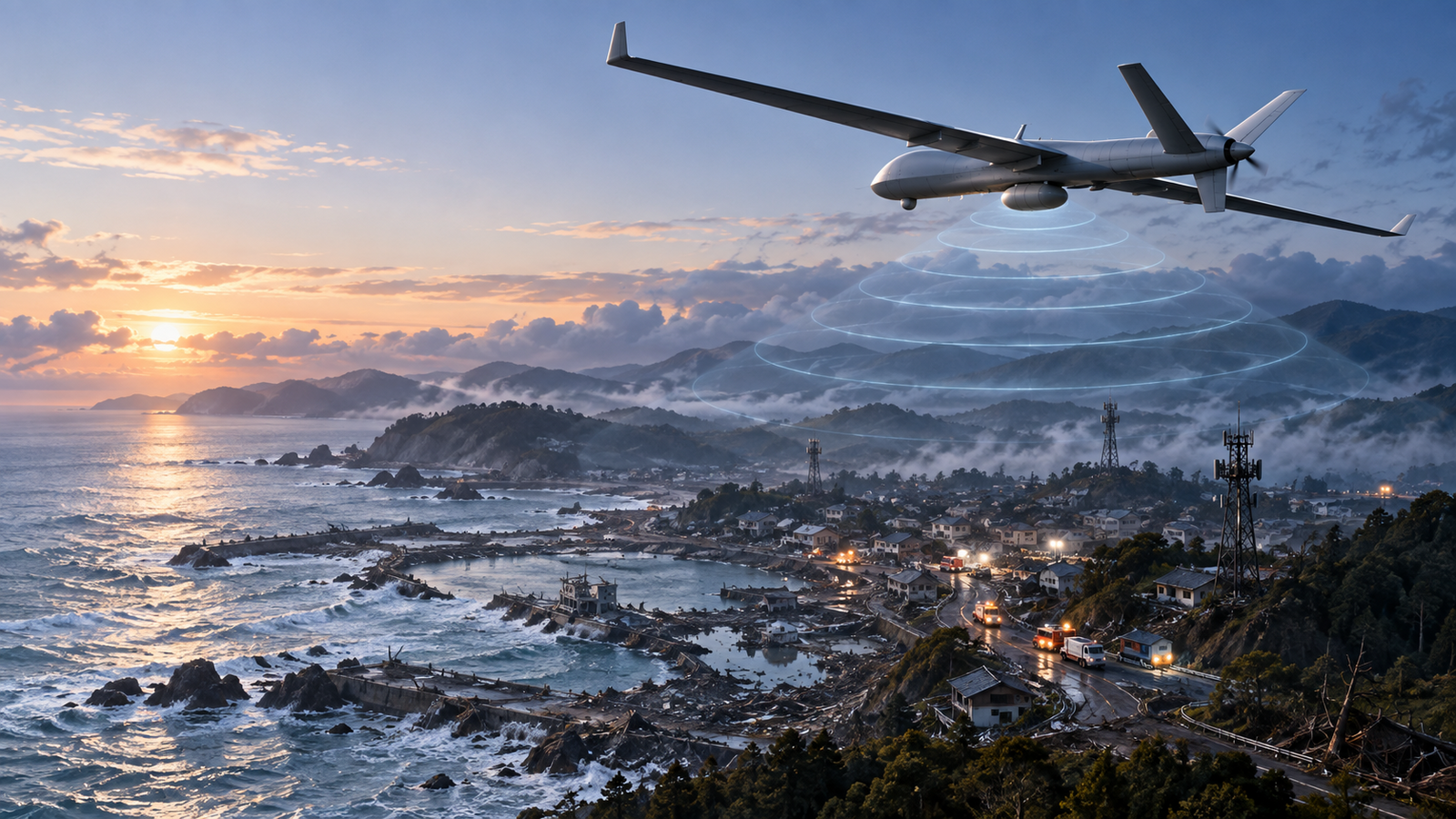
Featured image: AI-generated editorial illustration by OpenAI for All About UAVs. It is a conceptual scene and does not depict the July 2026 test. No affiliate links, sponsorship or paid placement are included.
Leave a Reply