
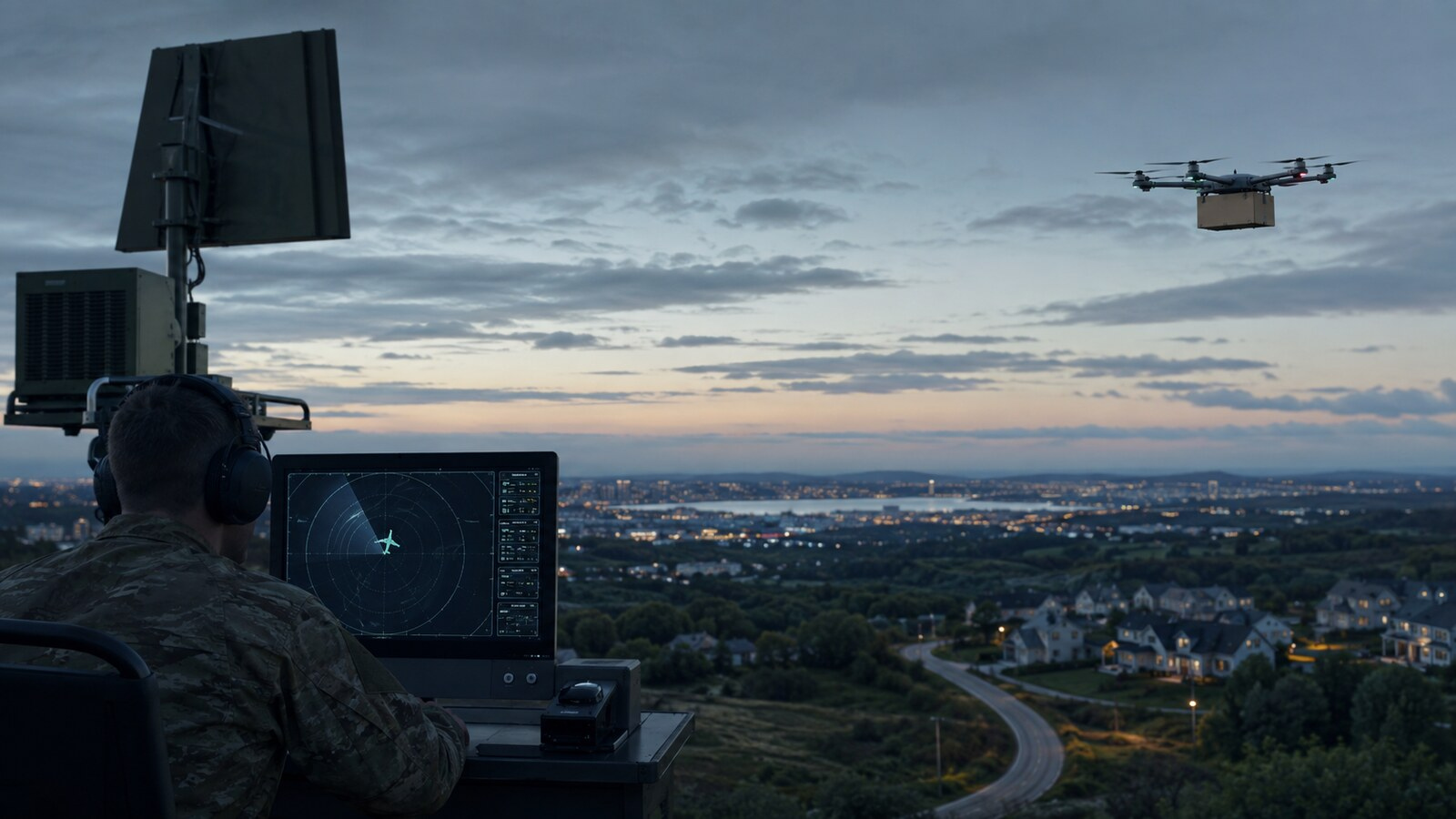
Three drone stories are shaping today’s operating environment: the United Arab Emirates says its air defenses intercepted a UAV approaching from Iran, Ukrainian officials report another intense week of Russian aerial attacks, and delivery-drone operators face a less dramatic but commercially important obstacle—noise.
UAE reports intercepting a drone approaching from Iran
The UAE Ministry of Defence said an aircraft was detected over the country’s territorial waters while approaching from Iran and that the UAE Air Force responded. A later Ministry of Foreign Affairs statement described the aircraft as an Iranian drone intercepted by air-defense systems.
Those are official UAE accounts, not an independently reconstructed incident report. The careful takeaway is limited but important: the event shows how quickly an individual uncrewed aircraft can become both an air-defense problem and a diplomatic flashpoint. Read the Ministry of Defence statement and the Ministry of Foreign Affairs statement.
Ukraine attributes nearly 2,000 drones in one week to Russia
Ukrainian President Volodymyr Zelensky said Russia launched nearly 2,000 drones, about 1,600 guided aerial bombs and 31 missiles against Ukraine during the previous week, according to reporting by the Kyiv Independent. Because the figures come from a government engaged in the conflict, they should remain clearly attributed rather than presented as independently verified totals.
The scale claimed by Ukraine illustrates why detection, identification, electronic warfare and layered defenses are being developed together. It also provides operational context for the counter-UAS procurement and investment covered in this morning’s counter-UAS market report, without repeating that article’s corporate and budget news.
Source: Kyiv Independent.
Delivery-drone noise is becoming a scaling constraint
Delivery networks are expanding from demonstrations toward routine neighborhood operations, making the sound profile of each aircraft a business issue as well as an engineering one. A drone that is acceptable during an occasional trial may generate a very different response when flights become frequent.
Public comparisons have cited aircraft-specific sound measurements from regulatory records, but the numbers are not directly comparable unless distance, flight condition, weighting and test method are the same. For that reason, this update does not treat a single decibel ranking as a definitive scorecard.
Amazon says it aims to deliver 500 million packages annually by drone by the end of the decade and expand service to more locations; that is a target, not current coverage. Community acceptance, route design and aircraft acoustics will help determine whether that scale is achievable. See Amazon’s expansion announcement and our coverage of the Uber–Zipline delivery partnership.
What operators and buyers should watch next
- Conflict reports: distinguish official claims from independently verified findings.
- Counter-UAS operations: watch how detection and identification rules affect responses near borders and civilian airspace.
- Delivery deployments: look beyond range and payload to route frequency, sound character and community feedback.
- Manufacturer claims: compare measurements only when the test conditions are disclosed.
Together, these stories show two very different constraints on drone adoption. In conflict zones, the immediate problem is detection and defense. In commercial delivery, the limiting factor may be whether repeated operations are quiet and predictable enough to earn public acceptance.
Updated August 31, 2026. Conflict figures and incident details are attributed to the organizations that reported them and may change as additional evidence becomes available.