
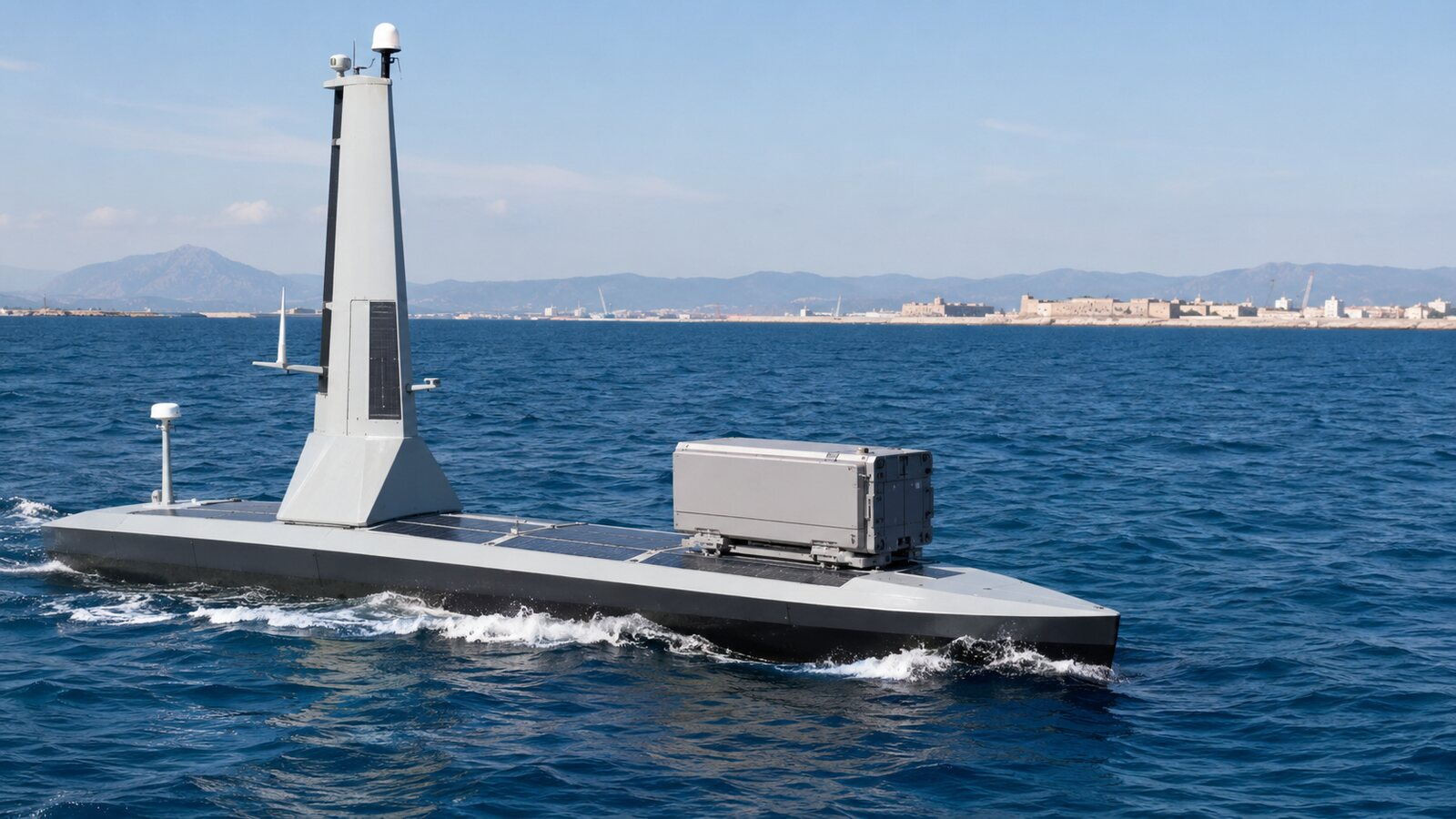
Saildrone announced a permanent European operating and manufacturing footprint on August 18, 2026. Two days later, Lockheed Martin reported that a Saildrone Surveyor had launched two Joint Air-to-Ground Missiles during a live-fire demonstration at RIMPAC. Together, the developments show progress in regional production and defense-payload integration—but they do not establish that autonomous armed fleets are broadly operational.
Saildrone establishes a permanent European base
Saildrone said it opened a European headquarters in Copenhagen, Denmark, with a ribbon-cutting ceremony on August 17. The company also announced three manufacturing agreements intended to support European production and regional operations.
- Van der Valk Shipyard in the Netherlands is slated to build the first European-produced 52-meter Saildrone Spectre.
- Umoe Mandal in Norway is expected to build the next Saildrone Surveyor.
- Southern Spars in Poland will manufacture wing structures for European-produced Saildrone vehicles.
The company presented the expansion as a way to place manufacturing, maintenance and operational support closer to European customers. Saildrone also reported that four Voyagers deployed for Denmark’s Defence Acquisition and Logistics Organisation achieved 92% operational uptime and detected more than 170,000 contacts during a three-month maritime-surveillance mission. Those performance figures are company-reported and have not been independently validated.
Surveyor launches two JAGM rounds at RIMPAC
In a separate August 20 announcement, Lockheed Martin said a Saildrone Surveyor launched two Joint Air-to-Ground Missile rounds using a JAGM Dual Launcher and the Adjunct Remote Engagement System (ARES) fire-control system. According to Lockheed Martin, the vehicle acted on targeting data associated with surrogate high-speed surface craft during the RIMPAC demonstration.
The companies also demonstrated passive electronic-warfare sensing coordinated with an MH-60S helicopter. Lockheed Martin described the event as the first in a planned series of tests. The release did not provide enough independent evidence to treat the exercise as proof of a fielded autonomous combat capability, nor did it state that both missiles struck their targets.
What the demonstration proves—and what it does not
The test shows that the Surveyor platform can host a missile launcher and participate in a controlled targeting and launch sequence. It also demonstrates integration work between Saildrone’s uncrewed surface vehicle, Lockheed Martin’s launcher and a networked command system.
It does not, by itself, demonstrate sustained combat operations, independent lethal decision-making or a production-ready fleet. Questions about operational authority, human control, rules of engagement, survivability and repeatable performance remain outside the scope of the companies’ announcement.
Spectre and the Lockheed Martin partnership
The two companies formalized their relationship in October 2025, when Reuters reported that Lockheed Martin invested $50 million in Saildrone. Saildrone says its larger Spectre vehicle is being designed to support payloads such as Lockheed Martin’s Mk70 launcher and towed sonar systems. Those integrations remain design goals until follow-on testing and customer programs confirm them.
Why this matters
For European maritime customers, local manufacturing could shorten support chains and make regional deployments easier to sustain. For defense planners, the RIMPAC event offers a concrete—but still limited—example of adding networked weapons and sensors to a long-endurance uncrewed surface platform.
The next meaningful signals will be follow-on test results, production contracts, named customer orders and evidence that the integrations perform reliably outside a controlled demonstration. Until then, the most accurate takeaway is measured progress in manufacturing and payload integration—not a fully operational autonomous combat fleet.