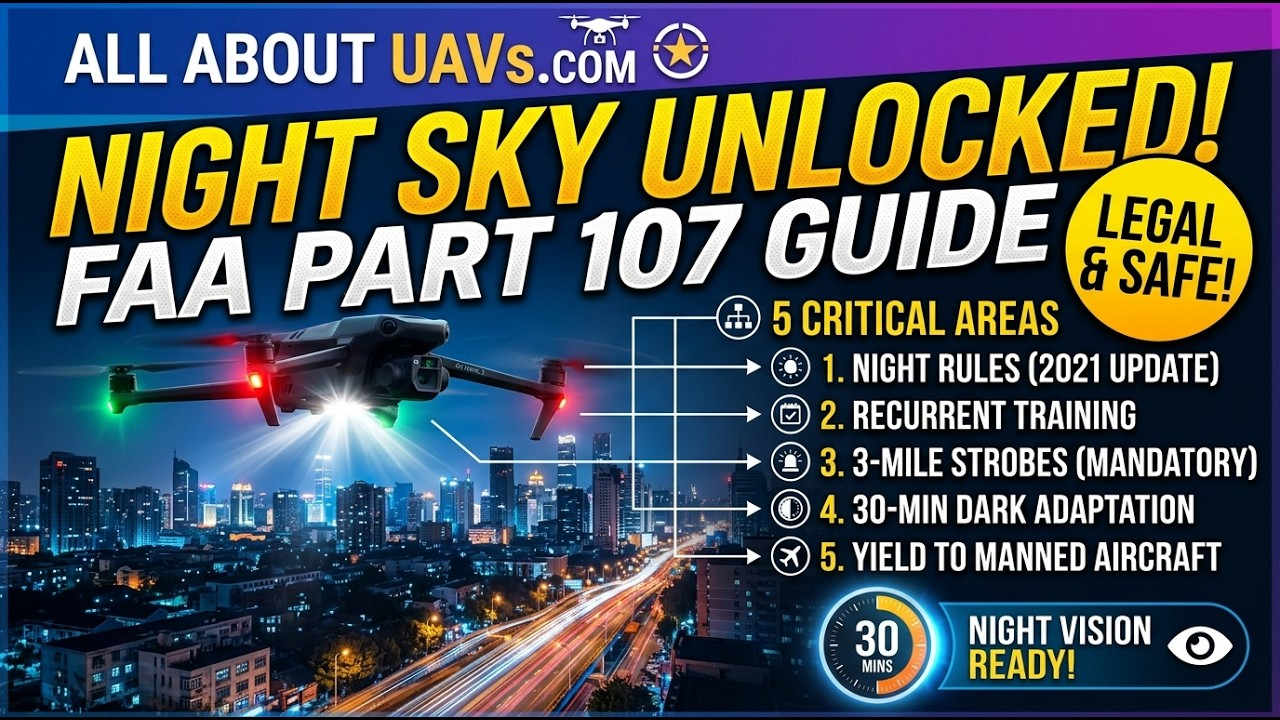
Flying a drone at night under Part 107 is legal without a routine night waiver, but only when the pilot and aircraft meet the FAA’s requirements. The remote pilot must have the required post-April 6, 2021 knowledge test or training for night operations, the drone must display qualifying anti-collision lighting, and the operation must still comply with visual-line-of-sight, airspace and right-of-way rules.
Night flights can produce striking photography and support inspections, public-safety missions and other commercial work. Darkness also makes it harder to judge distance, maintain orientation and detect obstacles. This guide expands on the video above with the current rule, a practical checklist and the mistakes most likely to create trouble.
Can Part 107 pilots fly at night?
Yes. The FAA changed the Part 107 night-flight framework in 2021. Under the current 14 CFR §107.29, routine night operations no longer require the old-style waiver when the standard rule’s conditions are satisfied.
For an operation conducted at night, the remote pilot in command must have completed an initial knowledge test or applicable training under §107.65 after April 6, 2021. Existing Part 107 certificate holders satisfy the recurrent requirement through the FAA’s online recurrent training. Pilots should confirm that their aeronautical knowledge is current before accepting a night assignment.
The three-statute-mile lighting rule
The small unmanned aircraft must have lighted anti-collision lighting that is visible for at least three statute miles and has a flash rate sufficient to avoid a collision. This is not the same as simply seeing the drone’s factory navigation lights nearby. Pilots should verify that the installed or attached anti-collision light is designed to meet the rule and is mounted where the aircraft does not obstruct it.
The remote pilot in command may reduce the light’s intensity when operating conditions make that safer—for example, when glare interferes with the crew’s ability to see the aircraft or surrounding hazards. The regulation permits reducing the intensity; it does not permit extinguishing the required anti-collision light during the operation.
Night versus civil twilight
Outside Alaska, the Part 107 civil-twilight periods run from 30 minutes before official sunrise until sunrise and from official sunset until 30 minutes after sunset. Alaska uses the civil-twilight period defined in the Air Almanac.
The anti-collision-light requirement applies during civil twilight as well as at night. The regulation’s post-2021 knowledge-test or training condition is stated in the paragraph governing operations “at night.” Regardless of the technical distinction, a pilot operating around dawn or dusk should prepare for rapidly changing visibility rather than treating twilight like an ordinary daytime flight.
Protecting night vision
Dark adaptation is gradual and can take approximately 30 minutes. A bright phone screen, vehicle headlight or work light can quickly reduce that adaptation. Assemble the aircraft while useful ambient light remains, dim displays when practical and use lighting that lets the crew work without flooding the operating area with glare.
Peripheral vision can be more useful than staring directly at a faint object because the center of the retina is less effective in very low light. Slow, deliberate scanning helps crews detect movement and avoid fixating on one point. A visual observer can add another set of eyes, but using one does not eliminate the remote pilot’s responsibility for the operation.
Visual line of sight still applies
Night does not convert a Part 107 flight into an instrument or FPV-only operation. Under §107.31, the required visual observer or flight crewmember must be able to see the aircraft throughout the flight with unaided vision other than corrective lenses. The crew must be able to determine the drone’s location, attitude, altitude and direction while scanning for traffic and hazards.
A camera feed can improve situational awareness, and binoculars may be useful momentarily, but neither replaces the continuing visual capability required by the rule. Plan a shorter operating radius at night if darkness makes aircraft orientation or surrounding hazards difficult to distinguish.
A practical Part 107 night-flight checklist
- Confirm pilot eligibility. Verify the remote pilot has completed the applicable post-April 6, 2021 test or training and remains current under Part 107.
- Check airspace and restrictions. Review controlled-airspace authorization, NOTAMs, TFRs and local operating hazards just as you would during daylight.
- Inspect the anti-collision light. Confirm secure mounting, unobstructed visibility, adequate charge and the required three-statute-mile specification.
- Survey the site before dark. Identify wires, trees, towers, uneven terrain, nearby roads and safe emergency landing areas.
- Protect the crew’s vision. Reduce unnecessary exposure to bright lights and allow time for dark adaptation.
- Set clear crew calls. Brief the visual observer, if used, on aircraft position, traffic calls, lost-sight procedures and emergency actions.
- Establish conservative limits. Set minimum battery reserve, maximum range and weather limits appropriate for reduced visibility and temperature.
- Yield immediately. Under §107.37, the small unmanned aircraft must yield the right of way to all aircraft and remain well clear.
Common mistakes to avoid
- Assuming the drone’s built-in position lights automatically satisfy the three-mile anti-collision requirement.
- Launching immediately after working under bright vehicle or site lights.
- Extending the mission until the drone is visible only as a light with no reliable sense of attitude or direction.
- Relying on the FPV display to replace visual line of sight.
- Forgetting that controlled-airspace authorization, TFRs and other restrictions still apply at night.
- Dimming the anti-collision light for convenience instead of making a safety-based decision—or switching it off entirely.
The bottom line
Part 107 night flying is accessible, but it is not casual. Complete the required training, use compliant anti-collision lighting, protect your night vision and keep the aircraft genuinely within visual line of sight. If darkness prevents you from confidently identifying the drone’s position and orientation or detecting other traffic, shorten the flight or land.
Preparing for the Remote Pilot exam? Review our guide to the 12 essential Part 107 subjects and practice with the All About UAVs Part 107 training app.
This article provides general educational information and is not a substitute for checking current FAA regulations, airspace authorizations, NOTAMs, TFRs and site-specific conditions before flight.