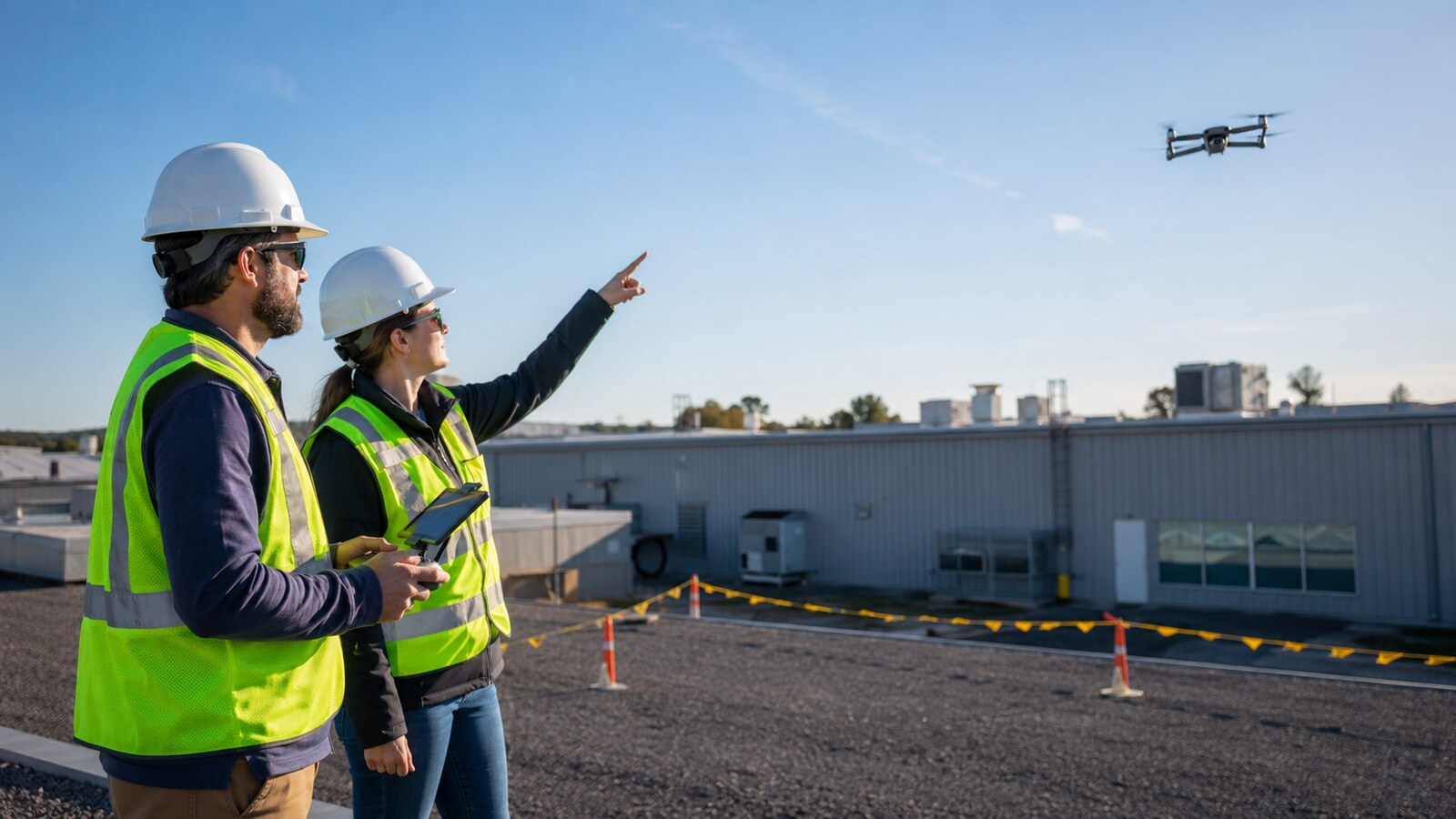
The remote pilot is concentrating on the controller as the drone approaches the far side of an inspection site. A helicopter appears low on the horizon—but the visual observer stays quiet because they assume the pilot has already seen it.
That is exactly how a visual observer becomes useless. A drone visual observer is an active crewmember who helps the remote pilot in command maintain awareness of the aircraft, surrounding airspace and developing hazards. The observer supports the decision; the RPIC still owns it.
Here are five things every RPIC and visual observer should understand before working together.
1. A visual observer is an active crewmember—not a casual spotter
Under ordinary Part 107 operations, a visual observer is not always required. Pilots often use one when buildings, trees, equipment, glare or workload make it harder to monitor the aircraft and surrounding airspace effectively.
14 CFR §107.31 requires the ability to see the aircraft throughout the flight to be exercised either by the RPIC and person manipulating the controls or by a visual observer. When an observer is used, §107.33 requires the observer, RPIC and person manipulating the controls to coordinate so they can know the drone’s location, determine its attitude and direction, scan for other aircraft and hazards, and determine whether the operation could endanger life or property.
The observer should be watching the operation—not checking a phone, talking with the client or filming behind-the-scenes footage. Their attention should move between the drone, nearby obstacles, people on the ground and the wider airspace. During an inspection, the pilot may focus on camera positioning while the observer protects the bigger picture.
The pilot flies the mission. The visual observer protects the pilot’s awareness.
2. The RPIC and observer need a communication plan before takeoff
Part 107 requires effective communication throughout the operation. “Just yell if you see something” is not a communication plan.
Before takeoff, brief the observer on:
- The planned flight area, altitude and mission objective
- Nearby airspace, roads, structures and power lines
- Where the observer should stand
- How the crew will describe the drone’s position
- Which hazards require an immediate warning
- Which words trigger a pause, return or landing
- What happens if visual contact or communication is lost
- The aircraft’s lost-link and return-to-home behavior
If radios are used, test them before launch. Both crewmembers should use the same location references. “Over there” is nearly useless; “traffic, two o’clock, low, moving left to right” gives the pilot actionable information.
On an inspection site, divide the work area into named sections such as north roof, loading dock, cooling tower and west parking lot. That makes position reports and ground-hazard warnings much clearer.
3. Good observers use short, specific and prioritized callouts
A useful traffic callout identifies the hazard, its direction, relative altitude or location, and movement. For example: “Traffic, ten o’clock, low, moving toward us.”
For a ground hazard: “Person entering from the west, 50 feet from the flight area.” For an obstacle: “Power line ahead, slightly above the drone.” If the threat requires immediate action, say so clearly: “Abort—traffic approaching.”
The pilot should acknowledge important calls so the observer knows the warning was received:
Observer: “Traffic, two o’clock, same altitude, moving left.”
RPIC: “Traffic in sight. Descending and holding.”
Avoid vague phrases such as “watch out,” “it’s getting close” or “you’re good.” Specific information supports better decisions. Vague reassurance can create false confidence.
4. The remote pilot in command remains responsible
The observer advises, but the RPIC decides. Under 14 CFR §107.19, the RPIC is directly responsible for the operation and has final authority over it.
That responsibility does not transfer because the observer missed an aircraft, a client pressured the crew, another person manipulated the controls, an obstacle sensor failed or the observer said the route looked clear.
The observer must report hazards promptly, but the RPIC decides whether to continue, reposition, return or land. If the observer loses sight of the drone, communication fails or the crew becomes uncertain about the aircraft’s location, the pilot should act immediately to restore a safe operation.
A professional briefing makes the authority clear: Anyone may call for a safety pause. The RPIC commands the aircraft.
5. Define stop-work conditions before the mission
The worst time to debate whether a condition is safe is while the drone is airborne. Agree before launch that the crew will hold, return or land when:
- The observer loses sight of the drone
- Communication between observer and pilot fails
- A crewed aircraft approaches the operating area
- An unauthorized person or vehicle enters the flight area
- Weather deteriorates beyond established limits
- The aircraft behaves unpredictably
- Battery performance falls outside the flight plan
- Either crewmember becomes uncertain about the drone’s position
The observer should never hesitate to call a concern because they fear interrupting the mission. A good RPIC welcomes early warnings.
After landing, take two minutes to discuss whether the descriptions were clear, either crewmember became overloaded, hazards were reported early enough and the observer stood in the best location. That short debrief turns an extra person on the jobsite into a more capable crewmember.
A practical visual-observer briefing
- Mission: What are we doing, and where will the drone fly?
- Positions: Where will the pilot and observer stand?
- Hazards: Which aircraft, people, vehicles, structures or weather concerns are expected?
- Communication: Which callouts and location references will we use?
- Critical calls: What requires an immediate warning or abort?
- Lost sight: What will happen if the observer can no longer see the drone?
- Lost communication: What will the pilot do if the verbal or radio link fails?
- Authority: Anyone may call a safety pause; the RPIC commands the aircraft.
The bottom line
A visual observer does not replace the remote pilot’s judgment, assume command responsibility or make an unsafe operation legal. A good observer reduces the chance that the pilot will miss something important while concentrating on the aircraft, controller or client deliverable.
The best RPIC–observer teams operate like a small flight crew: they brief before takeoff, use consistent callouts, acknowledge hazards and agree that protecting the operation matters more than finishing the shot.
For more context, review our guide to the essential Part 107 subjects and our explanation of FAA and NTSB accident-reporting rules. Pilots preparing for certification can also practice with the All About UAVs Part 107 training app.
Reviewed and updated: September 8, 2026. This article provides general operational guidance. Verify current FAA regulations, applicable waivers and site-specific requirements before operating.