
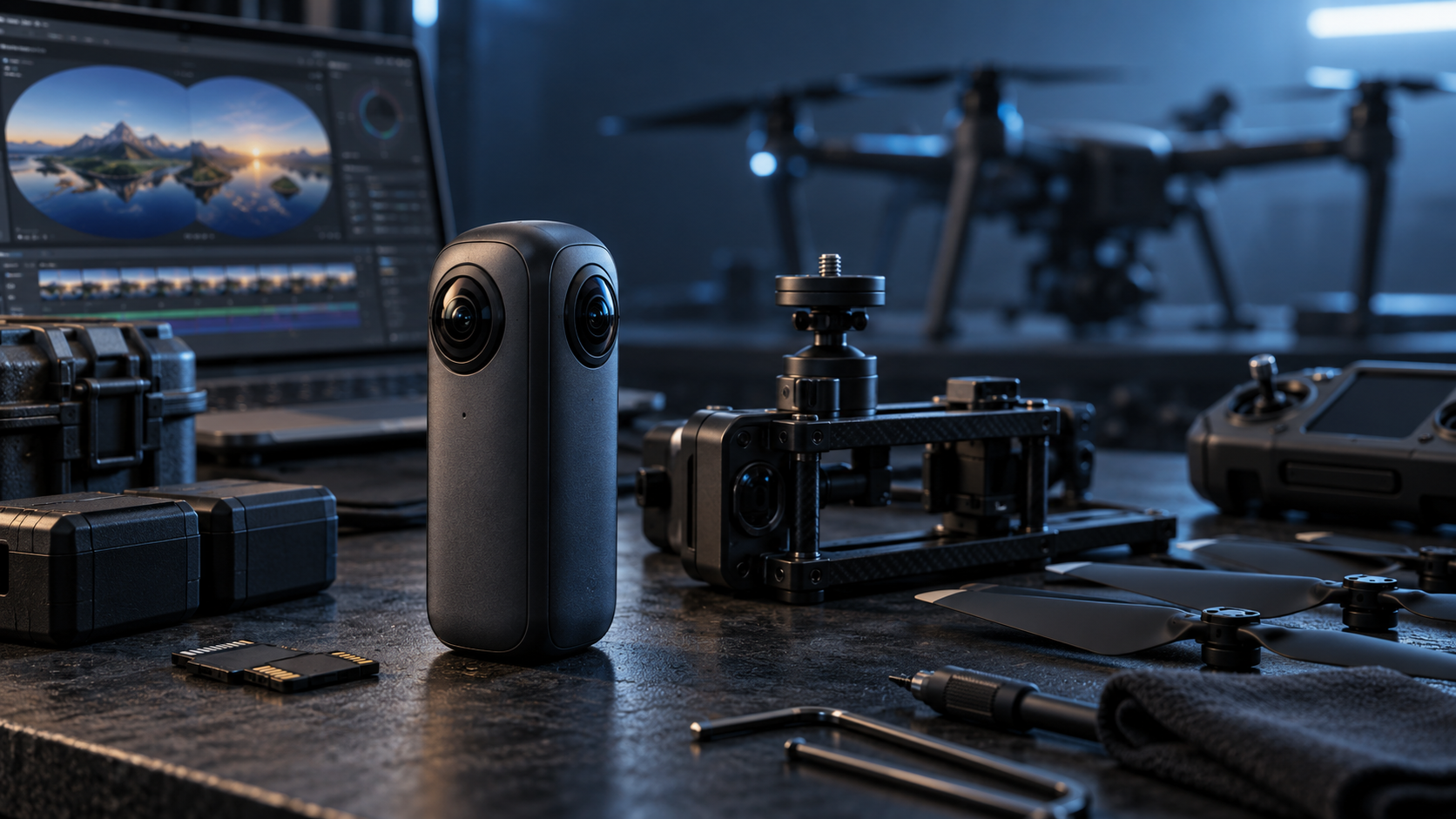
Bottom line: DJI’s Osmo 360 II is a meaningful upgrade for creators who need high-resolution reframing, tougher lenses, and a smoother DJI-centered workflow. But it is not currently a straightforward U.S. purchase, and DJI has not presented it as a plug-and-play drone payload. U.S. aerial creators should wait for domestic availability and a validated mount; buyers in supported markets should consider it mainly for action, virtual-tour, and ground-based production.
What the Osmo 360 II is meant to solve
A 360 camera records in every direction, letting an editor choose the viewing angle after the shoot. That can replace precise camera aiming on motorcycles, skis, walkthroughs, construction documentation, and some carefully engineered aerial rigs. The tradeoff is that the camera must capture and process far more image area than a conventional action camera, so resolution, low-light performance, lens durability, storage, heat, and post-production all matter.
DJI announced the Osmo 360 II on September 3, 2026. Its headline changes are a square 1-inch-class HDR sensor, native 8K/60 fps 360-degree recording, 120-megapixel HDR panoramas, 105GB of internal storage, and user-replaceable lenses. Those specifications come from DJI’s launch announcement; independent lab testing was not available for this analysis.
The important specifications—and what they mean
8K/60 fps and the new sensor
DJI says the square sensor uses 25% more of its area than a conventional rectangular design while preserving a 360-degree field of view. It also claims 14.5 stops of dynamic range and 2.4-micrometer pixels. The practical promise is cleaner shadow detail and better highlight retention, particularly in scenes that combine sky, reflective surfaces, and deep shade.
Native 8K at 60 fps is valuable for fast movement and for reframing a small portion of the sphere into a conventional video. It does not “eliminate” motion blur, however. Shutter speed, lighting, stabilization, subject speed, stitching, and export resolution still determine the final result. DJI’s AI SuperNight 2.0 and dynamic-range figures should also be treated as manufacturer claims until controlled reviews compare them with competing cameras.
Durability, storage, and battery
The 183-gram camera includes 105GB of built-in storage and replaceable lenses with what DJI calls an ultra-hard optical film. Replaceability is arguably the most practical improvement: protruding 360-camera lenses are vulnerable, and a damaged fixed lens can turn a small accident into a costly repair.
DJI rates continuous recording at up to 100 minutes in 8K/30 fps and says the battery can reach 80% in 22 minutes. Those are controlled-condition figures, not guarantees for cold weather, continuous wireless use, or high-bitrate field work. The camera is rated waterproof to 10 meters without a case and to 50 meters with DJI’s Invisible Waterproof Case, according to the company.
Workflow advantages
- Post-production flexibility: capture first and select the view later, useful when action is unpredictable.
- DJI color and audio ecosystem: 10-bit recording and D-Log M can simplify matching with compatible DJI cameras, while direct OsmoAudio connections support several DJI Mic models.
- Professional editing path: DJI says footage exported through DJI Studio can move into DaVinci Resolve using a dedicated plugin.
- Fast field handling: NFC pairing, internal storage, dual-sided magnetic mounting, and a standard 1/4-inch thread reduce setup friction.
The hidden cost is data and editing time. 8K/60 files are large, 360 footage typically needs stitching or reframing, and smooth editing may require a strong computer, fast external storage, spare batteries, protective cases, and replacement lenses. Buyers should price the complete production kit rather than the camera alone.
The drone-mounting question
The source report describes compatibility with DJI Matrice aircraft, FPV drones, and custom cinelifters. DJI’s official launch materials do not verify those aircraft integrations, name an approved aerial mount, or claim automatic drone removal. A 1/4-inch thread makes custom rigging possible; it does not establish safe compatibility.
Any external payload changes aircraft weight, balance, drag, endurance, vibration, obstacle sensing, and possibly warranty coverage. Operators should use a mount validated for the exact aircraft, confirm center of gravity and retention, conduct conservative flight tests, and remain within the aircraft manufacturer’s limits. For commercial operations in the United States, the aircraft remains subject to Part 107 requirements. The FAA notes that the sub-250-gram registration exception applies only to qualifying recreational operations—not Part 107 flights. See the FAA registration guidance and our guide to buying a commercial drone under Part 107.
Price, availability, and alternatives
DJI launched the Standard Combo at €589 and the Creator Combo at €739 in Europe. More importantly for All About UAVs readers, reputable launch coverage reported that the Osmo 360 II was not available in the United States at launch because authorization applications were still pending. DJI’s U.S. announcement links to product information but does not provide a U.S. purchase price or delivery date. Do not use converted European pricing as a promised U.S. price.
Buyers who need a camera immediately should compare currently available models from Insta360 and GoPro. The right alternative depends less on headline resolution than on low-light image quality, stitching artifacts, replaceable-lens strategy, editing software, audio support, warranty service, and the mounts already owned. Existing DJI Mic and DaVinci Resolve users may place more value on the Osmo workflow; teams standardized on another 360 platform may not gain enough to justify switching.
Who it is for—and who should skip it
Consider it if you work in a supported market, routinely reframe fast action, need 8K/60 capture, frequently risk lens damage, or can benefit from DJI microphones and D-Log M. Virtual-tour producers and spatial-documentation teams may also value the 120MP panoramas, but should validate stitching quality and their delivery software before standardizing.
Skip or wait if you are in the United States, need an off-the-shelf drone payload, edit on modest hardware, rarely reframe footage, or already own a capable 360 system with a mature workflow. A conventional action camera will remain simpler when the shot direction is known.
Recommendation: the Osmo 360 II looks promising on specifications, with replaceable lenses and 8K/60 recording as its clearest advantages. For U.S. buyers and drone operators, it is a watchlist product—not a purchase recommendation—until availability, pricing, independent image-quality results, and aircraft-specific mounting are established.
Disclosure: This article contains no affiliate links. All About UAVs did not receive or test the camera. The featured image is an AI-generated editorial illustration, not a product photograph.