Affiliate Disclosure: This article contains affiliate links. If you make a purchase through one of these links, All About UAVs may earn a commission at no additional cost to you. These relationships do not influence our editorial analysis or recommendations.
Consumer drones have spent years chasing larger sensors, longer endurance, greater range, and increasingly sophisticated flight systems. The DJI Neo takes almost the opposite approach. At approximately 135 grams, it is designed to make aerial video feel less like operating specialized aviation equipment and more like pulling out a camera when an interesting moment appears.
That shift is what makes the Neo interesting. Its specifications are modest compared with larger prosumer aircraft, but its combination of palm launch, full propeller protection, automated subject tracking, 4K recording, built-in storage, smartphone control, and compatibility with more advanced DJI controllers gives it an unusually broad role. It can be a first drone, a travel camera, an autonomous vlogging tool, or even a gateway into FPV.
DJI Neo specifications and design
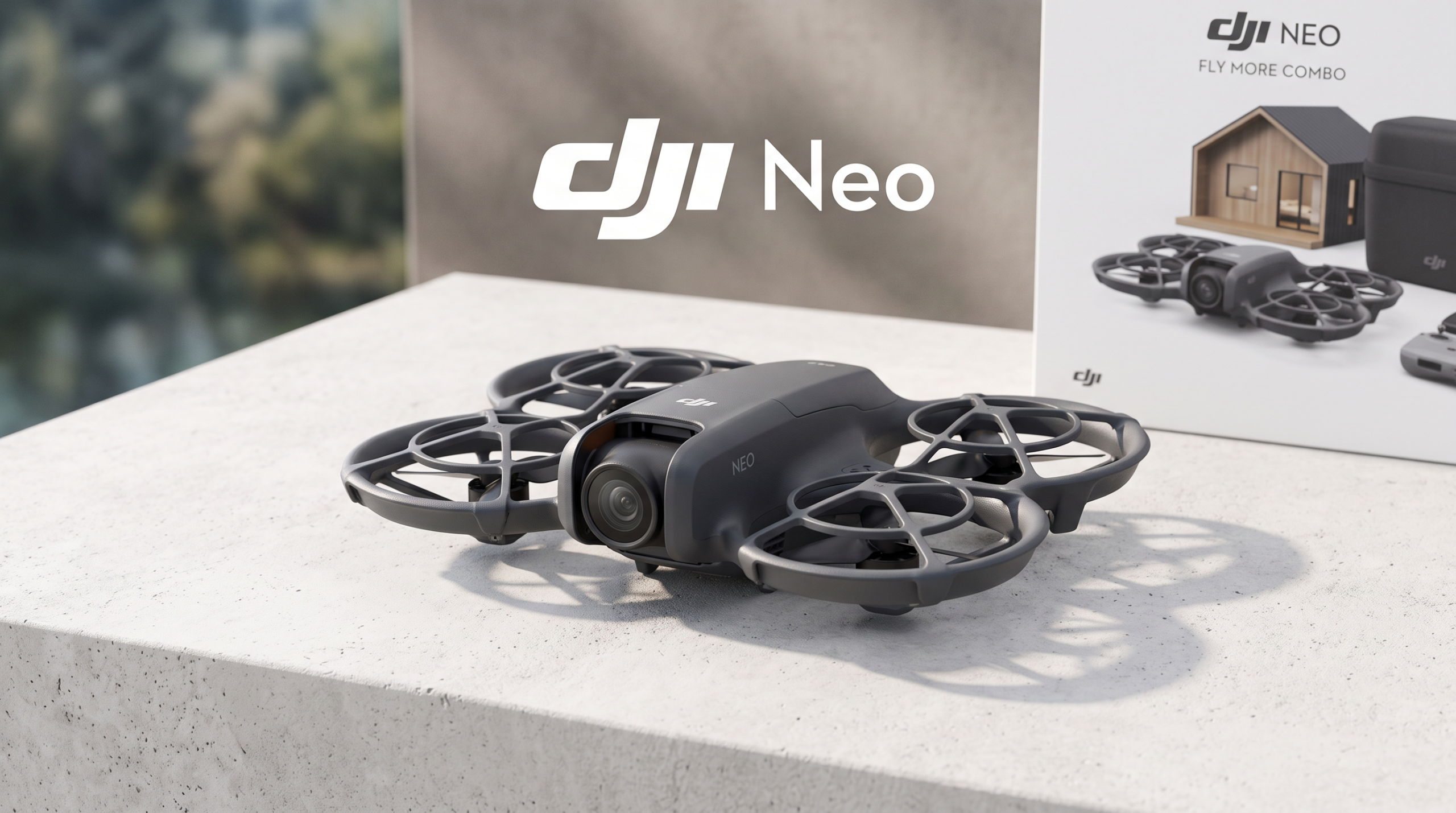
DJI lists the Neo at approximately 135 g. That low mass makes the aircraft exceptionally portable and contributes to one of its defining features: palm-based takeoff and landing. Full-coverage propeller guards further support close-range operation and reduce some of the intimidation that exposed propellers create for new pilots.
The camera uses a 1/2-inch image sensor capable of 12 MP still photography and stabilized 4K video at up to 30 frames per second. Rather than the three-axis mechanical gimbal found on many traditional camera drones, the Neo combines a single-axis mechanical gimbal with electronic stabilization technologies including RockSteady and horizon balancing.
That distinction helps define the product. The Neo is optimized for fast social and travel content rather than replacing a larger cinematic drone. Its stabilization is designed to produce usable footage from a tiny aircraft, but users seeking maximum low-light quality, dynamic range, or traditional three-axis gimbal performance should look higher in the camera-drone market.
Flight time, storage and control
DJI rates maximum flight time at approximately 18 minutes under controlled conditions, with actual endurance depending on wind, temperature, flight behavior, recording demands, battery condition, and configuration. That is shorter than many conventional camera drones, but reasonable for an aircraft built around extreme portability.
The Neo includes 22 GB of internal storage, eliminating another common point of friction: remembering and managing a removable memory card. For spontaneous shooting, built-in storage helps the aircraft behave more like a consumer camera appliance.
Control flexibility is one of the Neo’s strongest advantages. Basic automated shooting can be launched without a conventional controller. Users can also operate the aircraft through the DJI Fly app, pair it with supported DJI remote controllers, or move into compatible goggles and FPV-style controls. This creates a natural progression from simple automated shots to more deliberate manual flying.
Who is the DJI Neo really for?
The clearest audience is the solo content creator. Vloggers, travelers, hikers, cyclists, and outdoor creators often need footage of themselves without another person behind the camera. Automated tracking and preset flight movements allow the Neo to act as a compact aerial camera operator for short sequences.
Travelers are another natural fit. Conventional drone equipment can become an expedition of its own once the aircraft, controller, batteries, chargers, accessories, and case are packed. The Neo’s tiny airframe and controller-free shooting options reduce that burden substantially.
First-time pilots may benefit even more. Full propeller guards, automated flight modes, palm launch, and smartphone control reduce several psychological and practical barriers to entry. A new owner can capture useful footage before becoming proficient with traditional stick controls.
Automation should not be confused with hands-off aviation, however. Pilots remain responsible for monitoring the aircraft, understanding the environment, respecting airspace restrictions, and accounting for wind and obstacles.
The important FAA weight distinction
The Neo’s 135 g weight has a meaningful regulatory benefit in the United States, but it is easy to describe that benefit too broadly. Drones under 250 g generally do not require FAA registration when flown strictly under the recreational exception and otherwise meeting the applicable conditions.
That exemption does not mean a sub-250 g drone is universally registration-free. Part 107 operations still require aircraft registration. Remote ID requirements are also tied in part to whether the drone is required to be registered. Pilots should evaluate the rules based on the type of operation rather than assuming the aircraft’s weight alone settles the question.
DJI Neo vs. HoverAir X1
HoverAir helped establish the modern pocket-sized autonomous flying-camera category, and its X1 family remains a logical comparison. Both product lines emphasize fast deployment, subject tracking, protected propellers, and reducing the need for traditional piloting during common creator shots.
The important caution is that HoverAir now offers multiple X1-family models with different cameras, flight characteristics, features, and prices. Buyers should compare the specific HoverAir model they are considering rather than treating the entire X1 family as one specification.
The Neo’s major strategic advantage is the breadth of DJI’s ecosystem. A buyer can begin with automated palm-launched filming and later move into conventional remote control or compatible FPV hardware. That makes the aircraft appealing to users who do not yet know how deeply they want to enter the hobby.
DJI Neo vs. DJI Mini series
A DJI Mini-series aircraft solves a different problem. Models such as the Mini 4K follow the traditional GPS camera-drone formula, including a three-axis mechanical gimbal and conventional remote-control operation. That makes them stronger choices for pilots who want deliberate aerial photography, landscape composition, smoother mechanical stabilization, and the experience of actively flying a camera drone.
The Neo instead prioritizes immediacy. It is the better conceptual fit when the desired shot is “follow me while I walk down this trail” rather than “fly out and compose a cinematic landscape from 200 feet away.”
Where action cameras still win
The Neo also overlaps with GoPro and Insta360-style action cameras. The difference is perspective. An action camera normally remains attached to a person, vehicle, helmet, pole, or stationary mount. A small drone can detach from the subject and create third-person moving shots that would otherwise require another camera operator.
Action cameras remain preferable when weather resistance, very long recording sessions, impact tolerance, flight restrictions, or body-mounted perspectives are the priority. For many creators, the two tools are complementary rather than competitors.
The Neo’s biggest limitation is also its purpose
Physics still collects its fee. An aircraft this light cannot match the wind authority of heavier platforms, and approximately 18 minutes of maximum flight time leaves less margin for long shooting sessions. The compact imaging and stabilization system also involves compromises compared with larger camera drones.
But those limitations are the consequence of the same design decisions that make the Neo appealing. DJI has traded some endurance, camera sophistication, and weather authority for an aircraft small enough and simple enough to become an everyday carry device.
Why the DJI Neo matters to the wider drone market
The Neo represents a broader change in consumer drones. Early consumer aircraft sold users on the experience of flying. Products like the Neo increasingly sell the experience of being filmed.
That changes which specifications matter. Tracking quality, launch speed, automated framing, propeller protection, noise, charging convenience, editing workflow, and social-media integration become more important when the target customer thinks of the device as a camera rather than an aircraft.
DJI’s ecosystem strategy strengthens that position. Someone can enter through the easiest possible use case and gradually add complexity through remote controllers, goggles, or other compatible hardware. Instead of requiring customers to understand the drone hobby before purchasing, the Neo gives them room to grow into it.
Bottom line
The DJI Neo is not a miniature replacement for every camera drone. It is a different interpretation of what a consumer drone should be. Its approximately 135 g weight, palm launch, protected propellers, 4K recording, automated tracking, internal storage, and flexible control options make aerial video accessible to people who may have little interest in becoming traditional drone enthusiasts.
For vloggers, travelers, families, first-time pilots, and creators who prioritize spontaneous footage, that reduced friction may matter more than another increment of range or sensor size. And if the category continues moving in this direction, the next wave of mainstream drones may be judged less by how far they can fly than by how effortlessly they become part of everyday photography.