AirData has added cloud recording and a 10-minute rewind to its drone live-streaming service. For Drone as First Responder (DFR), remote inspection and beyond-visual-line-of-sight (BVLOS) teams, the practical value is fast review and an off-aircraft copy of mission video. The feature can strengthen evidence and operational review, but it does not by itself satisfy every record-retention, privacy or proposed Part 108 requirement.
What AirData added to drone live streaming
AirData announced the update on September 10. Its new Stream Recording and Rewind tools let authorized viewers move backward through as much as 10 minutes of an active feed and then return to live video. A team can also begin saving a recording after an event and include up to the preceding 10 minutes, or configure streams to record automatically.
The company says recordings are written to the AirData account while the aircraft is streaming, leaving a copy that does not depend on recovering the drone or its onboard storage. Administrators can select retention periods, and shared recordings can use a PIN, expiration date and QR code. The service accepts streams from the AirData app as well as RTMP, RTSP and SRT sources, including some docks, third-party flight applications and encoders.
DRONELIFE independently reported the release and its intended use in remote operations. AirData lists the feature as an add-on for Live Streaming customers; public pricing was not included in the announcement.
Why a 10-minute rewind can matter in DFR operations
A live feed is useful only if the right person sees the right moment. In a DFR response, a commander or analyst may join after the aircraft reaches the scene. Rewind can let that viewer review the original imagery without asking the pilot for a verbal recap or waiting for the flight to end.
AirData quotes Huntsville Police Department UAS coordinator Chad Tillman as saying his team has used the new tools to pause, rewind, zoom and capture details during unfolding events. That is a customer testimonial, not an independent performance study, but it illustrates the operational problem the feature is designed to address.
Retroactive recording may also preserve the lead-up to an event that operators did not initially recognize as important. For public-safety agencies, however, easier retention creates governance obligations. Programs should define who may view, export and share footage; how long it is retained; how public-records and evidentiary requests are handled; and when imagery unrelated to an incident should be deleted.
The value for remote inspection and dock-based flights
In an inspection, an engineer may notice a questionable condition after the drone has passed it. Reviewing the stream immediately can help the team decide whether to revisit the asset before the aircraft returns to its dock. That can reduce avoidable relaunches and give remote specialists better context while the mission is still active.
The independent cloud copy also adds resilience when onboard media is damaged, unavailable or not promptly retrieved. It should be treated as a secondary record, not a guaranteed replacement for full-resolution sensor data. A compressed live stream may lack the resolution, metadata, thermal radiometry or positioning information needed for a defensible technical inspection.
Operators evaluating dock-based workflows should pair video handling with the broader questions in our drone-in-a-box buying guide: communications reliability, remote supervision, contingency procedures, cybersecurity and the actual operating authority for each mission.
What this does—and does not—mean for Part 108
AirData positions recording alongside its flight, aircraft, personnel and maintenance data as support for more complex operations. That is sensible preparation, but proposed rules must be described carefully. The FAA’s Part 108 framework is not a final rule, and the new AirData feature does not create BVLOS authority or certify an operation as compliant.
Mission video can help with internal review, training and incident reconstruction, but it is not interchangeable with required flight, maintenance, personnel or training records. An organization should map each data field and retention period to the rule, waiver, certificate, contract, state law and agency policy that actually applies. It should also test whether timestamps, access logs, export formats and chain-of-custody controls meet its intended use.
Five questions for drone-program managers
- What quality reaches the cloud? Test resolution, latency, frame loss and performance on the cellular networks used in the field.
- Who controls the recording? Separate pilot, viewer, administrator and external-sharing permissions.
- Where is data stored? Confirm the selected region, encryption, retention, deletion and backup behavior.
- What survives an outage? Determine what happens when bandwidth falls, the stream disconnects or the aircraft switches networks.
- What is the authoritative record? Define whether the stream, onboard media, telemetry log or processed dataset governs each type of review.
What to watch next
The useful evidence will be operational, not promotional: measured latency and reliability, export quality, access-control audits, customer retention policies and documented results from real DFR or inspection programs. Pricing and storage limits will also determine whether routine recording is practical at fleet scale.
AirData’s release is a focused software improvement rather than a regulatory breakthrough. Its value is that it helps distributed teams recover a missed moment and preserve a second copy while a mission is still underway. Programs that add clear privacy, security and records procedures around that capability may gain a more reliable review workflow without overstating what the tool proves.
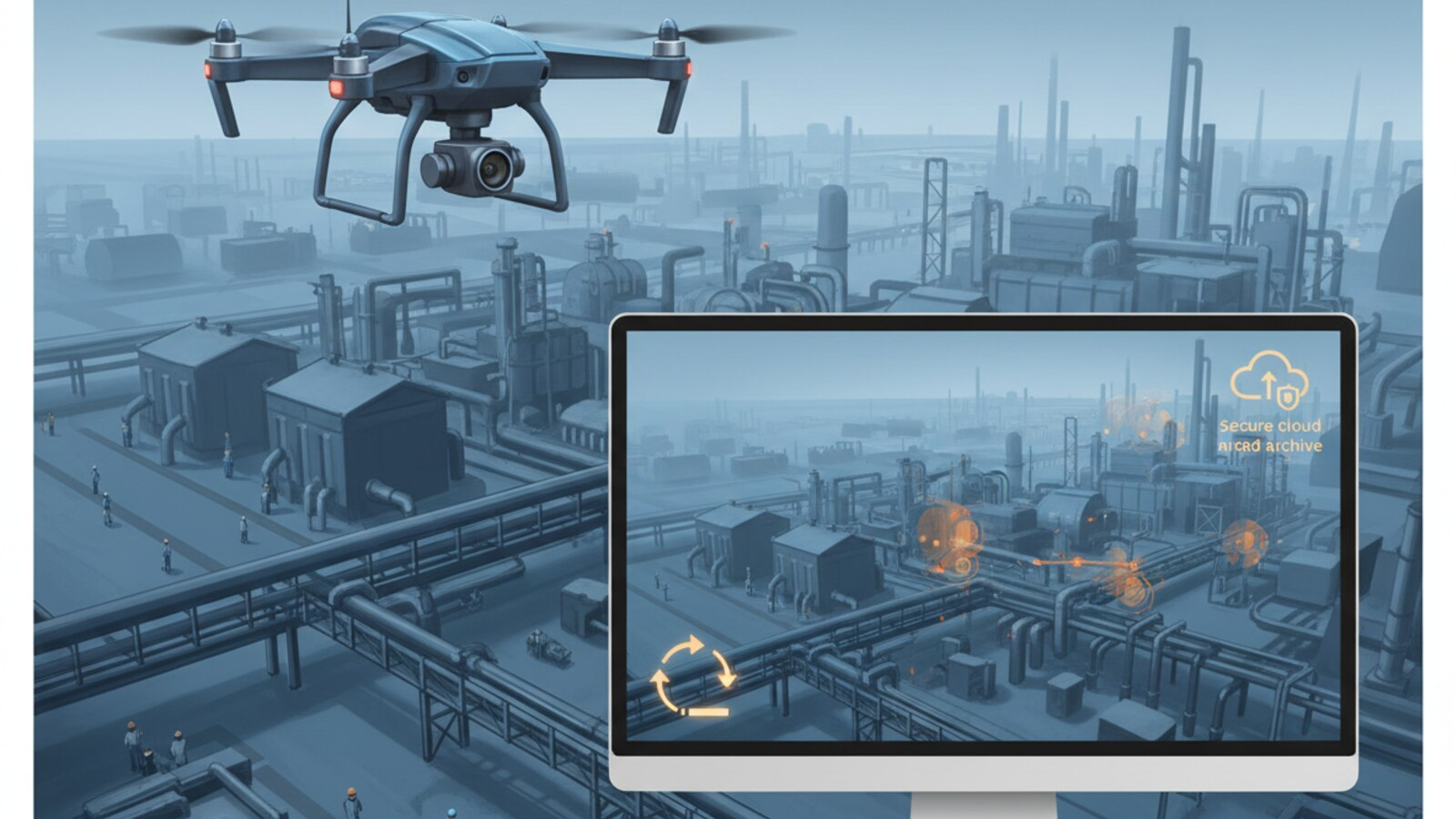
Disclosure: This article contains no affiliate links or paid placement. Product capabilities are based on AirData’s announcement and are identified as company claims where appropriate. The featured image is an original AI-generated editorial illustration and does not reproduce the AirData interface.