The XAG V40 is an unusual agricultural drone built around two tilting rotors instead of a conventional four- or eight-rotor frame. Its 16-liter spray tank, 25-liter spreading system and compact folding design still make it relevant to orchard and specialty-crop operators—but in the United States, the decisive questions are now parts, software, dealer support and FCC rules rather than headline performance.
This review is based on manufacturer documentation, dealer listings and the cited sources. All About UAVs has not operated or tested the V40.
Who the V40 is for
The V40 was designed for spraying, granular spreading and field mapping on smaller farms, orchards, vineyards and uneven terrain. Its twin-rotor layout produces a narrower, more concentrated downdraft than a typical quadcopter, according to XAG. That may help droplets move into a crop canopy, but deposition depends on height, speed, droplet size, wind, crop structure and the product label. A marketing claim about penetration is not a substitute for water-sensitive paper or a local calibration trial.
Verified specifications
| System | Published specification |
|---|---|
| Airframe | Tilting twin-rotor; model 3WWDZ-15.2AH; IP67 rating |
| Weight | 29.8 kg with battery and empty liquid tank (global version) |
| Maximum takeoff weight | 48 kg (about 106 lb) |
| Spray system | 16 L tank, dual peristaltic pumps, 60–400 μm adjustable droplets |
| Maximum spray flow | 10 L/min total |
| Published spray width | 5–10 m, depending on operating conditions |
| Spreading system | 25 L container; manufacturer claim of up to 40 kg/min |
| Positioning | RTK-assisted autonomous flight through the SuperX 4 system |
| Obstacle sensing | Multi-directional radar; published detection range of 1.5–40 m |
| Maximum published speed | 8 m/s (XAG global spec sheet; some dealer listings show 6 m/s) |
XAG’s original 2021 launch material describes the V40 as a three-function platform for mapping, spraying and broadcasting. XAG’s global specification sheet and XAG Australia’s listing confirm the core 16-liter, 25-liter and 10-liter-per-minute figures. The manufacturer’s IP67 rating indicates resistance under a defined laboratory standard; it does not make the aircraft immune to chemical corrosion or authorize pressure washing every component without following the maintenance manual.
What the twin-rotor design changes
The two large rotors tilt for forward flight while the central body remains relatively level. This reduces the number of propulsion motors compared with a quadcopter and allows the arms and propellers to fold into a compact transport shape. XAG says the concentrated wind field can improve spray penetration. The design also creates a less familiar maintenance and handling profile: operators need model-specific training, safe stand-off procedures and access to the correct rotor, arm and control-system parts.
Fewer motors do not automatically mean lower lifetime cost. Cost depends on part prices, service access, accident repairs, battery condition and software support. Buyers evaluating a used V40 should request a maintenance history and inspect the propulsion hinges, radar, pumps, hoses, tank seals, battery connectors and charger.
Availability and price
XAG still maintains the V40 product and specification pages and includes the aircraft in its online product catalog. Even so, dealer availability is uneven and newer P-series models receive more prominent marketing, so buyers should confirm whether an offer is current production, remaining stock or used equipment. As of October 20, 2026, XAG Australia lists a V40 Standard package at AUD $15,000, but the page shows it as sold out. That is not a U.S. list price and should not be used to value a complete American package.
U.S. availability is particularly uncertain. Raptor Dynamic, a former XAG dealer, announced on July 27, 2026 that it was ending new XAG drone sales in the United States while continuing to support existing aircraft with parts, service and technical support. AgriFuture describes itself as an official U.S. XAG distributor, but its current public product lineup does not show the V40. A buyer should therefore treat any new-old-stock or used V40 offer as configuration-specific and verify the serial number, lawful ownership, activation status and support path before paying.
U.S. regulatory and application questions
A spray drone is only one part of a legal application operation. Commercial flying generally requires an FAA Remote Pilot Certificate, registration and Remote ID compliance. With a published maximum takeoff weight of 48 kg (about 106 lb), a fully loaded V40 is above the 55-pound Part 107 limit, so operators should expect to need a Section 44807 exemption in addition to Part 137 agricultural-aircraft authority. Applying pesticides by aircraft also brings state applicator-licensing and product-label requirements. Operators should confirm the exact aircraft weight, tank configuration and planned chemical work with the FAA and applicable state agencies rather than relying on a dealer summary.
FCC rules add a second layer. On December 22, 2025, the FCC added foreign-made drones and critical drone components to its Covered List, which blocks new equipment authorizations for them. Aircraft that were already authorized can still be used, but no new foreign-made model can be authorized for import or sale. A July 21, 2026 FCC proposal on so-called military-grade drones (PS Docket 26-189) goes further: it covers drones that dispense pesticides and other “economic poison,” as well as aircraft weighing 55 pounds or more, and it names XAG. The V40 falls into both categories. The comment period closed on September 2, 2026, and we found no final rule as of October 20, 2026. As proposed, it would affect import and sale rather than the use of aircraft already owned, but it could further shrink the supply of new-old-stock aircraft and parts.
For public agencies and government-funded buyers, procurement rules may be more restrictive than ordinary civilian ownership. The full configuration—including aircraft, controller, radio, cameras, batteries and software services—should be checked against the specific contract or grant language.
Ownership checklist
- Confirm the exact model year, serial numbers and included RevoSpray, RevoCast and RealTerra hardware.
- Ask for the aircraft’s FCC ID and confirm the grant is still active.
- Demonstrate successful activation, firmware access, RTK connectivity and an autonomous test flight before purchase.
- Obtain written identification of the U.S. parts and repair provider.
- Check battery cycle counts, storage history and replacement availability.
- Verify the charger, generator and electrical configuration rather than assuming an overseas package works with U.S. power.
- Run a water-only calibration and document flow, swath and droplet behavior before applying chemicals.
Alternatives
A buyer wanting current manufacturer support should compare the V40 with newer XAG P-series systems and current DJI Agras models, plus domestic or distributor-backed agricultural platforms; note that the same FCC rules apply to other foreign-made spray drones. Compare complete working packages, not tank size alone: training, batteries, charging, RTK, software, parts inventory and local repair capability often determine uptime. For an existing V40 owner, keeping a proven aircraft may be reasonable if parts and software access are documented; for a new fleet, an actively supported model is usually the safer operational choice.
Recommendation
The V40 remains an inventive, compact agricultural platform with credible published spraying and spreading specifications. For U.S. buyers, it is best considered a configuration-specific purchase that requires written confirmation of inventory, activation, parts and service support—not an uncomplicated off-the-shelf acquisition. Do not rely on an old price estimate or the continued existence of a product page. Proceed only when the seller can demonstrate a complete, functioning configuration and identify who will supply batteries, parts, software and repairs in the United States—and keep an eye on the FCC’s pending military-grade drone rule.
Sources
- XAG: V40 official product page
- XAG: V40 specifications
- XAG: global V40 and P40 launch announcement
- XAG Australia: V40 specifications and availability
- Raptor Dynamic: July 27, 2026 U.S. sales update
- AgriFuture: U.S. XAG distributor site
- Holland & Knight: FCC moves to restrict foreign-made drones (September 2026)
- DroneLife: FCC proposal could cover agricultural spray drones
- Virginia Tech: spray-drone technology, regulation and field operations
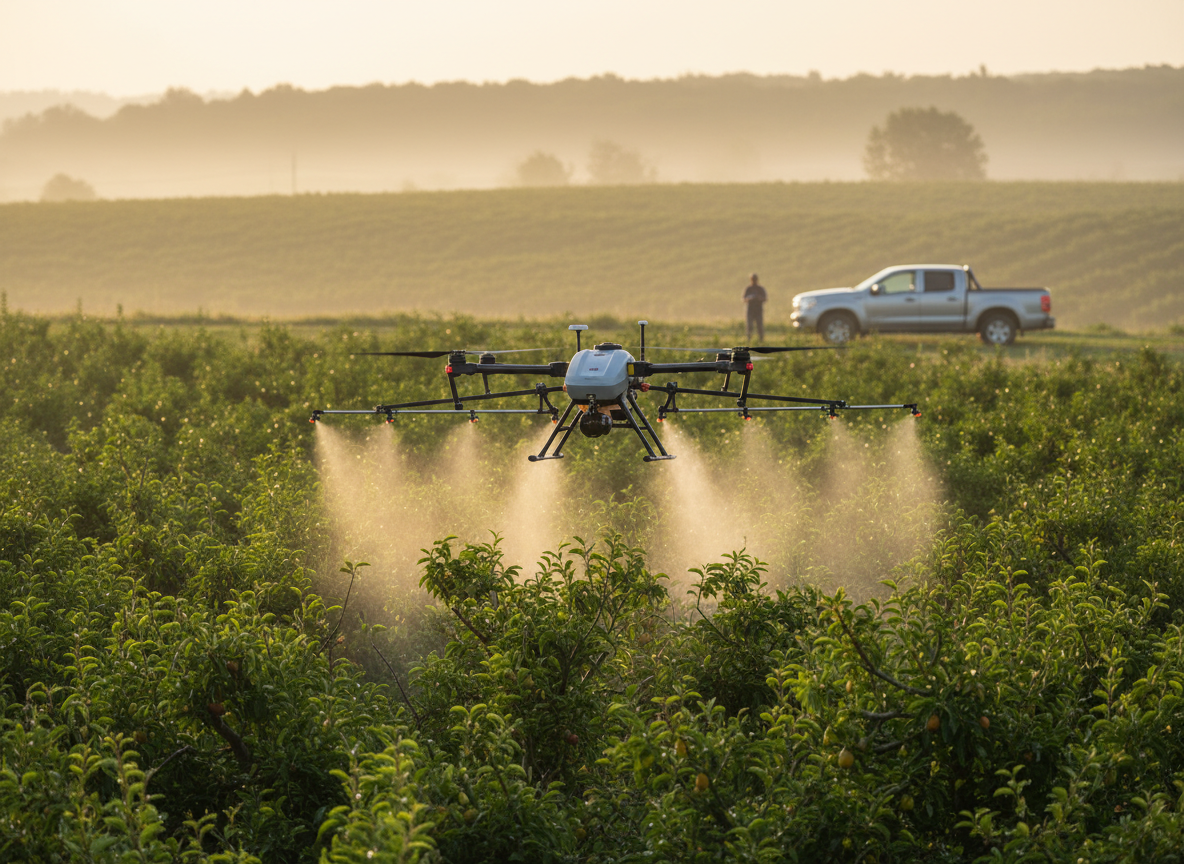
Disclosure: This independent article is based on manufacturer documentation, dealer information and other cited public sources. All About UAVs has not tested the XAG V40. No manufacturer or dealer sponsored or controlled the editorial conclusions. The featured image is an original AI-generated editorial illustration and does not depict an exact production configuration.
Leave a Reply