
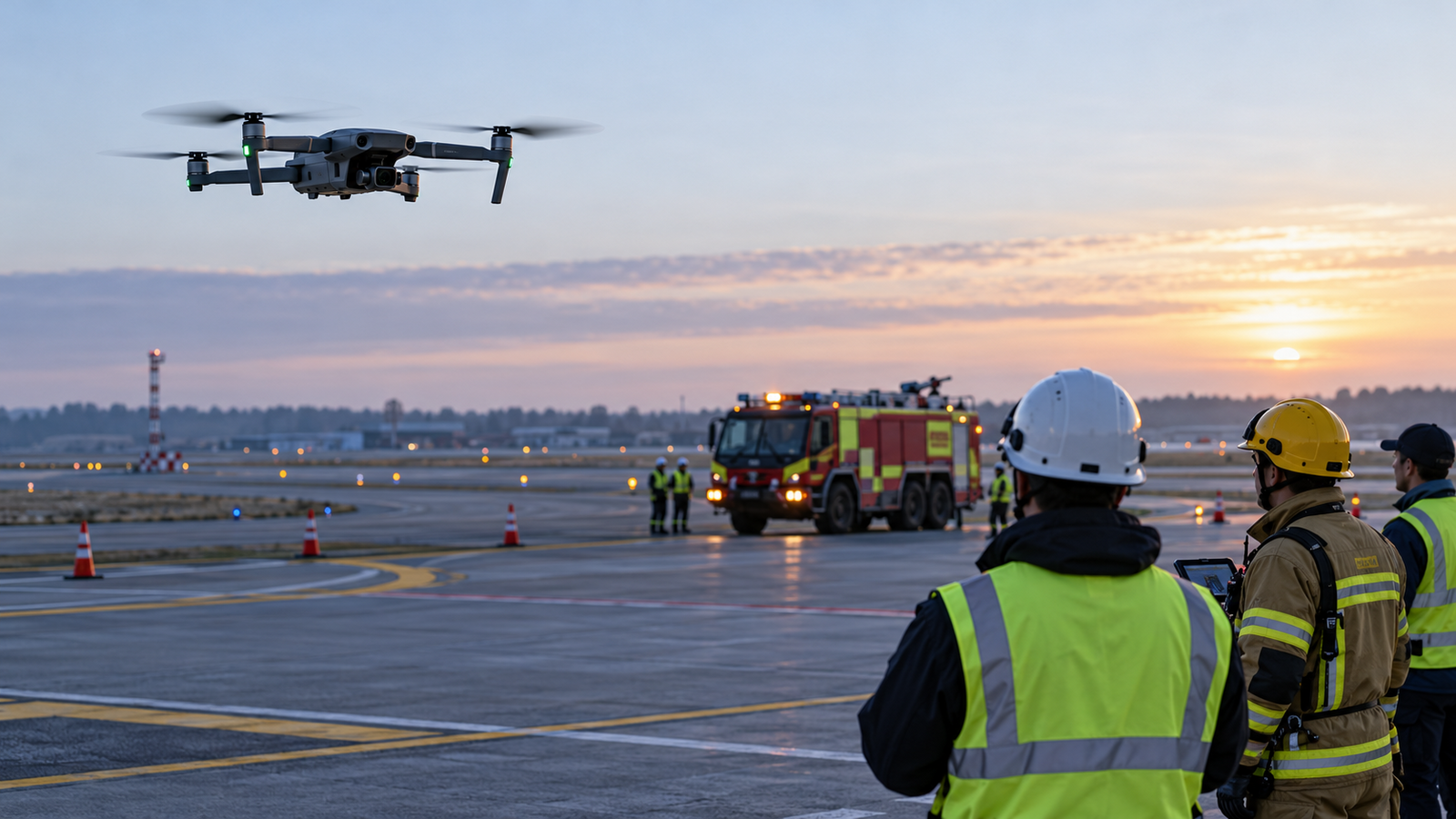
The takeaway: The FAA has clarified how airport sponsors must request approval before using small drones in airport emergency exercises. Part 107 operations in controlled airspace go through FAADroneZone, while Part 91 operations require a Certificate of Authorization through CAPS regardless of airspace class. The October 9 update is procedural—not a new permission to fly—and it reinforces an important point for airport teams: an exercise plan, local coordination and an airspace approval are separate requirements.
What the FAA changed for airport emergency exercise drones
In an October 9 update to its On Airport Unmanned Aircraft System Operations guidance, the FAA added a specific instruction for airport sponsors planning to use small UAS in controlled airspace during emergency exercises, including exercises conducted under 14 CFR 139.325(h). Sponsors must apply for airspace access with enough lead time for the agency to process the request before the planned operation.
The approval route depends on the operating framework. For a Part 107 operation in controlled airspace, the sponsor applies for an airspace authorization through FAADroneZone. For a Part 91 operation, the sponsor applies for a Certificate of Authorization, or COA, through the FAA’s CAPS system regardless of the airspace classification.
That distinction matters because “airport drone operation” is not a single regulatory category. An airport authority or its contractor may operate under Part 107 for one mission and under a public-aircraft COA for another. The FAA’s update does not merge those paths, create automatic emergency-exercise authority or say that a locally approved drill can proceed without federal airspace access.
Why LAANC is not the answer for an on-airport exercise
The FAA’s airport guidance also draws a boundary that can be easy to miss: any operator proposing to fly from airport property must submit the authorization request through FAADroneZone, and LAANC cannot be used to request authorization for an on-airport operation.
That is narrower than the general Part 107 workflow familiar to many public-safety pilots. LAANC can provide eligible controlled-airspace authorizations near participating airports, but the location and character of an on-airport flight introduce additional coordination needs. Our recent analysis of DroneSense’s native LAANC integration explained how in-app authorization can reduce app switching; the new airport-exercise clarification shows why teams still need to identify missions that must leave the normal LAANC path.
For planners, the practical lesson is to classify the proposed operation before choosing a submission channel. The airport sponsor should document whether the flight is Part 107 or Part 91, whether it launches or lands on airport property, the controlled-airspace boundaries involved and which FAA system applies. A familiar software interface should not determine the legal pathway.
What the guidance does not authorize
The October update does not amend Part 107, grant a waiver or establish blanket permission for airport emergency drills. It also does not replace the airport’s responsibility to coordinate with air traffic, operations, aircraft rescue and firefighting personnel, police, engineering, security and other affected stakeholders.
Nor does an airspace authorization automatically approve every planned maneuver. The remote pilot in command must still operate within the applicable rules and the conditions of the authorization. If the exercise scenario requires operations beyond visual line of sight, over people or moving vehicles, or outside another Part 107 limit, the team must separately confirm that it has the necessary authority. A COA likewise governs only the operations and conditions it covers.
The FAA’s broader airport page remains cautious about substituting drones for required work. UAS may supplement Part 139 self-inspections, perimeter surveillance and some survey tasks, but the agency says they generally cannot serve as the sole means of compliance while research, standards and policy development continue. Emergency-exercise imagery can improve situational awareness without replacing required command, inspection or response procedures.
A planning checklist for airport operators
- Choose the authority first: Record whether the flight will operate under Part 107 or Part 91/public-aircraft authority.
- Use the correct portal: Submit controlled-airspace Part 107 requests through FAADroneZone; submit Part 91 COA requests through CAPS.
- Do not assume LAANC applies: The FAA says LAANC cannot be used to request authorization for an on-airport operation.
- Build in processing time: File before the exercise with sufficient lead time rather than treating approval as a day-of-drill step.
- Match the exercise plan: Verify location, altitude, operating area, time window and contingencies against the issued authorization.
- Coordinate the field operation: Include air traffic, airport operations, ARFF, law enforcement, engineering, security and contractors as appropriate.
- Separate permissions: Track airspace access, property permission, operating-rule compliance and exercise safety controls as distinct approvals.
Why this matters beyond a single drill
Airport emergency exercises are designed to expose coordination gaps before a real incident. A drone can provide an overhead view of a simulated accident scene, help evaluators observe vehicle movement and give responders another source of situational awareness. But adding the aircraft also introduces a live aviation operation into an already complex exercise environment.
The FAA’s clarification is useful precisely because it is modest. It does not promise faster approvals or endorse a particular drone mission. Instead, it tells sponsors where to apply and signals that processing time belongs in the exercise schedule. For operators, the measurable outcome should be a repeatable authorization and coordination process—not simply whether the drone launches.
What happens next
Airport sponsors planning upcoming full-scale or tabletop-to-field exercises should review their UAS concept of operations against the October 9 guidance now. Questions that remain—such as expected processing times for a specific operation, unusual airspace constraints or the fit between a proposed mission and an existing COA—should be resolved with the relevant FAA channel before the exercise date.
For the wider UAV sector, the update is another sign that airport integration will advance through detailed operating procedures as much as through aircraft technology. The useful capability is not just capturing an aerial view; it is doing so under a clearly identified authority, with an approval that matches the mission and a crew that understands its limits.
Sources
- FAA: On Airport Unmanned Aircraft System Operations (updated Oct. 9, 2026)
- DRONELIFE: FAA Clarifies Drone Authorization Requirements for Airport Emergency Exercises (Oct. 12, 2026)
Featured image: Conceptual editorial image generated with AI for All About UAVs.
Leave a Reply