The takeaway: Dutch software company Intelic demonstrated a counter-drone workflow in late September that connected multiple radars, cameras, AI-assisted verification and an interceptor drone through its Nexus command-and-control software. A human authorized the launch, making this a supervised sensor-to-effector test—not proof of a fully autonomous defense system. The demonstration addresses a real interoperability problem, but public reporting does not disclose detection ranges, response times, hit rates, false alarms or the number of vendor systems proven compatible.
Nexus connected the counter-drone chain
Reuters reported on October 8 that the late-September test took place at a former airbase in Katwijk aan Zee, Netherlands. Intelic’s Nexus platform received information from multiple radars, sensors and cameras supplied by other companies. Image recognition on a reconnaissance drone helped verify a mock high-speed target, after which a human operator made the final decision to launch an AI-guided interceptor.
The important development is not one new aircraft. It is the software layer connecting detection, verification, command decisions and an interceptor from different systems. Counter-UAS programs often combine equipment from several suppliers, each with its own interface, data format and operating console. If those components cannot exchange reliable tracks and commands, operators may have to relay information manually during an engagement measured in seconds.
Reuters said the mobile command post brought radar detection, AI verification and interceptor control into a single interface for the first time in this test configuration. The report does not identify every participating vendor, publish the network architecture or say whether all data passed through standardized interfaces. It therefore demonstrates a functioning integration at the event—not universal plug-and-play compatibility.
The Dutch partnership predates the new test
The underlying government relationship is not new this week. On July 3, the Dutch Ministry of Defence announced a strategic partnership with Intelic to build a software environment capable of controlling different types of uncrewed systems together. The ministry described the approach as part of its Production Security Action Plan for Unmanned Systems and said it was examining protective measures, including a possible priority share in the company.
Intelic describes the agreement as a three-year partnership worth more than €30 million. Reuters characterized it as a €30 million contract to upgrade Dutch air defenses. The public ministry announcement reviewed here confirms the partnership and its purpose but does not state the value. The precise “more than €30 million” figure should therefore be attributed to the company, while the rounded contract figure is independently reported by Reuters.
The September test is the material update: it shows the software being exercised in a complete counter-drone sequence rather than merely described as a future interoperability platform. It does not establish that every function has been accepted by the Dutch military, that procurement milestones have been completed or that the tested configuration is ready for routine deployment.
Human authorization remains a key distinction
Intelic’s chief executive told Reuters that the process could be fully autonomous, but the demonstrated engagement retained a human launch decision. That difference matters operationally and legally. AI can help correlate radar tracks, camera imagery and classification results, yet an automated recommendation is not the same as lawful authority to engage an aircraft.
Classification errors carry serious consequences. A counter-drone network must distinguish hostile or unauthorized aircraft from friendly drones, crewed aviation, birds and ambiguous tracks. Its usefulness depends on detection probability, false alarms, identification confidence, latency, lost-link behavior, cybersecurity and rules for escalating a suspected threat. None of those performance measures was published for the Katwijk test.
All About UAVs’ counter-drone detection-system buying guide explains why detection, classification, tracking, operator identification and mitigation are separate capabilities. Integrating them into one console can reduce workload, but it does not make every sensor observation correct or every response legally available to the operator.
Interoperability is useful but not automatic
Intelic says Nexus uses standardized architectures and can connect with ATAK, LIRA and Ukraine’s Delta battlefield-management system. Its product page lists MAVLink, ROS 2 and various NATO protocols and says compatibility can be guaranteed only after technical due diligence. That qualification is important: shared protocols can reduce integration work, but implementations, message sets, security controls and aircraft-specific behavior still need testing.
A common command layer can also create concentration risk. If many sensors and effectors depend on one platform, a software defect, cyber intrusion, corrupted track or network outage can affect the entire response chain. A defensible architecture needs authentication, access controls, audit records, redundant communications, degraded-mode procedures and a safe method for isolating unreliable components.
What is verified in Ukraine—and what is not
Reuters reported that Nexus is being rolled out in Ukraine and supplements the country’s Delta system. Intelic says its software has operated there since 2025. The sources reviewed do not provide independent battlefield performance statistics, unit counts, failure rates or evidence that the exact Katwijk sensor-and-interceptor configuration is deployed in Ukraine.
The safest conclusion is narrower: the company has a Dutch defense partnership, maintains an office in Kyiv, and demonstrated a supervised multi-vendor counter-drone workflow at a Dutch test site. Claims about minutes saved, large-scale battlefield deployment or resilience under electronic warfare require more detailed operational evidence.
What to watch next
The next useful disclosures would include the systems and protocols integrated, track quality across sensor handoffs, time from first detection to operator decision, false-alarm and missed-detection rates, interceptor outcomes, electronic-warfare performance and recovery after communications loss. Independent evaluation by the Dutch ministry or another test authority would help separate architecture claims from repeatable operational capability.
For UAV and counter-UAS readers, the test illustrates where much of the industry’s difficult work is moving: from individual airframes toward the software and data standards that let heterogeneous systems operate as one network. The September demonstration is credible evidence that Intelic connected a complete supervised sequence. It is not yet evidence that Nexus can autonomously defeat every target or integrate every European drone without engineering work.
Sources and disclosure
- Reuters: Intelic counter-drone integration test and Ukraine deployment reporting (Oct. 8, 2026)
- Dutch Ministry of Defence: strategic partnership with Intelic (July 3, 2026)
- Intelic: partnership scope and company-supplied contract details (July 3, 2026)
- Intelic: Nexus architecture and compatibility statements
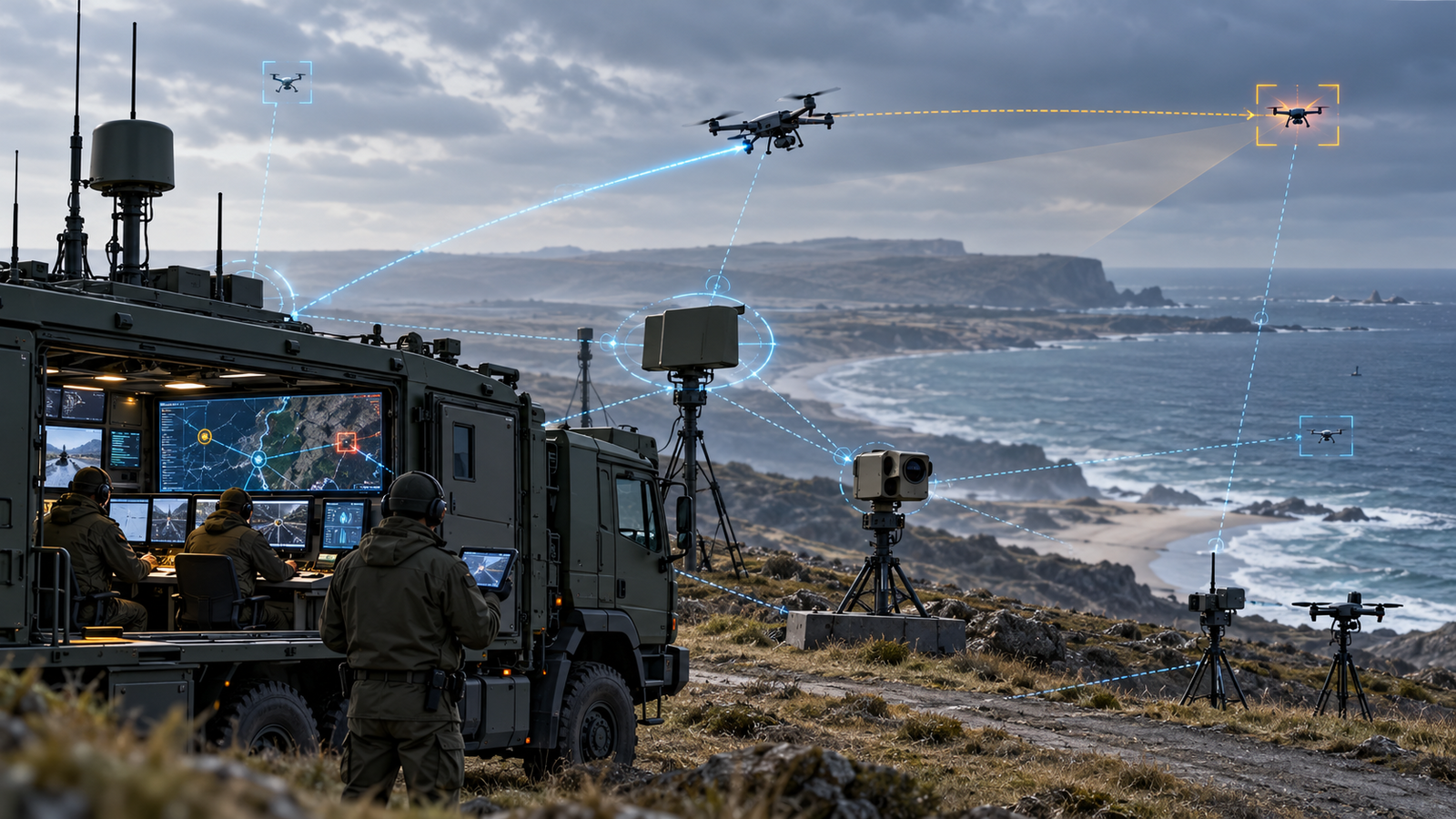
Featured image: AI-generated editorial illustration by OpenAI for All About UAVs. It depicts generic equipment and is not a photograph of the Katwijk test or any combat operation. No affiliate links, sponsorship or paid placement are included.
Leave a Reply