
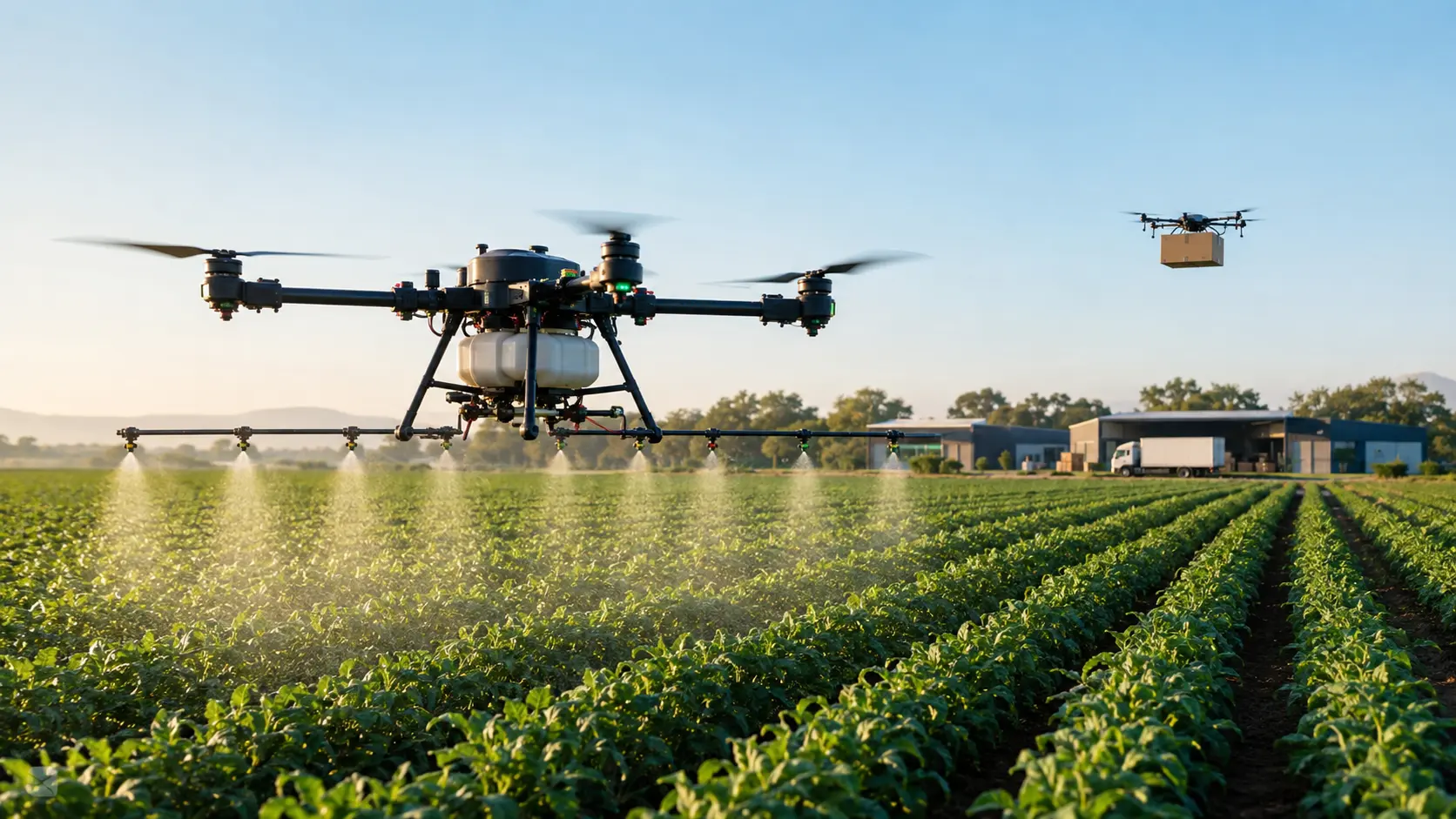
American commercial drone operators are entering a period defined by two very different forms of growth. Agricultural operators face new tariffs, supply-chain uncertainty, and pressure to find domestically produced equipment. At the same time, delivery-drone companies are expanding their infrastructure and pursuing the regulatory approvals needed to turn automated delivery into a larger commercial industry.
Together, these developments show how rapidly drones are moving from specialized tools into essential business equipment—and how strongly government policy can influence that transition.
New Tariffs Target Heavy Agricultural Drones
The most immediate change involves imported unmanned aircraft weighing more than 25 kilograms at maximum takeoff weight. These larger aircraft include many of the spray drones used to apply pesticides, fertilizers, and cover-crop seed.
Under an August 13 presidential proclamation, covered imported drones exceeding 25 kilograms will face an additional 100% tariff. The same rate applies to drones equipped with thermal imagers, docking stations, and certain designated components. Smaller covered drones are subject to a 25% tariff, while some components receive a 180-day delay before the new duty takes effect.
Most of the new drone tariffs are scheduled to begin 21 days after the proclamation was signed. The policy also establishes lower rates for qualifying products from certain allied countries and authorizes the Department of Commerce to create incentives for manufacturers investing in American production. Read the White House proclamation.
For agriculture, the 25-kilogram threshold is especially consequential. Large spray drones require substantial payload capacity, batteries, pumps, motors, and replacement components. Doubling the tariff rate does not necessarily mean every aircraft’s retail price will double, but it gives importers, distributors, and operators a major new cost to absorb.
An Opening for Domestic Manufacturers
The tariffs are intended partly to reduce American dependence on foreign drone systems and encourage domestic production. U.S. manufacturers such as Hylio already design and manufacture agricultural drones for crop spraying and other land-management applications.
The new policy could create opportunities for those manufacturers to expand production, attract investment, and build stronger dealer and service networks. It may also encourage foreign manufacturers to establish qualifying American assembly operations or restructure their supply chains through eligible trading partners.
However, replacing imported agricultural drones will require more than assembling airframes in the United States. Manufacturers must be able to provide batteries, chargers, pumps, nozzles, flight controllers, software support, repairs, and replacement parts at the scale demanded by working farms and custom applicators.
Farm Progress has previously reported that restrictions affecting foreign-made drones were already pushing agricultural operators toward American and non-Chinese alternatives while raising concerns about equipment and parts availability. Read the Farm Progress coverage.
Equipment Costs Become an Operational Risk
A spray drone is not merely another piece of consumer electronics. For a grower or custom applicator, it is a production asset that must be ready during narrow crop-protection windows.
If a battery, pump, motor, or controller is unavailable when weather and field conditions align, the operator may lose more than flight time. Treatment delays can reduce application effectiveness, allow pests or disease to spread, and force growers to hire alternative equipment on short notice.
Research from the University of Missouri Extension estimated agricultural-drone ownership costs using expenses that included batteries, maintenance, insurance, labor, and transportation. Its model demonstrates that the economics depend on more than the initial aircraft price. Higher component costs and shorter replacement cycles can influence the cost of every acre treated. Review the University of Missouri analysis.
Operators considering a purchase should therefore evaluate total fleet support rather than comparing aircraft prices alone. Parts availability, battery lead times, warranty service, software continuity, dealer capability, and backup-equipment access may become decisive purchasing factors.
Delivery Drones Follow a Different Growth Path
While agricultural operators prepare for tighter equipment economics, the delivery-drone industry continues to attract aggressive growth forecasts.
MarketsandMarkets projects the global delivery-drone market will grow from $2.88 billion in 2026 to $7.65 billion by 2031, representing a compound annual growth rate of 21.6%. The firm also forecasts unit volume rising from approximately 115,000 aircraft to more than 292,000 during that period. Read the published market forecast.
Market forecasts should be treated as estimates rather than promises. Competing research firms use different definitions and produce substantially different projections. Still, the broader direction is credible: retailers, logistics companies, healthcare networks, and drone manufacturers are investing in automated last-mile delivery.
In the United States, operators carrying another party’s property for compensation beyond visual line of sight generally must follow the FAA’s Part 135 certification process and obtain the necessary exemptions, waivers, and airspace authorizations. Certification is therefore not a minor administrative step—it is one of the foundations required for revenue-generating delivery networks. See the FAA’s Part 135 drone-delivery guidance.
What Commercial Operators Should Watch
Agricultural and delivery drones serve different customers, but both sectors now depend on reliable hardware, scalable support, and workable federal policy.
- Final tariff classifications and implementation dates
- Domestic manufacturing and onshoring announcements
- Battery and replacement-part pricing
- Dealer inventories and repair turnaround times
- New Part 135 certifications and expanded delivery operating areas
- Evidence that delivery programs can progress from pilots to sustainable commercial networks
The next phase of commercial drone growth will not be determined by aircraft performance alone. Manufacturing capacity, supply-chain resilience, regulatory approvals, and operating economics will decide which companies—and which customers—benefit most.