
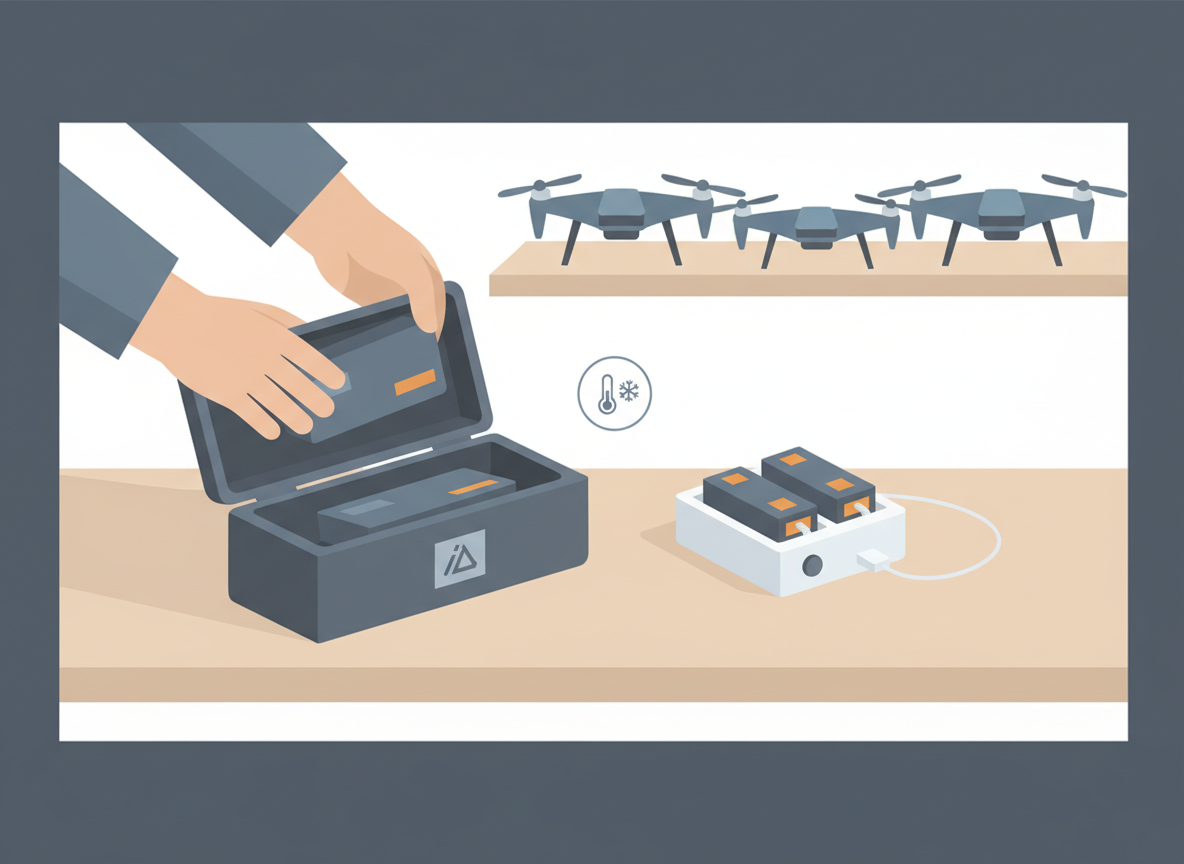
If your drone batteries sit in a gear bag between flights or in a closet between trips, how you store and transport them matters almost as much as how you fly. A LiPo or Li-ion pack left fully charged for weeks, baked in a hot car, or tossed loose into a suitcase loses capacity faster than it should — and, in rare but serious cases, becomes a fire risk. The short version: store most drone batteries at roughly 40–65% charge in a cool, dry place; run a full charge-and-discharge cycle every few months; and if you fly commercially or travel by air, pack spares only in your carry-on with the terminals protected. The rest of this guide explains why, using DJI’s own maintenance documentation and the FAA, TSA, and PHMSA rules that actually govern lithium batteries.
Why lithium batteries need special care
Drone batteries are almost always lithium polymer (LiPo) or lithium-ion (Li-ion) cells, chosen for how much energy they pack into a light airframe. That same energy density is the risk. The U.S. Department of Transportation’s Pipeline and Hazardous Materials Safety Administration (PHMSA), the federal office that regulates lithium battery transport, warns that these cells “can overheat and ignite under certain conditions, such as a short circuit, physical damage, improper design, or assembly,” triggering a chain reaction called thermal runaway that releases stored energy and flammable gas rapidly and is difficult to extinguish once started.
That is not a reason to panic about the pack sitting in your drone case. It is a reason to treat punctured, swollen, or physically damaged batteries as a real hazard rather than something to keep flying “until it stops working,” and to follow the storage, charging, and disposal practices below.
Storage: the 40–65% rule
DJI’s official Battery Routine Maintenance Guide gives specific numbers rather than vague advice. For any storage period longer than 10 days, it recommends discharging or charging the battery to 40–65% — roughly when the third indicator light is on or flashing on most DJI Intelligent Flight Batteries — and keeping it in a cool, dry environment, ideally 22–28°C (72–82°F). The logic is straightforward: a cell held near full charge degrades faster in storage, while one allowed to sit near empty risks over-discharging below roughly 10% capacity, which can permanently damage it.
DJI also recommends a full charge-and-discharge cycle at least once every three months for batteries in long-term storage, both to keep the cells exercised and to recalibrate the battery’s internal charge readout. Other battery-service specialists give a similar range with slightly different splits — for example, 60–80% for short stretches of a week or two and 40–60% for anything longer, in a dry, ventilated space between about 22–30°C. The exact numbers vary by source, but every one of them lands in the same neighborhood: roughly half charge, room temperature, out of direct sun and away from vehicles that bake in a parking lot.
Smart charging habits
Most of what protects a battery in storage also applies to charging. Use the charger the manufacturer sold or specifically approved for that battery — third-party chargers are a common source of the “improper design or assembly” failures PHMSA warns about. Charge on a hard, non-flammable surface, not on a bed or carpet, and avoid leaving packs charging unattended overnight. Let a battery cool to close to room temperature after a flight before plugging it in; charging a pack that is still hot from use stresses the cells more than charging a cool one.
If a battery ever swells, smells odd, or the case feels warm with no obvious cause, stop using it. That is the same failure mode PHMSA describes, just caught before it becomes a fire rather than after.
Charge cycles: when to retire a battery
Every full charge-and-discharge cycle wears a lithium cell down a small amount, and that wear is cumulative and irreversible. There is no single industry-wide number for how many cycles a drone battery is good for — it depends on the cell chemistry, how hard the battery was worked, and how well it was stored — but several battery-service guides put typical LiPo drone packs in the range of 200 full cycles before capacity loss becomes noticeable enough to justify replacement, with a full cycle recommended at least every 50 cycles (or every three months, per DJI) to keep the pack’s health readout accurate.
Treat that 200-cycle figure as a rule of thumb, not a warranty term — check your specific battery’s documentation, and if your app or flight controller reports a cycle count, watch it rather than guessing. If you’re managing more than a couple of aircraft, a fleet management platform that logs cycle counts against manufacturer guidance can flag an aging pack before it fails mid-flight instead of after.
Cold weather performance
Lithium chemistry simply performs worse when it’s cold. Expect reduced usable capacity and shorter flight times any time you’re flying near or below freezing, even with a battery that reads “fully charged.” A common field practice is to let the aircraft hover a minute or so at low altitude before starting the actual mission, giving the pack a chance to warm slightly under load rather than starting cold. Some enterprise platforms address this with self-heating battery packs that maintain an internal temperature around 16–20°C, though that feature adds weight and draws its own power, trimming flight time to buy reliability.
Cold-weather margin matters most on missions where you can’t just land and swap a pack on a whim — a long photogrammetry mapping flight or an inspection job on a tight weather window is a bad time to discover your battery has 20% less usable capacity than it did in summer. Budget extra reserve, not just extra batteries, when the forecast is cold.
Flying with batteries: what the FAA and TSA actually require
If you travel by air with drone batteries, the rules are federal, not airline preference, and they’re organized by watt-hours (Wh) — a rating usually printed on the battery itself or listed in the product manual.
- 100 Wh or less: Allowed, with no set quantity limit for personal use. This covers the batteries in most consumer and prosumer camera drones.
- 101–160 Wh: Allowed only with your airline’s advance approval, and limited to two spare batteries per passenger.
- Over 160 Wh: Forbidden on passenger aircraft entirely — not in checked baggage, not in carry-on, no exceptions for passengers.
Two rules apply regardless of size. First, per both the FAA and TSA, spare (uninstalled) lithium batteries must travel in carry-on baggage only — never in checked luggage — because a battery fire is far easier to detect and respond to in the cabin than in the cargo hold. If your carry-on bag is checked at the gate, you have to remove the spare batteries first and keep them with you. Second, exposed terminals need protection against short-circuiting: leave batteries in their retail packaging, tape over the contacts, or use individual battery cases or sleeves — the same rule that applies to any spare lithium battery, not just drone packs.
The 160 Wh ceiling matters more than it might seem for commercial operators, because it isn’t just power banks and camera batteries that can exceed it. Heavy-lift and long-endurance enterprise platforms — including some of the professional mapping drones we’ve reviewed — use much larger packs. One widely used enterprise mapping and inspection battery, for instance, is rated at roughly 263 Wh according to published retailer specifications, well above the passenger limit. A battery that size can’t fly with you at all; it has to move as air cargo or ground freight under PHMSA’s hazardous materials rules (49 CFR 173.185), which is a shipping-department problem, not a carry-on packing problem. If you operate a fleet with both consumer and enterprise-class batteries, check the Wh rating on every pack before a trip — don’t assume that because your small camera drone battery flew fine last time, your inspection drone’s battery will too.
Safe disposal and recycling
A dead or damaged drone battery does not belong in the trash or in ordinary curbside recycling. PHMSA is explicit on this point: lithium batteries need to go through dedicated recycling channels — an electronics recycler, a retail take-back program, a local household hazardous waste site, or a manufacturer’s mail-in program — precisely because the same short-circuit and physical-damage risks that apply in storage apply in a garbage truck or recycling sorter. If you do mail a battery in for recycling, it still has to comply with USPS or DOT shipping requirements for lithium batteries; check with the recycler or manufacturer for the correct packaging before you drop it in a mailbox.
Quick reference checklist
- Store batteries at ~40–65% charge, not full, for anything longer than 10 days.
- Keep storage temperature around 22–28°C (72–82°F), out of direct sun and hot vehicles.
- Run a full charge-and-discharge cycle every 1–3 months to keep cells healthy and the charge readout accurate.
- Let batteries cool to room temperature before charging; never charge on a bed, carpet, or unattended overnight.
- Retire a pack that’s swollen, damaged, or showing a sharp drop in flight time — don’t wait for it to fail in the air.
- Pack spare batteries in carry-on baggage only when flying, with terminals protected.
- Check each battery’s Wh rating before a trip: ≤100 Wh travels freely; 101–160 Wh needs airline approval and is capped at two spares; over 160 Wh cannot fly as passenger baggage at all.
- Recycle dead batteries through a certified program — never in household trash or curbside recycling.
The bottom line
None of this requires special equipment or much extra time — a habit of storing packs at half charge, keeping them cool, and checking the Wh rating before a flight or a trip covers most of what actually goes wrong with drone batteries. The FAA, TSA, and PHMSA rules exist because lithium battery fires are hard to stop once they start, not because regulators enjoy paperwork, and DJI’s own maintenance numbers exist because a mistreated pack is a real cost, not an abstract one. Build the habit once and it becomes automatic, the same way remembering the SD card or checking the weather already is.
This article provides general educational information, not safety, legal, or engineering advice. It draws on DJI’s published battery-maintenance documentation and on official FAA, TSA, and PHMSA guidance, current as of September 2026. All About UAVs has no material relationship with DJI, and no affiliate links are included. Airline, government, and manufacturer requirements change — verify current rules with your airline and the source agencies before you fly, travel, or ship lithium batteries.