
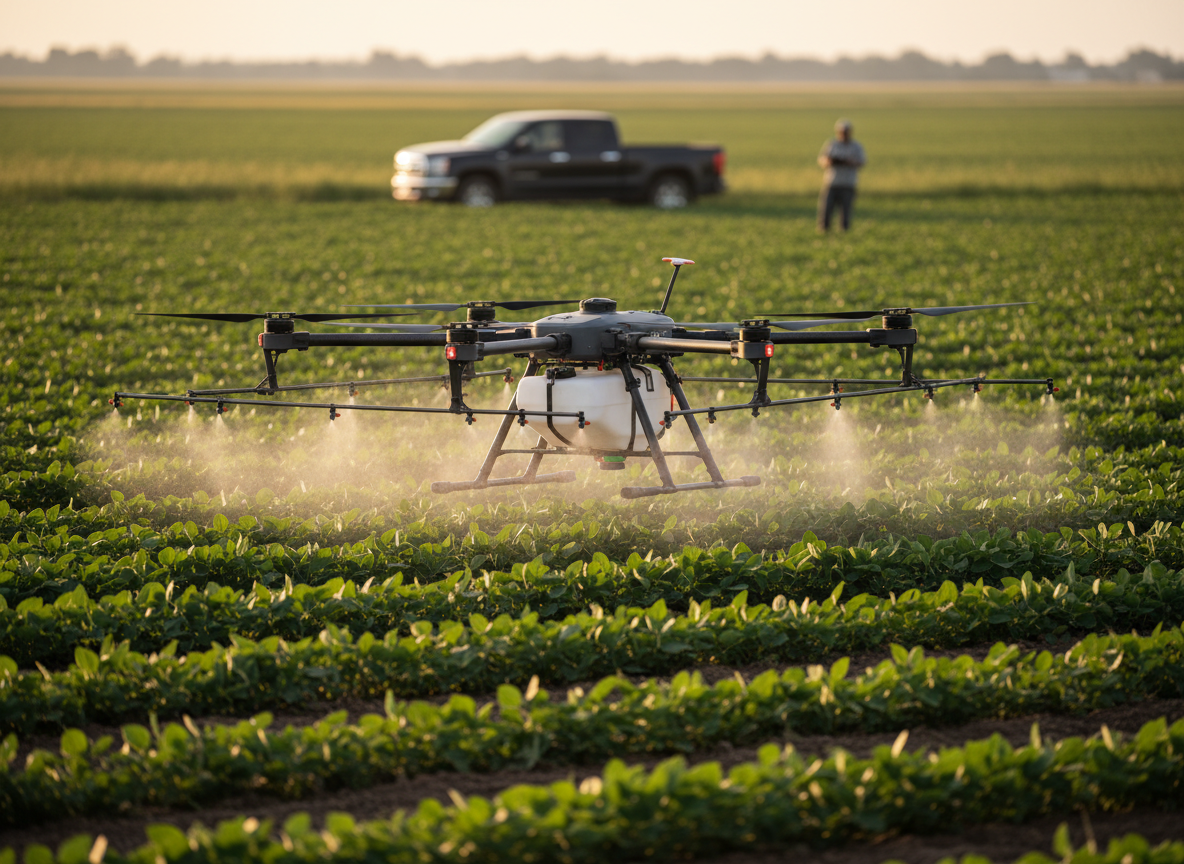
DJI Agriculture launched the Agras T55 and the Agras T100 Dual Battery Spraying System globally on July 1, 2026. The T55 is a lighter 50-liter platform built around an upgraded safety stack; the T100 Dual Battery configuration is an endurance-focused revision of the flagship DJI first shipped in July 2025 and showed alongside the T70P and T25P at Agritechnica that November. Neither is a clean-sheet airframe — both are refinements of drones already working fields worldwide.
Agras T55 specifications
| Spec | Value |
|---|---|
| Spray tank capacity | 50 L, up to 50 L/min with mist sprinklers |
| Spreading | 55 kg payload at up to 400 kg/min |
| Lifting payload | 40 kg, with Auto Balance Control and Emergency Cable Release |
| Safety sensing | Millimeter-wave radar (250,000 points per second) plus a quad-vision system (three top cameras and a low-light FPV camera) |
| Regulatory status (US) | FCC equipment authorization granted Dec. 19, 2025 (FCC ID SS3-T55A2510) |
| Price (As of October 2026) | No U.S. MSRP announced by DJI; one U.S. dealer lists a T55 Premium Set (aircraft, spreader, lifting system, batteries, charging, generator, training) at $31,999.99, currently sold out |
Agras T100 Dual Battery specifications
| Spec | Value |
|---|---|
| Spray tank (dual-battery config) | 90 L, 40 L/min via four mist sprinklers |
| Spread capacity (single-battery config) | 150 L, 400 kg/min |
| Lifting capacity | 80 kg (176 lb) |
| Hover time gain | ~50% improvement at equal payload with dual intelligent batteries |
| Optional payload | Mist sprinkler set for orchard canopy penetration |
| Regulatory status (US) | Base T100 holds FCC ID SS3-T100A2411 |
| Price (As of October 2026) | Dealer-quoted; DJI has not announced U.S. pricing or a U.S. release date for the Dual Battery system |
What the dual-battery setup is actually trading off
The Dual Battery T100 buys hover time, not a bigger tank — its 90 L capacity is smaller than the 150 L the single-battery spreading configuration carries. That’s a real trade-off, not a strict upgrade: an operator running long spray passes over a large field benefits from the extra hover endurance at equal payload, while one doing high-volume granular spreading is better served sticking with the single-battery, larger-tank setup. Buyers should match the configuration to their actual task mix rather than assuming Dual Battery is the better version by default.
The FCC wrinkle U.S. buyers need to know
Both drones have a U.S. regulatory paper trail worth flagging. The T55 cleared FCC equipment authorization on December 19, 2025, and the T100 holds its own grant — but the FCC added foreign-made drones to its Covered List just three days after the T55’s authorization, on December 22, 2025. That doesn’t retroactively block equipment already authorized, and neither does the FCC’s component rule that took effect October 13, 2026, barring covered DJI and Autel components from new drone authorizations; it applies to new applications rather than equipment already authorized.
The bigger risk is still pending. In July 2026 the FCC proposed treating certain foreign-produced drones as “military-grade” (PS Docket 26-189), a category that explicitly includes drones of 55 lb or more and aerial pesticide sprayers. Both Agras models fall squarely in scope. As written, the proposal would not stop anyone from flying a drone they already own, but it would end future U.S. import and sale of affected models even if they were previously authorized. Comments closed September 2, 2026, and as of October 15, 2026, no final order adopting that separate proposal was located. If you’re planning a fleet purchase, confirm current availability and parts and battery support with your dealer before committing, and watch this docket.
How they compare
Against NDAA-compliant competitors like Hylio’s AG-272 or domestically assembled platforms, the Agras line competes on raw capacity, an established service ecosystem, and multi-role spraying, spreading, and lifting configurations. Buyers who are not restricted by federal procurement rules should compare a complete dealer quote—including batteries, charging, generator, training, and support—rather than tank capacity alone. For those who are (state ag departments, federally funded programs), the Covered List issue makes the comparison moot regardless of specs, and a domestic-alternative review is worth reading before shopping Agras at all.
Bottom line
The T55 is a sensible safety-focused upgrade for growers already in DJI’s ecosystem, and the T100 Dual Battery is a genuine efficiency gain for spray-heavy operations specifically — just don’t assume it beats the single-battery T100 across every task. Pricing is dealer-quoted and region-dependent, and U.S. stock is thin, so get a specific number before comparing against any alternative. U.S. buyers should also factor in the pending FCC proposal: it wouldn’t ground a drone you own, but it could cut off future sales of these models here.
Disclosure: This is an independent, source-based assessment and not a hands-on test. DJI and the cited dealers did not sponsor or control the editorial conclusions. The featured image is an original AI-generated editorial illustration of a generic, unbranded agricultural spray drone—not a photograph of the T55 or T100.
Sources
- DJI: Agras T55 and T100 Dual Battery launch announcement
- DroneXL: Agras T55/T100 launch and FCC authorization detail
- Coptrz: Agras T55/T100 spec FAQ
- Ares Acres: DJI Agras T55 Premium Set U.S. dealer listing
- AgFunderNews: FCC proposal could cut off sales of existing ag spray drones
- Rupprecht Law: FCC drone import and marketing restrictions explained
Leave a Reply